Order Management App
What You Can Do with the Order Management Template
An Order Management Template can be used to build a custom order management app that enables your operations teams to manage orders from start to finish. They can track details related to orders, inventory, fulfillment, and customer service, as well as manage product details and customer information.
This Order Management Template is useful in several scenarios:
Manage Orders: Process orders with a single click, view invoices, request pickups, and provide discounts while maintaining a 360-degree view of clients, orders, and communications.
Manage Customers: Access all relevant customer data in one view. Update client details such as their phone number or email address on their behalf.
View Order History: Get a complete picture of customer orders to troubleshoot issues, provide top-notch customer service, and analyze total revenue per customer along with other key metrics.
Quickly Find Orders: Easily locate the right order by searching within the order list or using built-in filtering and search functions.
Update, Create, or Delete Orders: Take full control over orders with options to edit order data, delete orders, and create new ones, all while ensuring strict access control through granular permission settings.
Engage with Customers: Chat directly with customers to access their order history, personal details, and past interactions, ensuring seamless and informed communication.
Why Use an Order Management Template in Jet Admin?
Order Management Systems (OMS) are essential for retail and e-commerce businesses, enabling operations and procurement teams to manage the full process from ordering to fulfillment and delivery. Since order management workflows differ across organizations, ensuring that your OMS fits both internal team workflows and external partner processes is crucial.
With Jet Admin’s Order Management Template, you can customize the system to fit your workflow. Building on top of Jet Admin’s template saves time, integrates easily with other systems, and reduces ongoing maintenance efforts.
Easy and Flexible Deployment: You can self-host the Order Management app in the cloud, with Jet Admin handling infrastructure and updates, or you can host it locally behind your VPN in your own VPC. Ensure your live app is bug-free with version control, multiple environments, and audit logs.
Combine Multiple Data Sources: Jet Admin allows you to connect and unify data from multiple sources, including databases, external apps, and APIs, to create a 360-degree view of your order management process. No need to switch between apps or manually copy IDs—Jet Admin links all related data, ensuring seamless workflows.
Variety of UI Components: Jet Admin provides 60+ out-of-the-box UI components that are ready to use and can be linked to your data without any coding. Components also include built-in styling functions, making it easy to customize the look and feel of your app.
Granular Permission Management: Create custom roles for suppliers, packaging service providers, warehouse employees, and other partners to control access rights. Define who can view, create, update, or delete pages, datasets, and UI components. You can also set up authentication using Jet Admin’s built-in Auth system or external providers like Auth0, Xano Auth, and others.
Variables and Formulas: Jet Admin includes a library of no-code formulas that allow you to transform data, perform calculations, and create conditional logic. For added flexibility, you can define page-specific and global parameters, user attributes, and team attributes, which can be dynamically passed across items and pages to create complex logic.
Multiple Pages and Overlays: Optimize operational workflows by creating multi-view experiences and reducing friction in the process. Add multiple pages to your app and enhance usability with on-page overlays such as slideouts, modals, and dropdowns.
Data sources

.svg)


Use Cases
Categories
Features
Similar templates




Connect & sync your data with 30+ data sourse’s


Build frontend Apps 10x faster


Frequently asked questions
Jet supports many databases, including MySQL, PostgreSQL, Microsoft SQL Server, Amazon Redshift, and Google BigQuery. Jet also offers integrations with popular APIs and services such as Stripe, Twilio, and Slack, making it easy to incorporate data from these sources into Jet applications. Here is a list of all our different integrations.
Diverse businesses, from startups to enterprise companies in the healthcare, finance, and e-commerce sectors. For companies that depend on internal tools, portals, and dashboards for their workflow, offering the capability to craft customized applications suited to their requirements
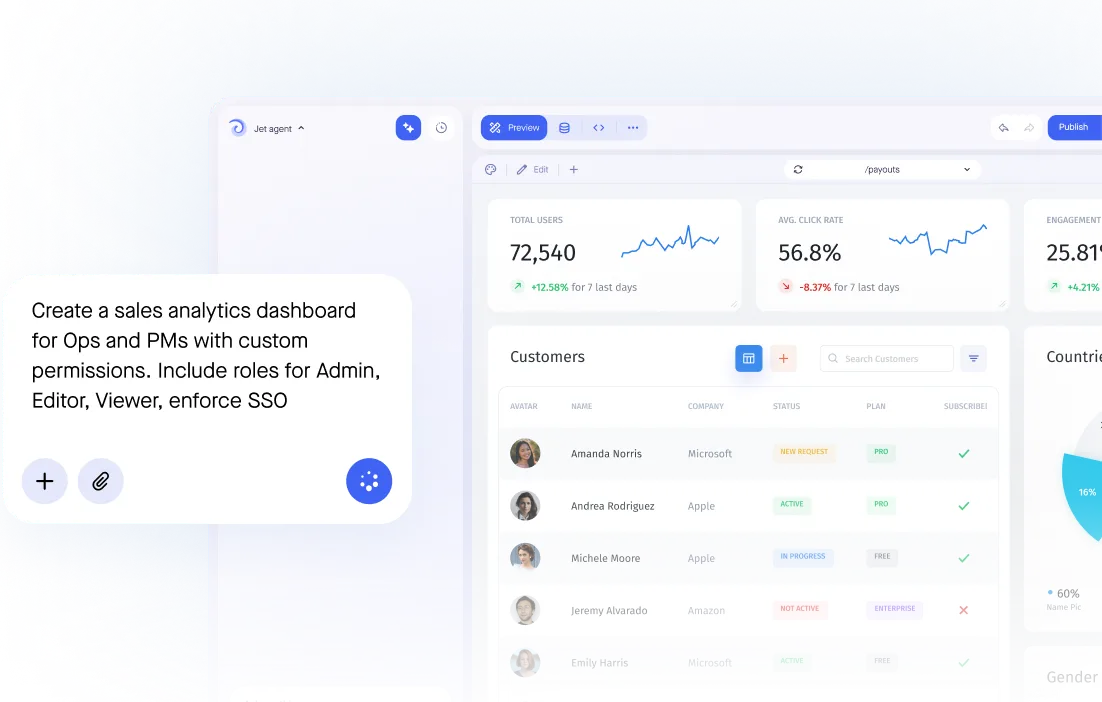
Jet Admin is a development platform that allows developers to quickly build custom business apps like internal tools, portals, dashboards for their businesses. Jet offers a drag-and-drop interface and pre-built components, making it easy to create applications while writing little code.