Partner Portal
App
Partner Portal
Overview
A partner portal template is a pre-built, customizable application blueprint that gives your organization a centralized hub for managing every aspect of partner relationships-from onboarding and deal registration to resource sharing and performance tracking. The partner portal template allows managing customers and opportunities in a single workspace, replacing the scattered mix of email threads, shared drives, and spreadsheets that most partnership teams rely on today.
The core problem is fragmentation. When partner communications, marketing collateral, lead data, and certification records live across disconnected tools, internal teams lose visibility and partners lose patience. Fewer than 20% of partners regularly use portals that aren't aligned with their workflows or kept current, according to ZINFI's research. A well-structured partner portal solves this by centralizing collaboration, enforcing consistent business processes, and giving every stakeholder-internal or external-a single source of truth.
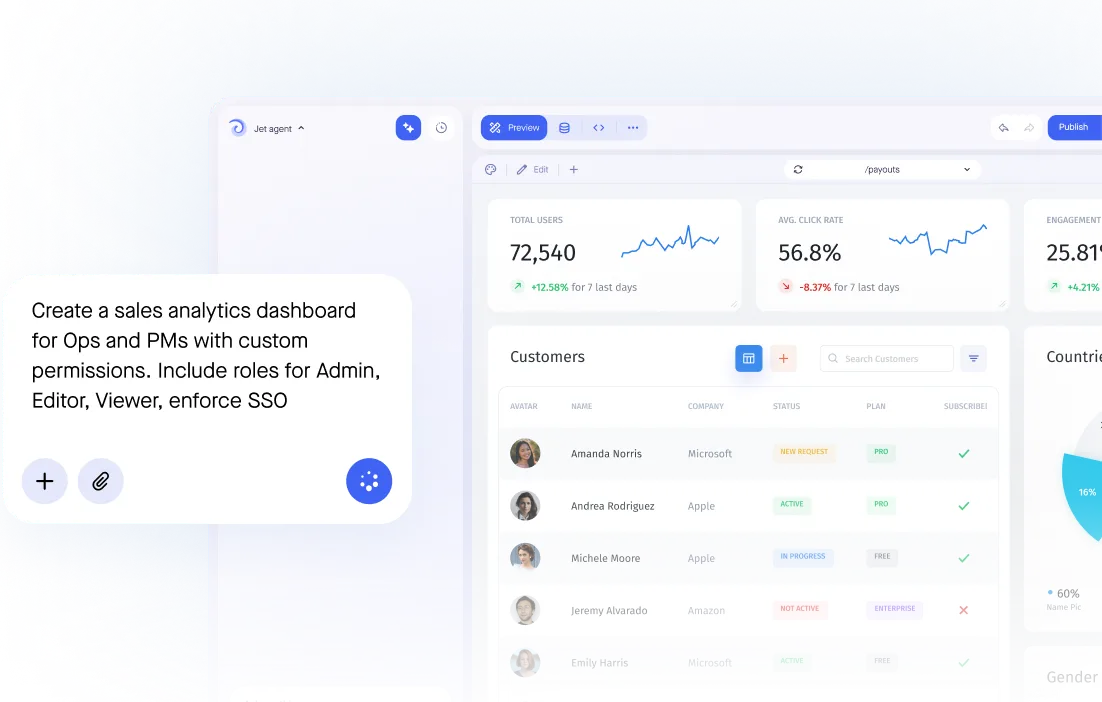
Jet Admin is an AI-powered no-code app builder that lets you generate a partner portal, connect your existing data, customize the interface and logic, configure access controls, automate workflows, and publish-without writing code. The template ships with pre-configured dashboards, onboarding checklists, deal registration forms, resource libraries, and reporting modules you can tailor to your program's exact needs.
Using templates reduces development time and administrative workload, so your team can focus on growing partnerships rather than managing tools. Ready to see what's included? Explore the partner portal template and start building today.
Why use this partner portal template
Most partnership and channel sales teams know the pain of managing resellers, distributors, or affiliates through a patchwork of tools. Here's what that looks like in practice-and how this template addresses each problem directly.
- Scattered partner communications – When updates go out via email, important messages get buried. Partners miss deadlines, internal teams duplicate effort, and no one has a clear record. This template centralizes communication, resources, and activity tracking in one portal so every partner and team member works from the same information.
- No single view of partner data – Contacts in one spreadsheet, deals in a CRM, certifications in a shared folder. Companies can centrally manage partner activity to reduce channel conflicts by bringing all partner records-contacts, deals, leads, tiers, and activities-into a unified dashboard with real-time data from your connected sources.
- Inconsistent onboarding – Without a structured process, new partners miss critical steps-training modules skipped, agreements unsigned, profiles incomplete. Templates streamline partner onboarding and improve accountability through automated checklists that track every step and send reminders when items are overdue. A consistent onboarding process reduces missed steps and gets partners productive faster.
- Limited visibility into partner performance – If you can't see which partners are closing deals, completing training, or engaging with resources, you can't optimize your program. Dashboards provide transparency into partner performance and metrics, giving both partners and internal teams the data they need to act.
- Heavy administrative workload – Manually processing deal registrations, certification requests, and approval workflows drains your team. This template automates approvals, notifications, and reporting so you spend less time on admin and more on enabling partners to succeed.
- Weak collaboration between teams and partners – Partner portals enhance collaboration through self-serve access to resources. Instead of waiting on emails or calls, partners log in, find what they need, register deals, and submit requests on their own schedule-customer self service applied to your partner ecosystem.
Template features
Each feature below is included in the template as a configurable module. You connect your data, customize the layout, and configure the logic to match your program's workflows.
Partner dashboard with performance metrics
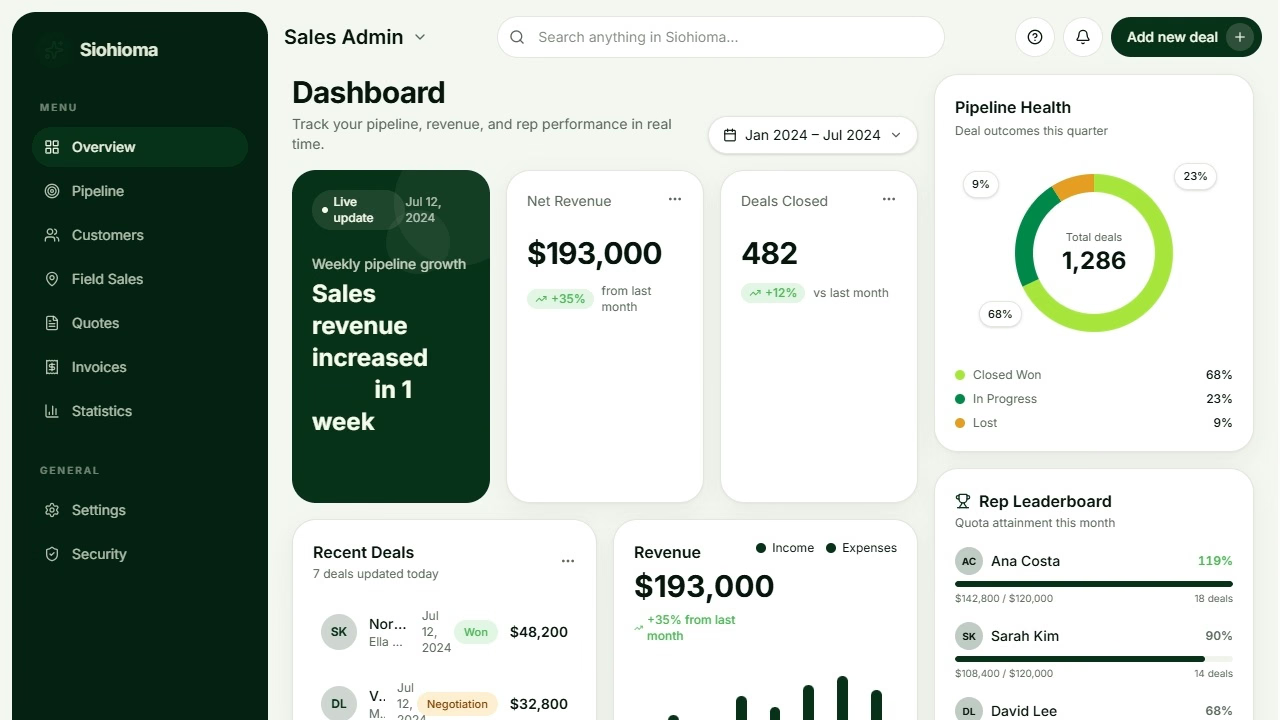
The dashboard is the first thing partners and internal managers see. Dashboards display metrics such as revenue, lead status, and training completion, giving every user a real-time snapshot of what matters most. Analytics track metrics like content downloads and training completion rates, so you can measure engagement alongside pipeline health. Internal teams get aggregate views; partners see their own data. Performance tracking features allow monitoring of deal closures and commissions at a glance.
Automated partner onboarding checklist
Partner onboarding templates streamline setup and enablement by breaking the process into defined steps: registration, document submission, training modules, profile completion, and certification. Phase-based action plans improve transparency in onboarding, with progress visible to both the partner and the admin. Automated notifications flag overdue items, and you can configure different onboarding flows per partner type or tier. Centralized resources enhance partner experience during onboarding by keeping everything accessible in one place.
Resource library with role-based access
Centralized content libraries provide access to marketing and sales materials, training videos, policy documents, and technical documentation-all organized by categories your partners actually use. Partner portals enable role-based access to sensitive materials, so a reseller sees different resources than a technology partner or affiliate. You can add forms for content requests, implement global search for quick discovery, and update documents without worrying about outdated versions circulating via email.
Deal registration and lead management
Partners can register deals to secure exclusivity for a defined period, submitting new opportunities directly through the portal. Internal teams review registrations, approve or reject them, and assign leads-all within a structured approval workflow that prevents duplicates and channel conflict. Partners can manage opportunities directly within the portal, viewing deal status (pending, approved, rejected) and tracking their pipeline without switching tools. Partners can submit forms for lead collection through the portal, keeping the process standardized.
Request forms and approval workflows
Beyond deal registration, the template includes configurable request forms for certification applications, support tickets, MDF fund requests, and custom pricing approvals. Each submission triggers a workflow: partner submits → manager receives notification → review and approval or denial → partner gets notified of the outcome. This replaces email-based back-and-forth with a trackable, auditable process.
Partner tier and status tracking
Define partner tiers-Registered, Silver, Gold, Platinum, or whatever structure fits your program-with clear criteria for progression (sales volume, certifications completed, leads generated). The template displays current tier status to each partner, shows what's needed to advance, and lets administrators manage tier transitions. This transparency motivates partners and keeps your program structured.
Per-partner data filtering and permissions
Effective portals are role-based and personalized for various partner user types. The template implements per-partner data filtering so each partner organization sees only their own deals, leads, contacts, and resources. Administrators manage user permissions and monitor portal engagement, configuring access at the module, record, and field level. This security model ensures sensitive data stays protected while partners get a personalized experience.
Automated notifications and reporting
Configure email or Slack alerts for key events: new deal registrations, approval decisions, onboarding reminders, certification expiration warnings, and resource updates. Scheduled reports-weekly pipeline summaries, monthly performance dashboards-can be delivered automatically to partners and internal stakeholders. This keeps everyone informed without requiring manual follow-up.
Who is this partner portal template for?
Partner portals serve a wide range of teams, organizations, and industries. Here's how different groups use this template to solve their specific challenges.
Channel sales and partnership teams
Channel sales teams managing resellers and distributors use the template to track partner pipelines, share co-marketing assets, manage deal registration, and monitor quota attainment. The centralized dashboard replaces scattered spreadsheets, giving sales leaders visibility into which partners are driving revenue and where enablement gaps exist. Partner portals streamline partner onboarding, deal tracking, and marketing activities for these teams.
Vendor and franchise management
Franchise organizations and vendor management teams need compliance tracking, documentation control, and performance monitoring. The template provides structured onboarding with required document submission, training completion tracking, and request workflows for support tickets or supply orders. This brings accountability to relationships that often span dozens or hundreds of locations.
Affiliate program managers
Affiliate programs run on commission-based partnerships where speed and simplicity matter. The template gives affiliate program managers a way to onboard affiliates quickly, share promotional resources, track referral leads, and display earnings dashboards-all without building a custom application. Training modules within portals help partners improve product and sales knowledge, which directly impacts affiliate performance.
Technology companies with integration partners
Technology and integration partners need access to API documentation, sandbox environments, certification programs, and co-selling resources. The template supports this by organizing technical content in the resource library, tracking certification progress, and managing joint deals through the registration workflow. Knowledge articles can be published for partner portal users, making it easy to keep technical documentation current.
Account management teams
For organizations where key accounts function as strategic partners or OEMs, the template provides a self-service portal where accounts can access performance data, joint forecasts, and shared resources. This employee self service approach (extended to external partners) reduces the volume of ad-hoc requests hitting your account managers.
Partner success and enablement teams
Partner success teams focused on expanding mentorship and scaling training programs use the template to deliver learning modules, track certification completion, and identify partners who need additional support. The portal becomes the central hub for enablement content, making it possible to maintain consistency across a growing partner community without adding headcount.
How to set up your partner portal template
Setting up your partner portal in Jet Admin follows a structured process. Each step builds on the previous one, taking you from template selection to a live portal your partners can use.
1. Select the partner portal template
Open Jet Admin's template library and choose the Partner Portal Template. Preview the included modules-dashboard, onboarding checklist, resource library, deal registration, request forms, tier tracking, and reporting-to confirm they align with your program structure. This is your starting point; every element can be customized in the steps that follow.
2. Connect your partner data sources
Link the data sources where your partner information lives. Jet Admin supports native connections to PostgreSQL, MySQL, Supabase, Airtable, and Google Sheets, along with CRM platforms like HubSpot and Salesforce. You can also integrate with Dynamics 365 applications or other partner systems through REST and GraphQL APIs. Partner portals can integrate with Dynamics 365 applications, extending the template's reach into your existing dynamics and Microsoft Dynamics environments. Softr supports 17+ data sources for partner portals; Jet Admin covers a similarly broad range.
3. Map your data fields
Align your partner records, contacts, deals, leads, resources, and certification data with the template's structure. Map fields so that partner names, tier levels, deal stages, training statuses, and resource categories display correctly. This step ensures the template reflects your actual program data rather than generic placeholders.
4. Customize interface and branding
Update the portal's colors, logos, navigation, and layout to match your company's branding. Jet Admin's drag-and-drop builder lets you rearrange dashboard components, adjust table columns, modify form fields, and configure the resource library's structure. Successful partner portals feature user-friendly interfaces for easy navigation-take the time here to create a clean, intuitive experience that partners will actually use.
5. Configure workflows and permissions
Set up approval processes for deal registrations, certification requests, and other submissions. Configure notification triggers so the right people receive email or Slack alerts at each stage. Define role-based access controls-partner users, partner admins, internal managers, super-admins-so each role sees the appropriate modules and data. Power Apps Portal Templates enable low-code website development with similar permission models; Jet Admin provides this through its no-code workflow builder.
6. Set up per-partner filtering
Implement data isolation so that each partner organization sees only their own records-their deals, leads, contacts, certifications, and resources. This is essential for security and trust. Test filtering with sample data to verify that Partner A cannot see Partner B's information under any circumstance.
7. Test with sample partners
Create test accounts representing different partner types and tiers. Walk through the complete experience: onboarding checklist completion, resource access, deal registration, request submission, dashboard review. Verify that permissions, notifications, and workflows function as configured. Fix any issues before inviting real partners.
8. Publish and launch
Deploy your portal and send onboarding invitations to your partners with clear instructions on how to access and navigate the portal. Consider a phased rollout-start with a small group, gather feedback, and iterate before opening to your full partner base. Power Apps portals support up to 43 different languages, and Jet Admin similarly lets you customize content for different partner environments.
Ready to accelerate deployment? Start with the Jet Admin Partner Portal Template and have your portal configured and live without writing a single line of code.
Frequently asked questions
What should a partner portal include?
A partner portal should include a performance dashboard, onboarding checklists, a centralized resource library with marketing and sales materials, deal registration and lead management, request and approval workflows, tier and status tracking, per-partner data filtering, and automated notifications and reporting. The best portals also support global search, branding customization, and integration with your existing CRM and data sources.
Can partners register deals?
Yes. The template includes a deal registration module where partners submit new opportunities through a structured form. Each registration enters an approval workflow-internal teams review, approve or reject, and assign leads. Partners can register deals to secure exclusivity for a defined period, with full visibility into their submission status directly in the portal.
Can each partner see only their records?
Absolutely. The template supports per-partner data filtering and role-based permissions. Administrators manage user permissions and monitor portal engagement, configuring access so that each partner sees only their own deals, leads, contacts, and resources. This data isolation is enforced at the application level, ensuring sensitive information remains protected.
Can onboarding and certifications be tracked?
Yes. The onboarding module includes automated checklists with step-by-step progress tracking visible to both the partner and your internal team. Certification management works similarly-partners complete training, submit certification requests, and their progress is displayed in their dashboard. Automated reminders notify partners and admins about incomplete steps or upcoming expiration dates.
Can I connect a CRM?
Jet Admin supports native connections to HubSpot and Salesforce, along with integrations to other CRM or partner management systems through REST and GraphQL APIs. You can also connect databases like PostgreSQL, MySQL, Supabase, Airtable, and Google Sheets to pull in partner data from wherever it currently lives.
Can the portal be branded?
Yes. You can customize colors, logos, navigation layout, and UI components to match your company's branding. The template's drag-and-drop builder gives you control over every visual element so the portal feels like a natural extension of your brand, not a generic third-party tool.
What integrations are available?
The template supports connections to relational databases (PostgreSQL, MySQL, Microsoft SQL), cloud databases (Supabase, Airtable), spreadsheet sources (Google Sheets), CRMs (HubSpot, Salesforce), and notification platforms (Gmail, Slack). Additional services can be connected via REST or GraphQL APIs, letting you extend functionality to match your existing technology stack. Partner portals facilitate collaboration and opportunity management by keeping all these data sources unified in one interface.
Data sources

.svg)




Use Cases
Categories
Features
Similar templates




Connect & sync your data with 30+ data sourse’s


Build frontend Apps 10x faster


Frequently asked questions
The template supports connections to relational databases (PostgreSQL, MySQL, Microsoft SQL), cloud databases (Supabase, Airtable), spreadsheet sources (Google Sheets), CRMs (HubSpot, Salesforce), and notification platforms (Gmail, Slack). Additional services can be connected via REST or GraphQL APIs, letting you extend functionality to match your existing technology stack. Partner portals facilitate collaboration and opportunity management by keeping all these data sources unified in one interface.
Yes. You can customize colors, logos, navigation layout, and UI components to match your company's branding. The template's drag-and-drop builder gives you control over every visual element so the portal feels like a natural extension of your brand, not a generic third-party tool.
Jet Admin supports native connections to HubSpot and Salesforce, along with integrations to other CRM or partner management systems through REST and GraphQL APIs. You can also connect databases like PostgreSQL, MySQL, Supabase, Airtable, and Google Sheets to pull in partner data from wherever it currently lives.
Yes. The onboarding module includes automated checklists with step-by-step progress tracking visible to both the partner and your internal team. Certification management works similarly-partners complete training, submit certification requests, and their progress is displayed in their dashboard. Automated reminders notify partners and admins about incomplete steps or upcoming expiration dates.
Absolutely. The template supports per-partner data filtering and role-based permissions. Administrators manage user permissions and monitor portal engagement, configuring access so that each partner sees only their own deals, leads, contacts, and resources. This data isolation is enforced at the application level, ensuring sensitive information remains protected.
Yes. The template includes a deal registration module where partners submit new opportunities through a structured form. Each registration enters an approval workflow-internal teams review, approve or reject, and assign leads. Partners can register deals to secure exclusivity for a defined period, with full visibility into their submission status directly in the portal.
A partner portal should include a performance dashboard, onboarding checklists, a centralized resource library with marketing and sales materials, deal registration and lead management, request and approval workflows, tier and status tracking, per-partner data filtering, and automated notifications and reporting. The best portals also support global search, branding customization, and integration with your existing CRM and data sources.