Help Desk
App
Help Desk
Overview
A help desk template is a prebuilt framework that centralizes support requests, automates ticket routing, and gives your team real-time visibility into every open issue - from submission to resolution. Instead of juggling emails, spreadsheets, or scattered Slack threads, a well-structured desk template captures all the relevant details upfront, routes tickets to the right person, and tracks progress against defined SLAs.
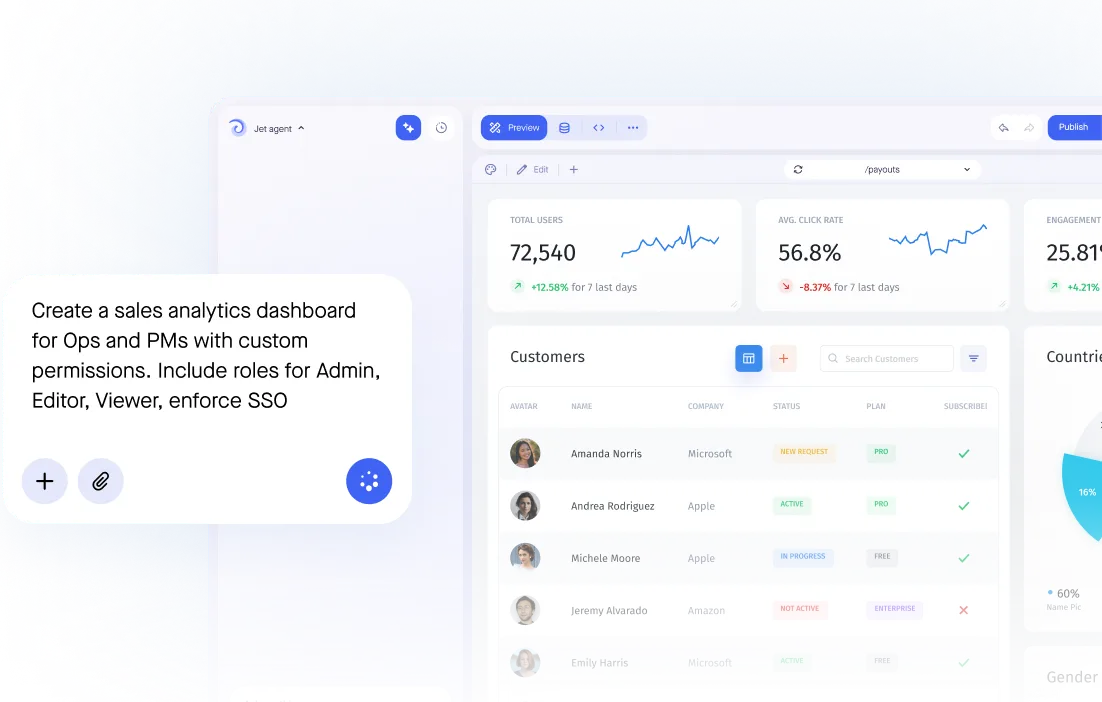
Jet Admin's AI-powered platform lets you generate a fully customized help desk template in minutes. Describe the support workflow your organization needs, and the platform builds your ticket submission forms, dashboards, automation rules, and role-based permissions automatically. Because Jet Admin connects to virtually any data source - SQL databases, REST APIs, third-party tools like HubSpot or Airtable - your new template works alongside the systems your team already uses rather than replacing them.
The core benefits are immediate:
- Centralized ticket management - every support request lives in one system with a clear status
- Faster resolution times - automated workflows route urgent issues to the right department instantly
- Measurable service quality - dashboards visualize key metrics like SLA compliance, first response time, and ticket volume
- Seamless integration - connect existing databases, CRMs, HRIS platforms, and communication tools without writing code
Why Use This Help Desk Template
Eliminate email and spreadsheet chaos. When support requests arrive via email, chat, and hallway conversations, tickets get lost. Helpdesk templates streamline communication and resolve issues efficiently by funneling every request through a single, structured system. A well-structured help desk template streamlines support by gathering necessary information upfront, so agents never chase requesters for missing details.
Reduce resolution time with automation. Automations can screen incoming tickets for urgency, assign them based on category or team availability, and trigger escalation rules when deadlines approach. Monitoring overdue tasks improves response time and customer satisfaction - industry benchmarks show that teams targeting first response under one hour for high-priority tickets consistently outperform those without SLA tracking.
Improve customer satisfaction through consistency. Implementing an organized ticketing and response template ensures consistent communication across every interaction. Automated email messaging keeps requesters updated on ticket status, and automated or quick-reply templates let users know their issue is being tracked from the moment they submit it.
Gain real-time visibility into team performance. Dashboards visualize ticket statuses and team performance metrics at a glance. Custom reports track team performance and ticket lead time, enabling managers to spot bottlenecks, redistribute workloads, and track trends over time. Tracking metrics such as response time and resolution time identifies improvement opportunities before they become systemic problems.
Scale effortlessly. Whether you're a five-person IT department or an enterprise service desk spanning multiple regions, the template adapts. Webster Central School District, for example, handles 800+ tickets per month with first response within one hour - and expanded the same system from IT to HR, Facilities, and Safety departments. The same structure that works for a small team scales without redesign.
Template Features
- Customizable ticket submission forms - Configure fields for priority, category, department, urgency, and attachments. Customizable forms allow users to submit detailed requests with all the necessary information agents need. Using dropdown menus improves reporting and categorization efficiency, while a clear summary of the problem helps set expectations for resolution scope.
- Automated ticket routing - Categorization and routing ensure tickets reach the right team quickly and are prioritized correctly. Rules can assign tickets based on issue type, keywords, urgency, or agent workload - reducing manual triage and enabling your support team to focus on resolution instead of sorting.
- Built-in SLA tracking and escalation rules - Service Level Agreement (SLA) references manage expectations for response and resolution times. Define priority tiers (Critical, High, Medium, Low) with specific response and resolution windows. Escalation triggers define when to escalate issues based on criteria like severity or response time, alerting managers automatically when deadlines are at risk.
- Role-based permissions - Role-based access separates user groups and permissions across your organization. Admins have different views compared to other team members - agents see their queue and performance data, while end users can only view their submitted requests and statuses. Role-based permissions enhance security in help desk systems and streamline ticket management processes.
- Real-time dashboards - Helpdesk dashboards illustrate first response time and ticket volume alongside resolution rates, backlog aging, and SLA compliance. Dashboards visualize key metrics like SLA and NPS, giving managers and executives the data they need to make informed decisions. Explore how to collaborate on your dashboards within Jet Admin.
- Automated notifications - Email notifications and status updates flow automatically throughout the ticket lifecycle. Requesters receive acknowledgment when they submit, updates when status changes, and confirmation when issues resolve. A clear description of the fix or workaround is needed before closing a ticket, ensuring complete communication.
- Knowledge base integration - Link help articles and documentation directly into the ticket submission flow. When users create new requests, the system can suggest relevant resources before a ticket is even opened - deflecting common issues and saving agent time. Spring Arbor University reduced repeat tickets significantly by converting resolved tickets into searchable knowledge base articles.
- Mobile-responsive design - The template works on any device, enabling field technicians and remote employees to manage tickets, update statuses, and access all the relevant details from their phone or tablet.
Who Is This Help Desk Template For?
This template is built for any team that needs to manage requests systematically:
- IT support teams managing internal infrastructure, software access, hardware issues, and employee onboarding/offboarding tasks
- Customer support departments handling external client inquiries through a structured service desk with SLA tracking
- Operations and facilities teams coordinating maintenance requests, service tasks, and due dates for recurring work
- HR, finance, and legal departments processing employee requests, policy clarifications, reimbursements, and approvals
- SMBs and mid-sized companies currently relying on email, Slack, or spreadsheets and needing a structured process to manage tickets at scale
- Organizations with existing tools - if your company already uses a CRM, HRIS, ERP, or project management software, the template integrates with those systems through Jet Admin's broad integration capabilities
An effective ticket template ensures consistent data collection across all IT support requests, but the same structure applies to any department fielding different types of internal or external requests.
How to Set Up Your Help Desk Template
1. Connect your data sources. Link the databases, APIs, or existing ticketing systems where your ticket data lives - or start fresh. Softr supports integration with Airtable, Google Sheets, and more; Jet Admin goes further, connecting to SQL databases, REST APIs, and dozens of third-party platforms. Wide app integrations enhance operations across your entire service desk.
2. Customize ticket forms and workflows. Use the visual builder to design your request form fields, categories, and priority levels. A streamlined ticket must capture the necessary details to route issues correctly - but a well-designed help desk template balances simplicity for users with detail for support teams. Standardized requests help ensure agents receive necessary information upfront. Set up workflow automations for routing, escalation, and approval processes.
3. Configure roles, permissions, and team assignments. Define who is an admin, agent, or end user. Assign department-specific views so each person sees only what's relevant. Role-based permissions streamline ticket management processes and keep sensitive data secure.
4. Set up notifications and SLA rules. Configure automated email notifications for ticket acknowledgment, status changes, and SLA breach alerts. Consistency in priority definitions helps in fair ticket triaging - establish clear tiers so your team knows exactly how to handle urgent issues versus routine requests.
5. Build your dashboard. Dashboards help track key metrics like ticket volume and response time. Set up views for agents, managers, and executives showing the key metrics that matter to each role. IT ticket templates standardize communication across support teams, and your dashboard should reflect that standardization.
6. Test with sample tickets. Feed a representative set of support requests through the system. Simulate different priority levels, escalation scenarios, and routing rules. Verify mobile responsiveness and confirm that each role sees the correct data.
7. Train your team and launch. Walk agents through the new interface, show requesters where to submit tickets, and set expectations for response times. Providing a detailed explanation of the issue clarifies user needs for agents - make sure your team understands how to capture that detail effectively.
Jet Admin's AI-powered builder can generate your initial template in minutes with minimal configuration. From there, iterate based on feedback - refine workflows, adjust SLA thresholds, and add new form fields as actual usage reveals what works.
Frequently Asked Questions
Can I integrate this template with my existing tools like ServiceNow or Jira? Yes. Jet Admin connects to external systems via REST APIs, webhooks, and native integrations. Integrating multiple tools improves help desk efficiency and response times. You can also pull data from CRMs like HubSpot or databases already powering your operations.
How quickly can I deploy a help desk template with Jet Admin? Most teams go from zero to a working help desk in under an hour. The AI generates your initial template - forms, workflows, dashboards - based on your description, and you customize from there. No-code templates from platforms like Softr can be configured in under 30 minutes; Jet Admin offers similar speed with deeper integration and customization options.
What data sources does the template support? SQL databases (PostgreSQL, MySQL, MariaDB, SQL Server), NoSQL databases, REST APIs, Google Sheets, Airtable, Notion, BigQuery, and more. Pipefy integrates with existing software for easy data transfer - Jet Admin follows the same philosophy, connecting to whatever data layer your business already uses.
Can non-technical users customize the template without coding? Absolutely. The visual builder lets anyone modify form fields, adjust workflow rules, create dashboards, and configure permissions without writing a single line of code. Wrike allows customization of request forms for better ticket management - Jet Admin takes this further with a complete drag-and-drop interface for every element.
Does the template support multi-level approval workflows? Yes. You can configure approval chains for specific ticket types - budget requests, access provisioning, change management - with escalation paths when approvers are unavailable within a given time frame.
How does the template handle ticket escalation and SLA monitoring? Define escalation rules tied to priority tiers and SLA thresholds. For example: Critical tickets that miss a one-hour response window automatically escalate to a team lead. An industrial engineering company with global operations achieved 15% faster incident resolution and 91% user satisfaction by implementing standardized escalation across consolidated service desks.
Is the help desk template mobile-friendly for field technicians? Yes. The template is fully responsive and works on any device - phone, tablet, or desktop. Agents in the field can update ticket status, add notes, and access necessary information without returning to a workstation.
What reporting and analytics capabilities are included? Built-in dashboards cover ticket volume, first response time, mean time to resolve, SLA compliance percentage, agent productivity, backlog aging, and channel effectiveness. An effective help desk template should capture critical data to aid resolution efforts - and the reporting layer turns that data into actionable insights. Many teams target 90–95% SLA compliance and use these reports to identify where they're falling short.
Data sources

.svg)





Use Cases
Categories
Features
Similar templates



Connect & sync your data with 30+ data sourse’s


Build frontend Apps 10x faster


Frequently asked questions
Built-in dashboards cover ticket volume, first response time, mean time to resolve, SLA compliance percentage, agent productivity, backlog aging, and channel effectiveness. An effective help desk template should capture critical data to aid resolution efforts - and the reporting layer turns that data into actionable insights. Many teams target 90–95% SLA compliance and use these reports to identify where they're falling short.
Yes. The template is fully responsive and works on any device - phone, tablet, or desktop. Agents in the field can update ticket status, add notes, and access necessary information without returning to a workstation.
Define escalation rules tied to priority tiers and SLA thresholds. For example: Critical tickets that miss a one-hour response window automatically escalate to a team lead. An industrial engineering company with global operations achieved 15% faster incident resolution and 91% user satisfaction by implementing standardized escalation across consolidated service desks.
Yes. You can configure approval chains for specific ticket types - budget requests, access provisioning, change management - with escalation paths when approvers are unavailable within a given time frame.
Absolutely. The visual builder lets anyone modify form fields, adjust workflow rules, create dashboards, and configure permissions without writing a single line of code. Wrike allows customization of request forms for better ticket management - Jet Admin takes this further with a complete drag-and-drop interface for every element.
SQL databases (PostgreSQL, MySQL, MariaDB, SQL Server), NoSQL databases, REST APIs, Google Sheets, Airtable, Notion, BigQuery, and more. Pipefy integrates with existing software for easy data transfer - Jet Admin follows the same philosophy, connecting to whatever data layer your business already uses.
Most teams go from zero to a working help desk in under an hour. The AI generates your initial template - forms, workflows, dashboards - based on your description, and you customize from there. No-code templates from platforms like Softr can be configured in under 30 minutes; Jet Admin offers similar speed with deeper integration and customization options.
Yes. Jet Admin connects to external systems via REST APIs, webhooks, and native integrations. Integrating multiple tools improves help desk efficiency and response times. You can also pull data from CRMs like HubSpot or databases already powering your operations.