Recruitment Management
App
Recruitment Management
Overview
A recruitment management template is a pre-built application framework that structures how your hiring team tracks candidates through every stage of the recruitment process - from initial application to signed offer. Instead of piecing together an applicant tracking spreadsheet in Google Sheets, juggling email threads for interview feedback, and manually updating candidate data across disconnected tools, this template gives you a single system where every job opening, candidate profile, and interview score lives in one place.
The core problem is familiar to any HR team or recruiter managing multiple positions: candidate information gets scattered across inboxes, spreadsheets, and chat threads. Follow-ups slip through the cracks. Hiring managers don't know which candidates are in play for their roles. Interview notes disappear. The result is a slower hiring process, poor communication with applicants, and lost top candidates.
This recruitment management template solves that by giving you centralized candidate tracking with customizable workflows that replace manual spreadsheets entirely. Recruitment trackers centralize candidate information in one place, and templates help track multiple job openings simultaneously. Every member of your hiring team - recruiters, hiring managers, interviewers - sees the same pipeline, the same candidate details, and the same real-time status updates.
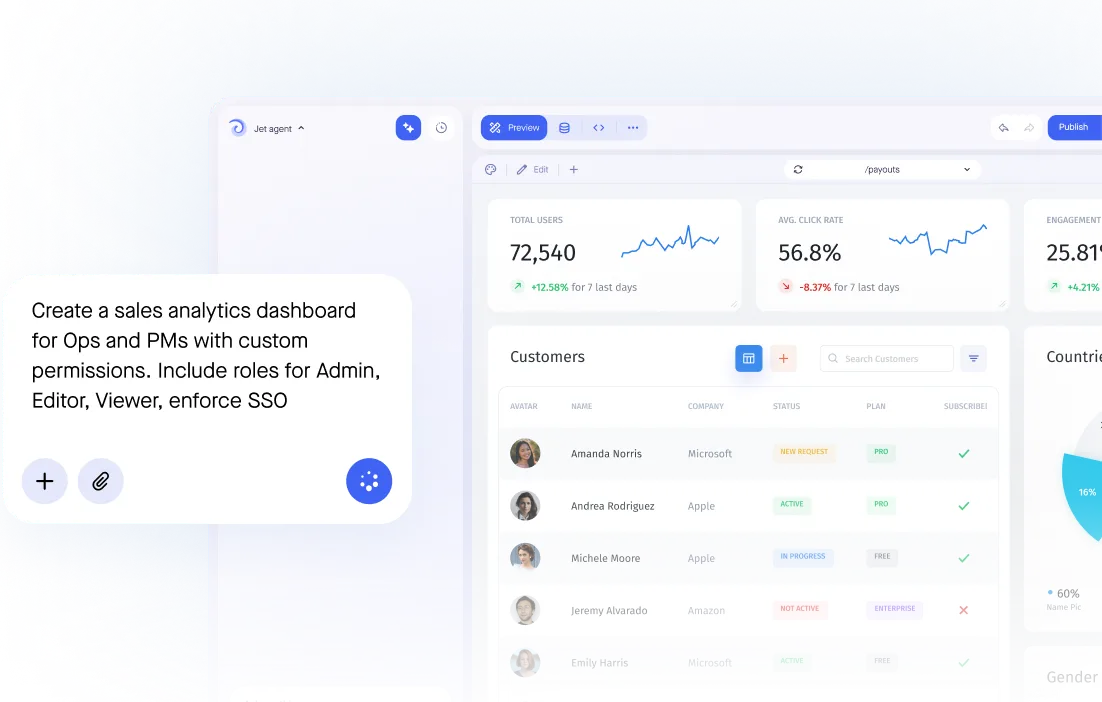
Built on Jet Admin's AI-powered no-code app builder, this recruitment template connects directly to your existing data sources - PostgreSQL, Airtable, REST APIs, or Jet Admin's built-in database - so you don't need to migrate anything. Describe what you need, generate the app, customize the interface and logic through a visual builder, and publish a working recruitment tracker in minutes rather than weeks.
Why use this recruitment management template
Hiring teams lose candidates and waste hours on repetitive tasks not because they lack effort, but because their tools don't match their process. Here's how this recruitment tracker template addresses the specific pain points that slow down your entire recruitment process.
Scattered candidate data becomes centralized information. When applicant information lives across email attachments, multiple spreadsheets, and different ATS solutions, nobody has the full picture. This template consolidates every candidate's contact details, resume, application status, interview history, and feedback into a single profile. No more searching through inboxes to find a candidate's current status. Organized hiring processes create better first impressions for candidates and keep your team on the same page.
Real-time pipeline visibility replaces status meetings. Instead of scheduling weekly syncs just to learn which candidates are at which interview stages, every stakeholder sees the live candidate pipeline. Recruiters, hiring managers, and executives can check pipeline health at a quick glance - how many qualified candidates are in screening, who's waiting on a job offer, which roles are stalled. Recruitment dashboards provide visual reports on hiring metrics like offer acceptance rates.
Standardized evaluation criteria replace inconsistent feedback. When each hiring manager uses different other criteria to evaluate job applicants, comparing candidates becomes subjective guesswork. Standardized evaluation checklists improve candidate comparison and reduce bias. This template enforces consistent feedback forms with scoring rubrics and recommendation fields, so every interview conducted produces structured, comparable data.
Shared access enables real time collaboration. Recruiters, hiring managers, and interviewers all work within the same system - submitting interview feedback, reviewing candidate profiles, and tracking progress through the recruitment pipeline. Templates should allow for easy collaboration among hiring teams, and this one does so with role-based access control that ensures everyone sees exactly what's relevant to their role.
Automated workflows reduce administrative overhead. Using a tracker reduces manual data entry and paperwork. Stage-change notifications, interview reminders, and scheduled pipeline reports replace the manual emails and follow-ups that consume recruiter time. Automated communication improves candidate experience significantly by ensuring timely follow-ups at every stage of the hiring process. 94% of companies using ATS report faster hiring, and structured templates are a direct path toward that efficiency.
Process consistency across departments and roles. Whether you're hiring engineers, sales reps, or executives, this template ensures every role follows a defined workflow. Structured frameworks for screening and interviewing help ensure consistency - the same stages, the same feedback format, the same evaluation criteria - while still allowing customization where departments need it. Templates should reflect an organization's unique requirements for optimal effectiveness.
Template features
Kanban Pipeline Board
Track every candidate visually through your hiring stages with a Kanban board that maps your recruitment pipeline. Define stages - Applied, Screening, Interview, Offer, Hired - and customize them per role or department. Drag and drop candidates between stages as they progress. See candidate counts per stage at a quick glance, identify bottlenecks where candidates are stalling, and track stage conversion rates. The board supports conditional logic, so you can add stages like "Take-Home Assessment" or "Panel Interview" for specific job openings without disrupting other workflows.
Candidate Profile Pages
Every candidate gets a dedicated profile page that compiles all applicant information in a single view. Contact details, resume attachments, portfolio links, application date, current status, and interview history are immediately accessible. Interview notes and feedback from every interviewer are aggregated on the profile, so anyone reviewing a candidate sees the complete picture. File upload supports resumes and work samples. Customize templates to include specific fields for candidate demographics, current employer, target start date, or any other criteria your team needs for tracking candidates effectively.
Interview Scheduling and Feedback
Coordinate interview schedules without the back-and-forth emails. The template integrates with calendar tools via API - Calendly for self-scheduling, Google Calendar or Outlook for conflict detection - so interviewers and candidates can find open slots quickly. Each interview conducted is logged with structured feedback forms that include interview score fields, written notes, and a recommendation. Timely follow-ups improve candidate experiences during hiring, and automated reminders ensure interviewers submit their feedback promptly. Tracking metrics like time-to-hire and cost-per-hire helps evaluate recruitment effectiveness.
Job Opening Management
Maintain a centralized list of all job openings with status tracking - Open, On Hold, or Closed. Each role includes its job title, department, assigned hiring manager, job posting date, and number of applicants. A clearly defined job description outlines job title, responsibilities, and required skills. Good trackers allow tracking of multiple job openings simultaneously, and this template lets you filter by department, status, or hiring manager to manage hiring across your entire organization. Customize fields per opening to include salary band, seniority level, remote or onsite designation, and more.
Source Attribution Tracking
Know where your best candidates come from. Every application records its source - job boards, LinkedIn, referrals, career site, agency, or direct application. This goes beyond simple tracking: you get ROI analysis per recruitment channel. According to 2026 sourcing data, job boards account for approximately 49% of applications but only about 24.6% of hires, while referrals convert at roughly 11 times the rate of inbound applications. Average cost per hire for non-executive roles runs approximately $5,475, and referrals tend to fill roles in about 29 days compared to an average of 44 days across all channels. With source attribution built into your recruitment tracker, you can see these patterns in your own data and allocate budget accordingly.
Bulk Import and Data Sync
Migrating from an applicant tracking spreadsheet or another system doesn't mean starting from zero. Import existing spreadsheet data via CSV and map fields to your template's data model. If you're connecting to an existing database - PostgreSQL, MySQL, or Airtable - two-way sync keeps records current across systems and prevents duplicate candidate entries. This means you can keep track of candidates in your recruitment management template while maintaining connections to other HR tools or ATS platforms like Greenhouse or Lever via REST API.
Role-Based Access Control
Not everyone on your hiring team needs to see everything. Define user roles - recruiter, hiring manager, admin, interviewer - with permissions configured down to the record level. Hiring managers see only candidates for their job openings. Interviewers access only the feedback forms and interview dates relevant to their upcoming interviews. Sensitive information like salary negotiations or internal comments stays restricted to authorized roles. Audit logs track every access and change for compliance. SSO and SAML support ensures enterprise-grade security.
Automated Workflow Triggers
Set up workflow automations that eliminate repetitive tasks. When a candidate moves to the next stage, the template can trigger an email notification to the candidate, the recruiter, or the hiring manager. Interview reminders go out automatically before scheduled sessions. If feedback isn't submitted within a defined window, a reminder follows. Scheduled pipeline reports can be emailed to leadership daily or weekly, summarizing pipeline health, candidates per stage, and overdue actions. Automated communication enhances candidate engagement throughout hiring, and recruitment management templates enhance efficiency by reducing time-to-hire.
Who is this recruitment management template for?
HR managers and recruiters managing multiple openings. If you're overseeing dozens of open roles across departments, you need unified visibility over every candidate pipeline. This template gives you standardized workflows, consolidated candidate data, and reporting on where your entire hiring process is slowing down - without relying on HR teams to manually compile updates from hiring managers.
Talent acquisition teams needing structured collaboration. High-volume recruiting means tracking job applicants across interview stages, coordinating with multiple interviewers, and reporting up to leadership. This recruitment template provides the collaboration tools and standardized evaluation processes that keep your team on the same page. Use it as your recruiting sourcer hub where every team member contributes feedback and every candidate gets a consistent experience.
Staffing and recruitment agencies. Agencies tracking candidates across multiple client requirements need separate pipelines per client, performance metrics per placement, and controlled access so clients see only their own data. This recruiter hiring template supports multi-client workflows with role-based permissions and source attribution that ties each placement back to its channel ROI.
Startup founders and small teams. If you're hiring your first team members without a dedicated HR system, you don't need a full-scale applicant tracking system - you need simple templates that work. This template gives small recruiting teams and small businesses a structured hiring process without the learning curve or cost of enterprise ATS platforms. Start with the built-in database and scale as your hiring needs grow.
Operations and people ops leads. For those responsible for process efficiency, data governance, and cost reduction across the organization, this template provides audit logs, role-based access, and the ability to connect to your existing data stack. Deploy it cloud-hosted or self-hosted to meet data residency requirements. User-friendly interfaces help users navigate recruitment trackers easily, and customization allows tailoring hiring processes to industry-specific needs.
Hiring managers across departments. Engineering, sales, marketing - each department's hiring managers need to view candidates for just their roles, submit interview feedback, and check interview schedules without wading through irrelevant data. Record-level filtering ensures they see only what matters, with a calendar view of upcoming interviews and a clear pipeline of their active candidates.
How to set up your recruitment management template
Getting your recruitment tracker running follows a straightforward process. Using a tracker reduces manual data entry and paperwork from the start.
Step 1: Select the recruitment management template from Jet Admin's template library. Choose the recruitment management template. You can also describe your hiring needs in natural language and let the AI-powered builder generate a starting point that matches your requirements.
Step 2: Connect your data source. Decide where your candidate data will live. Connect natively to PostgreSQL, MySQL, or Airtable if you already have an HR database. Use REST API connections to sync with existing ATS platforms like Greenhouse or Lever. Or start fresh with Jet Admin's built-in database - no external setup required. If you're migrating from a recruitment tracker spreadsheet, import your CSV data and map fields to the template's data model (candidates, job openings, applications, interview stages, feedback, sources).
Step 3: Map your hiring pipeline stages and customize job opening fields. Define the stages that match your recruitment process - Screening, Phone Screen, Technical Interview, Panel, Offer, or whatever your workflow requires. Add conditional stages for specific role types. Customize fields per job opening: job title, department, seniority, location, salary band, target start date. Use dropdown menus to standardize application status tracking across all openings. Customize templates by adding or removing columns as needed.
Step 4: Configure the interface and candidate profile layouts. Using the visual builder, arrange your candidate profile pages to show the important details your team needs - resume uploads, contact details, interview history, aggregated feedback, and activity logs. Set up the Kanban pipeline board as your primary view. Apply conditional formatting or visual cues to highlight overdue candidates or stalled stages. Customize the interface with your organization's branding.
Step 5: Set up role-based permissions and record-level access. Define roles for recruiters, hiring managers, admins, and interviewers. Configure record-level filtering so hiring managers see only candidates for their job openings. Restrict access to sensitive information like salary negotiations. Enable SSO/SAML if required for enterprise compliance. Templates should include detailed reporting capabilities for metrics analysis - set permissions for who can view and export reports.
Step 6: Configure workflow automations and integrations. Set triggers: email notifications when candidates change stages, reminders for interviewers to submit feedback, alerts via Slack for urgent actions. Connect Gmail or Outlook via API for candidate communication. Integrate Calendly for interview scheduling. Set up DocuSign via API for offer letter e-signatures. Configure scheduled pipeline reports that go out to stakeholders weekly with key metrics.
Step 7: Test with sample data and publish. Before rolling out to your full hiring team, run the template with sample candidates across your pipeline stages. Verify that automated workflows fire correctly, permissions restrict access as intended, and data syncs properly with connected sources. Collect feedback from a pilot group of hiring managers and interviewers. Once validated, publish and grant team access - the template is responsive, so hiring managers can review candidates and submit feedback from any device.
Ready to replace your applicant tracking spreadsheet with a system that actually matches your hiring process? Select the recruitment management template and start building.
Frequently asked questions
What is a recruitment management template?
A recruitment management template is a pre-built application framework designed for tracking candidates through your entire hiring process - from job posting to offer acceptance. Unlike a basic applicant tracking spreadsheet in Google Sheets, it includes structured workflows, role-based permissions, automated notifications, and reporting dashboards. Unlike a commercial applicant tracking system, it connects to your existing data sources and lets you customize every aspect of the interface and logic without being locked into a vendor's workflow. Recruitment management templates streamline the hiring process and help organize candidate information in one place.
Can I customize the hiring pipeline stages for my process?
Yes. The template supports fully customizable pipeline stages - rename them, reorder them, add conditional stages for specific role types (such as a take-home assessment for engineering or a portfolio review for design), or remove stages you don't use. You can maintain different pipeline configurations for different departments or seniority levels while keeping a consistent overall recruitment process. A recruitment tracker can manage multiple job openings simultaneously, each with its own stage configuration if needed.
How do I connect this to LinkedIn or job boards?
LinkedIn and job board connections are available via API integration. You can pull candidate sourcing metadata into the template to automatically tag where each applicant originated, supporting your source attribution tracking. REST API connectors allow you to integrate with major job boards for application data and sourcing information. Note that these are API-based integrations that require configuration - they're not automatic out-of-the-box connections, but Jet Admin's data editor and API connector make setup straightforward.
Can hiring managers submit interview feedback directly in the app?
Absolutely. Hiring managers and interviewers access the template through role-based permissions that show only the candidates and job openings relevant to their roles. After each interview conducted, they fill out standardized feedback forms with interview score fields, written interview notes, and a recommendation. This feedback is compiled on each candidate's profile page, making it easy for recruiters to compare evaluations across multiple interviewers without chasing responses through email.
How do I track where candidates are coming from?
Source attribution is built into every candidate record. When applicants enter your pipeline - whether from job boards, LinkedIn, referrals, your career site, or a staffing agency - the source is logged. You can then run reports showing which channels deliver the most qualified candidates, the best conversion rates through your pipeline, and the lowest cost per hire. Industry data shows referrals convert at significantly higher rates than job board applications, and this template gives you the data to verify that pattern in your own hiring. Templates should include detailed reporting capabilities for metrics analysis.
Can I automate notifications when a candidate moves to the next stage?
Yes. Workflow automations let you set triggers for any stage change in your candidate pipeline. When a candidate moves from Screening to Interview, for example, you can automatically send an email to the candidate confirming next steps, notify the interviewer with candidate details, and alert the hiring manager. You can also set up reminder triggers - if interview feedback isn't submitted within a defined timeframe, the system sends a follow-up. Automated workflows handle the repetitive tasks that otherwise consume recruiter time.
How do I report on time-to-hire and offer acceptance rates?
The template includes a reporting dashboard where you track key metrics: time-to-hire (from application date to offer acceptance), time in each stage, pipeline conversion rates between stages, offer acceptance rates, and source effectiveness. Filter reports by department, role, hiring manager, or time period. Schedule automated reports to be emailed to stakeholders weekly or monthly. Recruiting operations benchmarks analyzing over 54 million applications across approximately 93,000 job openings show that reducing small delays across multiple stages - application review, scheduling, feedback collection, offer approval - is the key to improving time-to-hire. These dashboards give you the valuable insights to identify exactly where your process is slowing down.
Data sources

.svg)







Use Cases
Categories
Features
Similar templates




Connect & sync your data with 30+ data sourse’s


Build frontend Apps 10x faster


Frequently asked questions
The template includes a reporting dashboard where you track key metrics: time-to-hire (from application date to offer acceptance), time in each stage, pipeline conversion rates between stages, offer acceptance rates, and source effectiveness. Filter reports by department, role, hiring manager, or time period. Schedule automated reports to be emailed to stakeholders weekly or monthly. Recruiting operations benchmarks analyzing over 54 million applications across approximately 93,000 job openings show that reducing small delays across multiple stages - application review, scheduling, feedback collection, offer approval - is the key to improving time-to-hire. These dashboards give you the valuable insights to identify exactly where your process is slowing down.
Yes. Workflow automations let you set triggers for any stage change in your candidate pipeline. When a candidate moves from Screening to Interview, for example, you can automatically send an email to the candidate confirming next steps, notify the interviewer with candidate details, and alert the hiring manager. You can also set up reminder triggers - if interview feedback isn't submitted within a defined timeframe, the system sends a follow-up. Automated workflows handle the repetitive tasks that otherwise consume recruiter time.
Source attribution is built into every candidate record. When applicants enter your pipeline - whether from job boards, LinkedIn, referrals, your career site, or a staffing agency - the source is logged. You can then run reports showing which channels deliver the most qualified candidates, the best conversion rates through your pipeline, and the lowest cost per hire. Industry data shows referrals convert at significantly higher rates than job board applications, and this template gives you the data to verify that pattern in your own hiring. Templates should include detailed reporting capabilities for metrics analysis.
Absolutely. Hiring managers and interviewers access the template through role-based permissions that show only the candidates and job openings relevant to their roles. After each interview conducted, they fill out standardized feedback forms with interview score fields, written interview notes, and a recommendation. This feedback is compiled on each candidate's profile page, making it easy for recruiters to compare evaluations across multiple interviewers without chasing responses through email.
LinkedIn and job board connections are available via API integration. You can pull candidate sourcing metadata into the template to automatically tag where each applicant originated, supporting your source attribution tracking. REST API connectors allow you to integrate with major job boards for application data and sourcing information. Note that these are API-based integrations that require configuration - they're not automatic out-of-the-box connections, but Jet Admin's data editor and API connector make setup straightforward.
Yes. The template supports fully customizable pipeline stages - rename them, reorder them, add conditional stages for specific role types (such as a take-home assessment for engineering or a portfolio review for design), or remove stages you don't use. You can maintain different pipeline configurations for different departments or seniority levels while keeping a consistent overall recruitment process. A recruitment tracker can manage multiple job openings simultaneously, each with its own stage configuration if needed.
A recruitment management template is a pre-built application framework designed for tracking candidates through your entire hiring process - from job posting to offer acceptance. Unlike a basic applicant tracking spreadsheet in Google Sheets, it includes structured workflows, role-based permissions, automated notifications, and reporting dashboards. Unlike a commercial applicant tracking system, it connects to your existing data sources and lets you customize every aspect of the interface and logic without being locked into a vendor's workflow. Recruitment management templates streamline the hiring process and help organize candidate information in one place.