Leave Management
App
Leave Management
Overview
A leave tracker template is a pre-built application that centralizes every aspect of employee time-off management-requests, approvals, balance calculations, calendaring, and reporting-into a single, accessible system. Instead of scattered spreadsheets, email chains, and manual reconciliation, it delivers a structured workflow where employees submit requests, managers approve or reject with context, and HR maintains real-time visibility across the entire organization.
The core problem is familiar to any HR team or people operations lead: manual tracking in spreadsheets leads to calculation errors, version conflicts, delayed approvals, and scheduling blind spots. When a person must beg leave through an email thread and wait days for a response, requests get lost. When balances live in a static file, they're outdated the moment someone takes a day's leave. When managers can't see who else is off, they risk understaffing critical functions.
This leave tracker template solves those problems by delivering automated leave management with real-time visibility. Templates streamline the process of tracking leave, replacing manual steps with structured workflows that route requests to the right approver, calculate balances automatically, and surface team calendars so conflicts are caught before they happen. The template is fully customizable-configurable for different leave types, accrual rules, carry-over policies, and departmental structures so it adapts to your company rather than forcing your company to adapt to it.
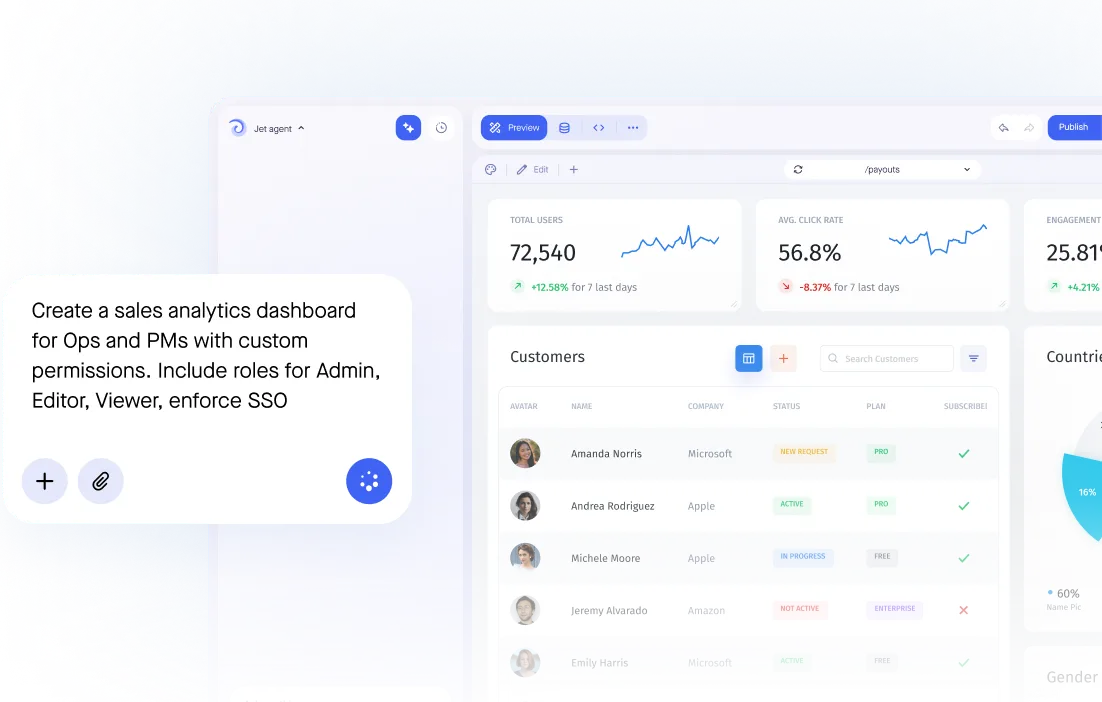
With Jet Admin, you can generate a customized leave tracking app from this template, connect your existing data, and publish a responsive application-all without writing code.
Why use this leave tracker template
Manual leave management creates friction at every level of the organization. Here's where the pain hits hardest-and how a centralized leave tracker template directly addresses each issue.
- Spreadsheet errors erode trust. When leave balances live in Excel or Google Sheets, calculation mistakes are inevitable. Accrual logic, partial days, carry-overs, and mid-year hires produce edge cases that formulas miss. Using templates can reduce errors in leave tracking by enforcing consistent calculation rules across every employee record. According to a SHRM/Kronos study, roughly 25–35% of organizations still rely on manual spreadsheets for absence tracking-leaving a lot of room for miscalculation.
- Email approval chains cause delays and lost requests. When employees must send an email to request time off, then wait for a manager reply that may never come, requests fall through the cracks. A clearance/approval process helps manage leave requests effectively by routing each submission into a structured queue with clear status tracking-pending, approved, or rejected.
- Managers lack team coverage visibility. Without a shared calendar, managers can't see overlapping requests or anticipate coverage gaps. Real-time visibility prevents double-booking and understaffing, giving managers the information they need to confirm or deny requests with confidence.
- Employees can't check their own balances. When balance data sits in an HR-owned spreadsheet, employees must ask someone else how many vacation days they have left. Self-service access eliminates that back-and-forth, reducing HR's administrative burden while giving employees the transparency they hold dear.
- Version control becomes a responsibility no one wants. Multiple copies of a tracker across departments, each slightly different, create a situation where no single source is reliable. Centralized data eliminates version conflicts-one system, one truth, updated in real time.
- Policy compliance is hard to enforce manually. With 55% of HR professionals citing compliance as a top priority in leave policy management, consistent approval workflows ensure that rules around accruals, carry-overs, and entitlements are applied uniformly rather than left to individual interpretation.
Effective templates improve team communication regarding leave by making absence data visible, structured, and actionable-replacing scattered information with a system everyone can watch and rely on.
Template features
Employee self-service request form
Employees submit leave requests directly through a structured form-selecting date ranges, choosing from drop-down menus for leave types, and adding a comment with context or notes. Drop-down menus for leave types enhance usability in leave tracking templates by eliminating free-text errors and ensuring every request is properly categorized. Leave types should include vacation, sick leave, personal leave, and jury duty, among other categories you define. The form captures everything the approver needs to make a decision, replacing informal email requests that often lack critical details.
Real-time leave balance dashboard
Each employee can view their remaining vacation, sick, and personal days in a live dashboard that reflects every approved request and accrual update. Leave tracking helps manage employee time off effectively because balances aren't static numbers on a spreadsheet-they update as requests move through the approval process. This self-service visibility means employees stop asking HR for balance confirmations and can plan their time off with confidence.
Manager approval queue
Managers see all pending requests in a dedicated queue with employee name, dates, leave type, and current team coverage context. One-click accept or reject actions keep approvals moving-no more searching through email for a request submitted last week. Status notifications deliver alerts through email or Slack so managers don't miss time-sensitive submissions. This structured workflow ensures that no request remains in limbo.
Team calendar view
A visual calendar allows managers to see who is off on any given day, making it simple to spot potential conflicts before approving new requests. Color coding can visually indicate different types of absences on leave trackers-vacation in one color, sick leave in another-so the scene at a glance tells managers everything about their team's coverage. Essential features for a robust leave tracker include visual tracking and categorization of leave types, and this calendar delivers both.
Configurable leave types and policies
Templates can be customized for different leave types, from standard vacation and sick days to parental leave, bereavement, and unpaid absence categories. You define the accrual rules, carry-over limits, probation restrictions, and entitlement caps that match your company's policies. Extended leave is often requested by skilled workers, and the template supports indefinite leave configurations where employees remain away without a set return date. Whether your policies are simple or vary by department, region, or employment type, the configuration adapts.
Automated balance calculations
Accrual tracking runs according to your defined rules-monthly, quarterly, or annual accumulation with caps and carry-forward limits. The system calculates opening balance plus accrued days minus approved leave to produce leaves balance figures that are always current. Edge cases like mid-year hires, policy transitions, and half-day requests are handled consistently, avoiding the manual recalculation that consumes HR time in spreadsheet-based systems.
Status notifications and reminders
Automated alerts keep every stakeholder informed. Employees receive confirmation when a request is submitted and notification when it's approved or rejected. Managers get reminders about pending approvals. HR is alerted to low balances or policy exceptions. These notifications flow through email or Slack, ensuring nothing gets lost regardless of how a person prefers to communicate.
Absence reporting and analytics
Departmental reports surface leave patterns-which teams take the most sick days, when absence rates spike, whether utilization is balanced across the organization. TechTarget identifies reporting and analytics as among the most valued features in leave management systems, and this template delivers filterable reports that help HR spot trends, forecast coverage needs, and make data-informed policy decisions. Over 70% of indefinite leave applications are completed within two weeks, and reporting helps HR track these timelines.
Who is this leave tracker template for?
- HR departments managing employee time-off policies across the organization. HR teams need to enforce accrual rules, maintain compliance with leave regulations across jurisdictions, and maintain audit trails. This template replaces the duty of manual reconciliation with automated calculations and centralized records. A 2025 Leave Management & HR Trend Report found that 71% of respondents agreed leave policies have a significant impact on employee satisfaction-making accurate, transparent tracking a strategic responsibility, not just an administrative one.
- People operations teams coordinating leave across distributed workforces. When employees span multiple time zones, countries, or office locations, a centralized system ensures everyone follows the same submission and approval process regardless of geography. The template handles different policy configurations for different groups, so a team in one country can have distinct entitlements from a team in another.
- Managers who need visibility into team coverage and carry the responsibility of approving or denying requests. The approval queue and team calendar give managers the context to make informed decisions quickly, avoiding the situation where too many people depart at once and projects stall.
- Employees wanting self-service access to submit requests, check balances, and track the status of pending leave. Extended leave is often requested for personal reasons, and employees benefit from a system where they can initiate and monitor these requests without chasing someone for updates.
- Small to medium businesses replacing manual spreadsheet tracking. When a growing company's spreadsheet tracker starts to hit its limits-slow performance, formula errors, no approval workflow-this template provides a structured alternative without requiring enterprise-level software investment.
- Growing companies that need scalable leave management as they add employees, departments, and locations. What works for 20 people in a single office won't work for 200 across multiple regions. The template scales with your organization, and leave pay can include significant amounts for various reasons, making accurate tracking increasingly important as headcount grows.
How to set up your leave tracker template
- Select the leave tracker template from Jet Admin's template library. Browse to the leave management template and generate your application. Jet Admin's AI-powered no-code builder creates the foundational app structure-request forms, balance views, approval queues, and calendar-ready for customization.
- Connect your employee data source. Link the template to where your employee data lives. Jet Admin offers native connections to Google Sheets, Airtable, PostgreSQL, Supabase, and MySQL. For HRIS, calendar, or payroll systems, connect through APIs. This step ensures your leave tracker pulls from your existing employee records rather than requiring you to build a separate database from scratch-replacing duplicate data entry with a live connection.
- Map employee fields. Configure which columns or fields correspond to employee names, departments, managers, job titles, start dates, and current leave balances. This mapping tells the template how to associate each person with their correct records, approver, and policy group.
- Customize leave types, accrual rules, and approval workflows. Define your leave categories-vacation, sick, personal, parental, unpaid, or any custom type your organization uses. Set accrual rates, carry-over limits, entitlement caps, and any probation-period restrictions. Configure approval chains so requests route to the correct manager or HR contact based on department or leave type.
- Configure user permissions. Separate access levels for employees, managers, and HR administrators. Employees see their own balances and request history. Managers see their team's requests and calendar. HR has full visibility and reporting access. Restricting records by role ensures privacy and keeps each view relevant.
- Set up automated notifications. Configure email or Slack alerts for request submissions, approval decisions, upcoming leave reminders, and balance warnings. These notifications keep the workflow moving without anyone needing to manually check the system.
- Test the workflow with sample requests and publish. Submit test leave requests across different leave types and scenarios-partial days, overlapping dates, carry-over situations-to confirm that balances calculate correctly, approvals route properly, and notifications fire as expected. Once validated, publish the live application. Jet Admin produces a responsive app accessible on desktop and mobile.
Ready to learn how this template fits your organization? Start with the leave tracker template and customize it for your policies and data.
Frequently asked questions
What is a leave tracker template?
A leave tracker template is a pre-built application designed for managing employee time-off-from request submission through approval to balance tracking and reporting. It provides structured forms, automated calculations, and visual calendars so organizations can manage absence without manual spreadsheets or email chains. In the formal sense, it's a ready-to-use system you customize to match your company's leave policies and data.
Can employees see their leave balances?
Yes. The template includes a self-service dashboard where each employee can view their current balance across all leave types-vacation, sick, personal, and any custom categories you configure. Balances update in real time as requests are approved, so employees always have an accurate picture of their remaining days.
Can managers approve requests directly in the system?
Yes. Managers access an approval queue that lists all pending requests from their team. Each entry shows the employee name, requested dates, leave type, and any comment the employee included. Managers can approve or reject with a single action, and the system sends a notification to the employee with the decision. This eliminates the need to compare email threads or track approvals in a separate document.
Can holidays and leave types be configured?
Yes. You define company holidays, regional observances, and custom leave categories within the template. Each leave type can have its own accrual rules, entitlement limits, and carry-over policies. This flexibility supports organizations that operate across multiple regions or have department-specific rules-whether you need to account for local public holidays in one country or distinct sick leave entitlements in another.
Can the system identify overlapping leave requests?
The team calendar view displays all approved and pending leave across a department or team, making overlapping requests immediately visible. Managers can review the calendar before approving a new request to confirm adequate coverage remains. This visual approach to conflict detection avoids the guesswork inherent in spreadsheet-based tracking.
Can I connect my existing HRIS or calendar system?
Jet Admin provides native connections to data sources like Google Sheets, Airtable, PostgreSQL, Supabase, and MySQL. For HRIS, payroll, and calendar systems-such as Google Calendar or Outlook-you can connect through APIs. This means your leave tracker can pull employee data from your existing systems and push notifications through Gmail or Slack without requiring you to abandon or duplicate your current tools.
How do I handle different leave policies for different departments?
The template supports configuring department-specific rules, including distinct accrual rates, entitlement caps, carry-over limits, and approval chains. You can map each department to its own policy group, ensuring that a leave request from engineering follows different rules than one from sales if your policies require it. This avoids the one-size-fits-all limitation common in basic spreadsheet trackers.

.svg)




Use Cases
Categories
Features
Similar templates




Connect & sync your data with 30+ data sourse’s


Build frontend Apps 10x faster


Frequently asked questions
The template supports configuring department-specific rules, including distinct accrual rates, entitlement caps, carry-over limits, and approval chains. You can map each department to its own policy group, ensuring that a leave request from engineering follows different rules than one from sales if your policies require it. This avoids the one-size-fits-all limitation common in basic spreadsheet trackers.
Jet Admin provides native connections to data sources like Google Sheets, Airtable, PostgreSQL, Supabase, and MySQL. For HRIS, payroll, and calendar systems-such as Google Calendar or Outlook-you can connect through APIs. This means your leave tracker can pull employee data from your existing systems and push notifications through Gmail or Slack without requiring you to abandon or duplicate your current tools.
The team calendar view displays all approved and pending leave across a department or team, making overlapping requests immediately visible. Managers can review the calendar before approving a new request to confirm adequate coverage remains. This visual approach to conflict detection avoids the guesswork inherent in spreadsheet-based tracking.
Yes. You define company holidays, regional observances, and custom leave categories within the template. Each leave type can have its own accrual rules, entitlement limits, and carry-over policies. This flexibility supports organizations that operate across multiple regions or have department-specific rules-whether you need to account for local public holidays in one country or distinct sick leave entitlements in another.
Yes. Managers access an approval queue that lists all pending requests from their team. Each entry shows the employee name, requested dates, leave type, and any comment the employee included. Managers can approve or reject with a single action, and the system sends a notification to the employee with the decision. This eliminates the need to compare email threads or track approvals in a separate document.
Yes. The template includes a self-service dashboard where each employee can view their current balance across all leave types-vacation, sick, personal, and any custom categories you configure. Balances update in real time as requests are approved, so employees always have an accurate picture of their remaining days.
A leave tracker template is a pre-built application designed for managing employee time-off-from request submission through approval to balance tracking and reporting. It provides structured forms, automated calculations, and visual calendars so organizations can manage absence without manual spreadsheets or email chains. In the formal sense, it's a ready-to-use system you customize to match your company's leave policies and data.