Sales CRM
App
Sales CRM
Overview
A CRM template is a pre-designed structure for managing customer relationships, tracking deals, and organizing every interaction your sales team has with prospects and customers. Instead of building a customer relationship management system from scratch-or wrestling with a simple spreadsheet that breaks as your pipeline grows-this sales CRM template gives you a customizable starting point that connects to your existing data and adapts to your unique business needs.
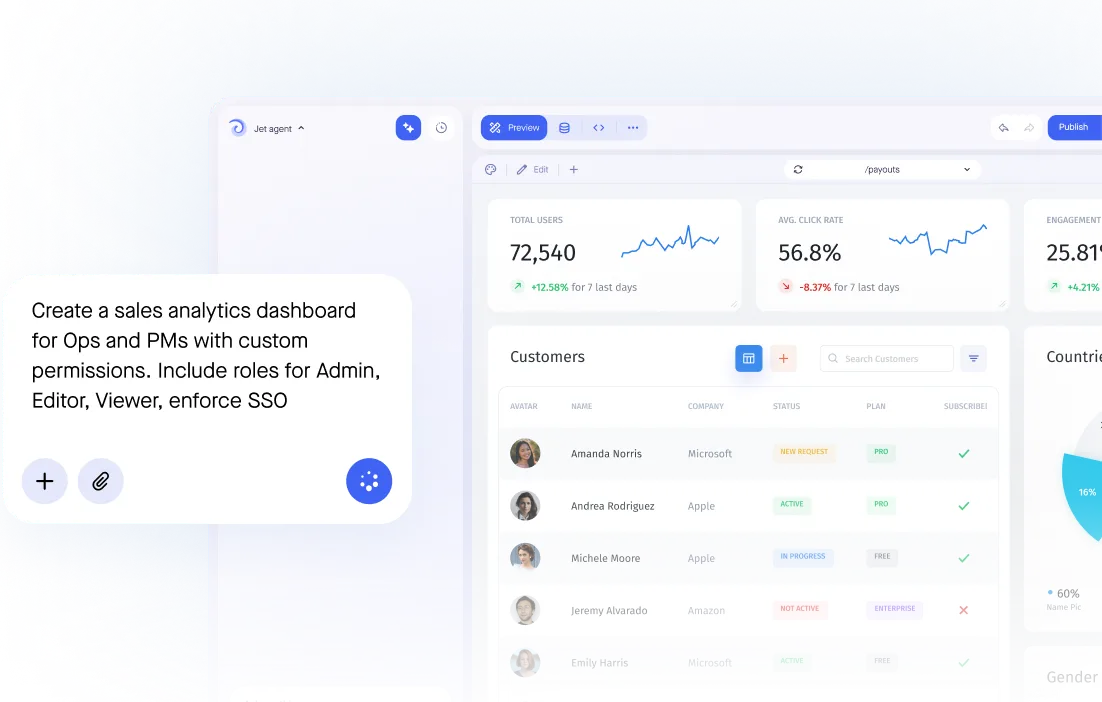
With Jet Admin, you can generate a working CRM app using AI prompts that describe your sales process, then connect it to databases, spreadsheets, APIs, or business tools you already use. The result is a centralized system where your team can track leads, manage deals through every pipeline stage, log communications, and analyze sales performance-all without writing code.
The core benefit is straightforward: you transform scattered customer data, disconnected follow ups, and manual tracking into a single, automated platform your entire team can rely on. Unlike rigid off-the-shelf solutions, this template bends to fit your workflows, not the other way around.
Strong CRM templates help answer key questions about customers and sales processes-who your best leads are, where deals stall, which reps are closing more deals, and what your revenue forecast looks like next quarter. This page covers exactly what this sales CRM template includes, who it's built for, and how to set it up.
Here's what you'll gain from this template:
- A centralized contact database replacing fragmented spreadsheets and scattered notes
- Visual sales pipeline tracking with customizable stages matching your actual sales funnel
- Automated follow-up reminders and task assignments that reduce manual data entry
- Dashboards and reporting that let you identify trends and make data driven decisions
- Role-based user permissions so every team member sees exactly what they need
Why use this CRM template
Sales teams lose time to problems that compound quietly. Customer information lives in one spreadsheet, deal notes in another, and follow up emails get buried in individual inboxes. The average sales rep spends only about 28% of their time actually selling-the rest goes to data entry, searching for contact details, and administrative work. A CRM template directly attacks these inefficiencies.
Scattered lead data creates blind spots. When new leads arrive from your website, marketing campaigns, cold outreach, and referrals, they end up in different places. This template consolidates every lead source into a single system, so nothing falls through the cracks. CRM templates help track leads and manage customer relationships from a centralized location rather than across disconnected tools.
Manual follow-ups get missed. Templates can include sections for notes and follow-up actions, but more importantly, this CRM template automates routine tasks-saving team time for more strategic activities like building customer relationships and closing deals. Instead of remembering to check a spreadsheet, your team gets automated reminders tied to each pipeline stage.
Sales visibility disappears without structure. Managers can't coach what they can't see. Dashboards in CRM templates provide real-time sales performance insights, showing exactly where deals sit, which reps need support, and whether the team is on track for quarterly targets. This kind of visibility supports accurate sales forecasting and performance tracking that a CRM spreadsheet template simply can't deliver at scale.
Collaboration breaks down across roles. Using CRM templates can streamline communication with customers and across your team. When every rep, manager, and executive works from the same system-with appropriate permissions-everyone stays team aligned on deal status, next steps, and customer engagement history.
Effective CRM templates include sections for contact management and sales pipelines, and this template goes further by connecting to your existing data sources with two-way sync. That means you're not copying data into yet another tool-you're working with live information from your actual databases, whether that's PostgreSQL, MySQL, Google Sheets, or REST APIs.
Templates serve as a cost-effective alternative to full-scale CRM software, especially for companies that need flexibility without the steep learning curve or price tag of enterprise platforms.
Template features:
Sales Pipeline Dashboard
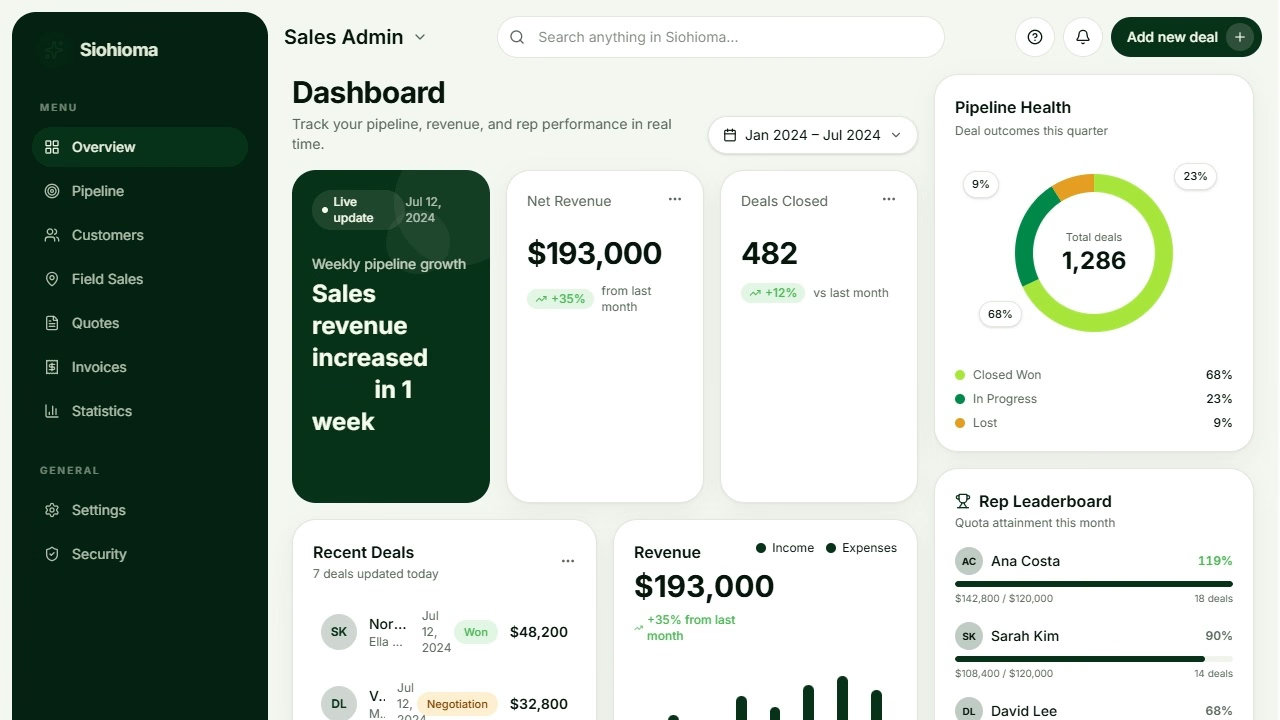
A visual dashboard gives your team a quick overview of every deal in motion. You can customize pipeline stages-from lead capture through qualification, proposal, negotiation, to closed won or lost-to match your actual sales process. Drag deals between stages, monitor deal velocity, and spot bottlenecks before they cost you revenue. Sales pipeline tracking is a common feature in CRM templates, but here it's backed by live data visualization rather than static cells.
Lead Management System
Comprehensive lead tracking starts at capture. Import leads from forms, spreadsheets, or third-party tools, then score and qualify them based on criteria you define. Every lead includes its lead source, qualification status, and assigned rep. You can track opportunities from first touch through conversion, ensuring faster lead qualification and fewer missed prospects. A good CRM template should include sections for notes and interactions at every stage of the lead lifecycle.
Contact Database
Contact management centralizes customer information including names, emails, phone numbers, company details, and every interaction your team has had. This contacts page replaces the scattered contact list problem-instead of hunting through email threads or Excel files, reps search a single, organized database. CRM templates provide a standardized layout for customer data, and this one supports custom fields so you can capture whatever matters to your business.
Deal Tracking
Every deal gets its own record with revenue value, close date, probability, and current status. Track deal progression through each pipeline stage, monitor win/loss patterns, and build revenue forecasts based on actual pipeline data. This goes well beyond what a simple CRM excel template can offer-you can automate workflows triggered by deal stage changes and analyze historical performance to refine your sales strategy.
Activity Automation
Set up automated follow-up reminders, task assignments, and notifications triggered by deal stages, time intervals, or specific events. When a deal moves to "Proposal Sent," the system can automatically schedule a follow-up task three days later. Automating routine tasks saves team time for more strategic activities-like actually talking to customers. CRM templates should facilitate consistent follow-ups and track sales progress without relying on memory.
Sales Reporting
Performance dashboards show conversion rates by stage, revenue trends over time, rep productivity metrics, average deal size, and marketing performance attribution. These aren't static charts-they update as your data changes, letting you analyze sales performance in real time and make adjustments to your sales funnel. You can identify trends across time periods, segments, or team members to refine where effort gets invested.
Communication Logs
CRM templates can integrate with email platforms for logging conversations, and this template supports tracking every email, call, and meeting against the relevant contact or deal record. Searchable notes mean any team member can pick up a relationship where a colleague left off. A good CRM template includes sections for notes and interactions that build a complete picture of every customer engagement.
Role-Based Access
Customizable user permissions let you control exactly who sees and edits what. Sales reps might access only their own leads, while managers get full visibility across the team. Executives see high-level dashboards and forecasts. This kind of governance-including authentication, roles, and access control-is critical as your team grows and handles sensitive customer data.
Who is this CRM template for?
- Sales teams needing centralized pipeline management. If your reps are toggling between spreadsheets, email, and sticky notes to track deals, this template replaces that chaos with a single system. Sales teams represent 82% of CRM users for good reason-pipeline tracking and deal management are the foundation of consistent revenue.
- Small business teams outgrowing spreadsheets. Templates are beneficial for small businesses or startups before investing in full CRM systems, and many start with a CRM spreadsheet template in Excel or Google Sheets. But spreadsheets become hard to manage as sales grow-no automation, limited collaboration, and manual data entry in templates increases the risk of errors. This template bridges the gap between a simple spreadsheet and a dedicated CRM platform.
- Operations and revenue managers wanting visibility. If you need to track leads across reps, forecast revenue accurately, or identify where deals stall, this template delivers dashboards and analytics that a free CRM template in Excel can't match. Account management, project management oversight, and cross-team reporting all become manageable.
- Business development representatives tracking qualification. BDRs who handle high volumes of new leads need fast lead tracking, scoring, and handoff workflows. This template structures that process so qualified leads move to the right reps at the right time, with full context attached.
- Growing companies needing scalable CRM infrastructure. CRM templates lack scalability for growing businesses-but this one connects to production databases and APIs, so it scales with your data volume and user count. As your business needs evolve, you can add custom fields, new pipeline stages, custom views, and additional automation without starting over.
- Teams requiring mobile and multi-channel access. Templates do not support mobile access for teams on the go in most spreadsheet-based setups. Building your CRM as an app through Jet Admin means your team can manage customer relationships from any device, wherever they work.
How to set up your CRM template
Getting from template to working CRM takes minutes, not weeks. Here's the process:
- Generate your CRM app with AI. Start with the sales CRM template and use AI prompts to describe your sales process-your pipeline stages, the types of deals you track, and what data matters most. Jet Admin generates a working application structure based on your description.
- Connect your existing data sources. Link your current databases, spreadsheets, or business apps. Jet Admin supports PostgreSQL, MySQL, BigQuery, SQLite, REST/GraphQL APIs, Google Sheets, and more with two-way sync. Your existing data populates the CRM immediately-no manual re-entry required.
- Map your fields to the template structure. Ensure your data fields (Company Name, Lead Source, Deal Value, Close Date, Status) align with the template's structure. CRM templates should standardize data entry to prevent errors and facilitate analysis, so this step is critical. Clean up duplicates and normalize formats before going live.
- Customize pipeline stages and deal statuses. Templates can be customized to fit specific sales processes and needs. Adjust the default stages to match your actual sales funnel-whether that's a three-stage process or a ten-stage enterprise cycle. Add custom fields for data points unique to your business.
- Configure user roles and permissions. Define who can view, edit, and manage which records. Set up authentication and assign roles for reps, managers, and executives. A good CRM template must integrate seamlessly with existing business tools and team structures.
- Set up automation rules. Configure automated follow-up reminders, task assignments, and notifications. Define triggers based on deal stage changes, time thresholds, or specific events. This is where you eliminate the manual work that slows your team down.
- Test with sample data and refine. Run through realistic scenarios-creating leads, moving deals through stages, logging interactions, checking dashboards. Verify that permissions work correctly and that reports show meaningful data.
- Deploy and train your team. Publish the CRM app and walk your sales team through the interface. Start with core functionality-lead capture, deal pipeline, contact logging-then expand to more advanced reporting and automation as the team gets comfortable.
Start building your Sales CRM now →
Frequently asked questions
What does the CRM template include and what business processes does it cover? A CRM template organizes and tracks customer interactions and sales pipelines. This template includes lead management, a contact database with interaction history, deal tracking with revenue forecasting, a visual sales pipeline dashboard, activity automation, sales reporting, communication logs, and role-based access. It covers the full lifecycle from lead capture through deal close and ongoing customer support cases.
Can I customize the sales stages and fields to match my specific sales process? Yes. You can add, remove, or rename pipeline stages to reflect your actual sales funnel. You can also add custom fields for any data your business tracks-industry, deal type, lead source, product interest, or anything else. The template adapts to your unique business rather than forcing you into a generic structure. Many CRM templates offer basic customization, but this one lets you modify both the data model and the interface.
Which data sources can I connect to populate the CRM with existing customer information? Jet Admin supports connections to PostgreSQL, MySQL, BigQuery, SQLite, REST and GraphQL APIs, Google Sheets, and other business applications. Data syncs in both directions, so changes in your CRM reflect in the source system and vice versa. You can create a basic CRM template using Excel or Google Sheets as a starting point, then connect more robust databases as you scale.
Do I need coding knowledge to set up and customize this CRM template? No coding is required. Jet Admin is a no-code app builder-you configure the interface, data connections, workflows, and permissions through a visual builder. If you want more advanced customization, you can augment with JavaScript, but it's entirely optional. This makes it accessible to operations teams, sales managers, and business analysts without engineering support.
How does this template handle sales team collaboration and permissions? Role-based access control lets you define what each user or role can see and do. Sales reps can be restricted to their own leads and deals, managers can view team-wide data, and executives can access high-level dashboards and forecasts. CRM templates often lack advanced reporting features and governance-this one includes both, with authentication, role assignment, and data-level permissions built in.
Can the template scale as my business grows and I add more users? Because the template connects to production databases and APIs rather than storing data in a flat file, it handles growing data volumes and user counts without the limitations of a simple CRM template in a spreadsheet. You can add new pipeline stages, reporting views, automation rules, and user roles as your organization evolves. About 91% of companies with more than 10 employees use a CRM system-this template is designed to grow with you from early adoption through scale.
How quickly can I get started with this template? Most teams go from template to working CRM in under an hour. The AI-powered setup generates your initial app structure, connecting your data sources takes minutes, and customization happens through drag-and-drop configuration. Compare that to weeks of implementation time with enterprise CRM platforms, and the time-to-value difference is significant. Mobile accessibility for CRM templates allows managing relationships on the go from day one.

.svg)


Use Cases
Categories
Features
Similar templates




Connect & sync your data with 30+ data sourse’s


Build frontend Apps 10x faster


Frequently asked questions
Most teams go from template to working CRM in under an hour. The AI-powered setup generates your initial app structure, connecting your data sources takes minutes, and customization happens through drag-and-drop configuration. Compare that to weeks of implementation time with enterprise CRM platforms, and the time-to-value difference is significant. Mobile accessibility for CRM templates allows managing relationships on the go from day one.
Because the template connects to production databases and APIs rather than storing data in a flat file, it handles growing data volumes and user counts without the limitations of a simple CRM template in a spreadsheet. You can add new pipeline stages, reporting views, automation rules, and user roles as your organization evolves. About 91% of companies with more than 10 employees use a CRM system-this template is designed to grow with you from early adoption through scale.
Role-based access control lets you define what each user or role can see and do. Sales reps can be restricted to their own leads and deals, managers can view team-wide data, and executives can access high-level dashboards and forecasts. CRM templates often lack advanced reporting features and governance-this one includes both, with authentication, role assignment, and data-level permissions built in.
No coding is required. Jet Admin is a no-code app builder-you configure the interface, data connections, workflows, and permissions through a visual builder. If you want more advanced customization, you can augment with JavaScript, but it's entirely optional. This makes it accessible to operations teams, sales managers, and business analysts without engineering support.
Jet Admin supports connections to PostgreSQL, MySQL, BigQuery, SQLite, REST and GraphQL APIs, Google Sheets, and other business applications. Data syncs in both directions, so changes in your CRM reflect in the source system and vice versa. You can create a basic CRM template using Excel or Google Sheets as a starting point, then connect more robust databases as you scale.
Yes. You can add, remove, or rename pipeline stages to reflect your actual sales funnel. You can also add custom fields for any data your business tracks-industry, deal type, lead source, product interest, or anything else. The template adapts to your unique business rather than forcing you into a generic structure. Many CRM templates offer basic customization, but this one lets you modify both the data model and the interface.
A CRM template organizes and tracks customer interactions and sales pipelines. This template includes lead management, a contact database with interaction history, deal tracking with revenue forecasting, a visual sales pipeline dashboard, activity automation, sales reporting, communication logs, and role-based access. It covers the full lifecycle from lead capture through deal close and ongoing customer support cases.