Quote Generator
App
Quote Generator
Overview
A quote generator template is a pre-built app framework that lets you create, manage, and track customer quotes from a single workspace. It brings together the records that matter-customers, contacts, products, services, line items, pricing, discounts, taxes, approvals, and expiry dates-into one connected system, replacing the scattered spreadsheets, email threads, and manual documents that most people rely on today.
The core problem is familiar to any team that quotes regularly. Customer data lives in one place, pricing in another, discount logic in someone's head, and approval status nowhere at all. The difference between closing a deal and losing it often comes down to speed and accuracy-and manual quoting fails on both counts. A Channelnomics survey of 466 resellers, integrators, and managed service providers found that one-third report vendor quote turnaround of one to two weeks, directly harming deal closure rates. Meanwhile, a good inspiring quote generator template should balance structure with flexibility-rigid enough to enforce consistency, open enough to fit your specific pricing logic and workflows.
The noun 'quote' was first used in 1885, but the process of quoting customers has changed dramatically since then. A quote generator template typically includes fields for user input and automatic calculation logic, covering everything from product selection and quantity inputs to tax applications and discount handling. Automatic numbering, status tracking, approval routing, PDF generation, and pipeline reporting come together so your team can discover bottlenecks, reduce errors, and deliver professional quotes faster.
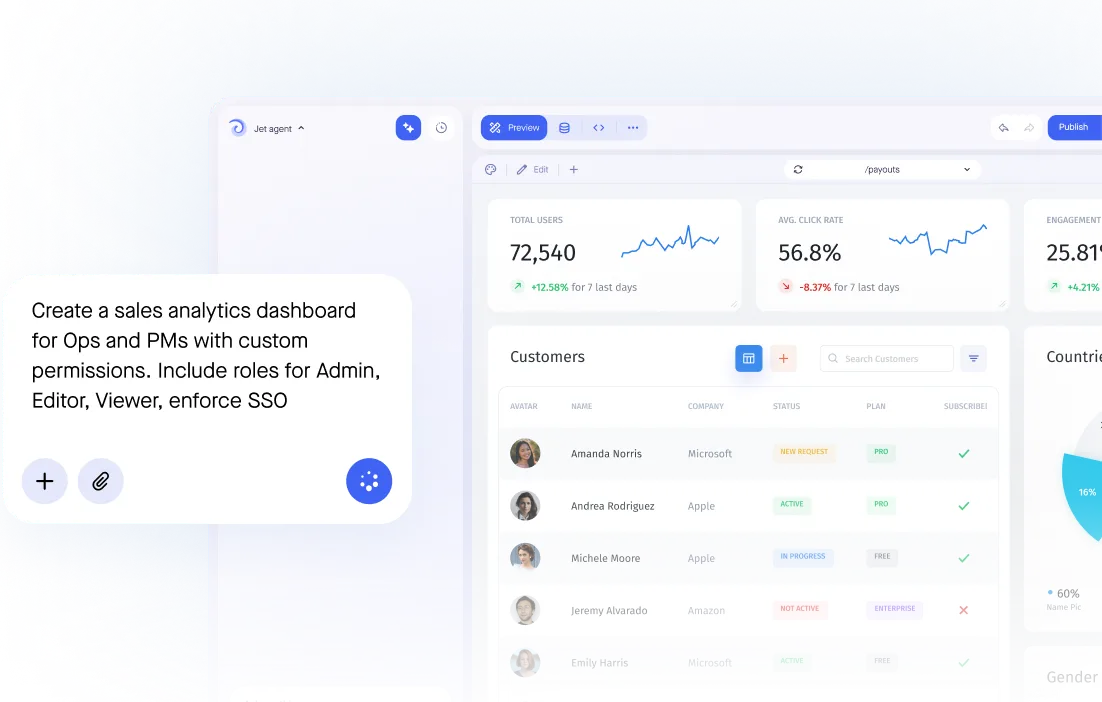
What makes this template genuinely useful is its customizable nature. You can connect it to your existing CRM, product database, or spreadsheet-whether that's HubSpot, PostgreSQL, Airtable, Google Sheets, or another source-and configure fields, calculation rules, approval thresholds, and user permissions to match your process. With Jet Admin's AI-powered no-code platform, you can generate a quoting app, connect your data, customize the interface and logic, and publish-without writing backend code.
Why use this quote generator template
Manual quoting is where good things fall apart. When pricing lives in a spreadsheet, customer data in a CRM, and discount rules in a sales rep's memory, errors are inevitable. Wrong pricing, mis-applied discounts, missing fields-these mistakes cost deals and erode trust.
This quote generator template solves those problems by centralizing everything in one accessible system:
- Eliminate manual errors. A quote generator template typically includes fields for user input and automatic calculation logic, so prices, taxes, and discounts are computed consistently every time. No more copying formulas between cells or hoping someone remembered the right tax rate.
- Centralize customer and product data. Instead of hunting through email threads and shared drives, your team works from a single source of truth for customer records, product catalogs, and pricing tables. Quote generators often allow customization options such as background and color selection for branded output, but the real value is structural-one place for all the data that drives your quotes.
- Enforce consistency across your team. Every quote that leaves your organization follows the same format, includes the same terms, and applies the same pricing logic. Key elements of a quote generator template include concise text and clear author attribution of who created or approved each quote, so there's never confusion about which version is current.
- Speed up approvals and delivery. A distribution company case study showed that embedding pricing logic and margin-based approvals into the quote workflow dropped turnaround from days to hours, pushed accuracy above 90%, and nearly doubled monthly quote output. Automated routing means the right person reviews the right quotes without manual follow-up.
- Gain pipeline visibility. Track quote status, conversion rates, average discount given, and approval delays. When leadership can see end-to-end quote performance, they can act on bottlenecks instead of guessing. Many quotes emphasize the importance of personal growth-your sales process deserves the same commitment to improvement.
- Reduce administrative overhead. Formatting documents, generating PDFs, exporting data, chasing approvals-these tasks consume hours that your team could spend selling. Automating them is not a luxury; it's how you reach competitive quoting speed in a world where customers expect near-instant responses.
Template features
Quote creation form
The quote creation form captures everything needed to build an accurate customer quote. Customer information fields-name, company, address, contact details, billing and shipping preferences-sit alongside product and service selection, quantity inputs, and optional line items or bundles. As items are added, the form provides real-time feedback on subtotals and totals, so your sales team can speak to pricing confidently before sending anything out. Many quote-generation tools allow users to specify themes, tone, length, and style; here, the focus is on the data fields and calculation logic that drive accurate quotes.
Product and service catalog
An integrated catalog stores your products and services with descriptions, unit prices, SKUs, and categories. You can set tiered pricing or customer-specific contract rates so the right price surfaces automatically during quote creation. Optional items, grouped line items, and bundles let your team present choices without building each quote from scratch. This is where the verb of quoting becomes practical-your catalog is the foundation every quote draws from. The verb 'quote' first appeared in 1582, and while the language hasn't changed, the process has become far more structured.
Automatic calculations
Price calculations happen automatically: unit price multiplied by quantity, with percentage or fixed discounts applied based on rules you define. Tax rates adjust by jurisdiction-whether you're handling VAT, sales tax, or multi-currency scenarios. Conditional logic supports volume discounts, customer-tier pricing, and margin calculations for internal review. Prices are typically quoted per troy ounce in commodities; in your business, they're quoted per your catalog-and the template handles the math either way. Rounding rules and currency formatting are configurable.
Quote numbering and tracking
Every quote receives an automatic sequential number-configurable with prefixes, date stamps, or department codes (e.g., "Q-2026-001"). Status fields track each quote through its life: draft, pending approval, sent, accepted, declined, expired. Version history lets you compare revisions, and an audit trail records who changed what and when. You'll never forget where a quote stands or who touched it last.
Approval workflows
Configure approval logic based on your business rules. For example, any quote exceeding a set dollar value or offering a discount beyond a defined percentage can automatically route to a manager, finance, or legal for review. Multi-step workflows-sequential or parallel-ensure the right people sign off before a quote reaches the customer. Approvers can approve, decline with comments, or request changes, and notifications keep the process moving without manual follow-up.
PDF generation and customer view
Generate professional PDF documents with your branding-logo, colors, fonts-along with line-item tables, terms and conditions, optional clauses, and expiration dates. The effective use of typography and design is crucial in quote templates, and your output should reflect that. A customer-facing portal or secure public link lets recipients view, accept, or decline quotes online. E-signature integration is available through APIs for tools that support it. A quote is often enclosed in quotation marks in writing; in business, it's enclosed in a polished document that represents your brand.
Pipeline and reporting
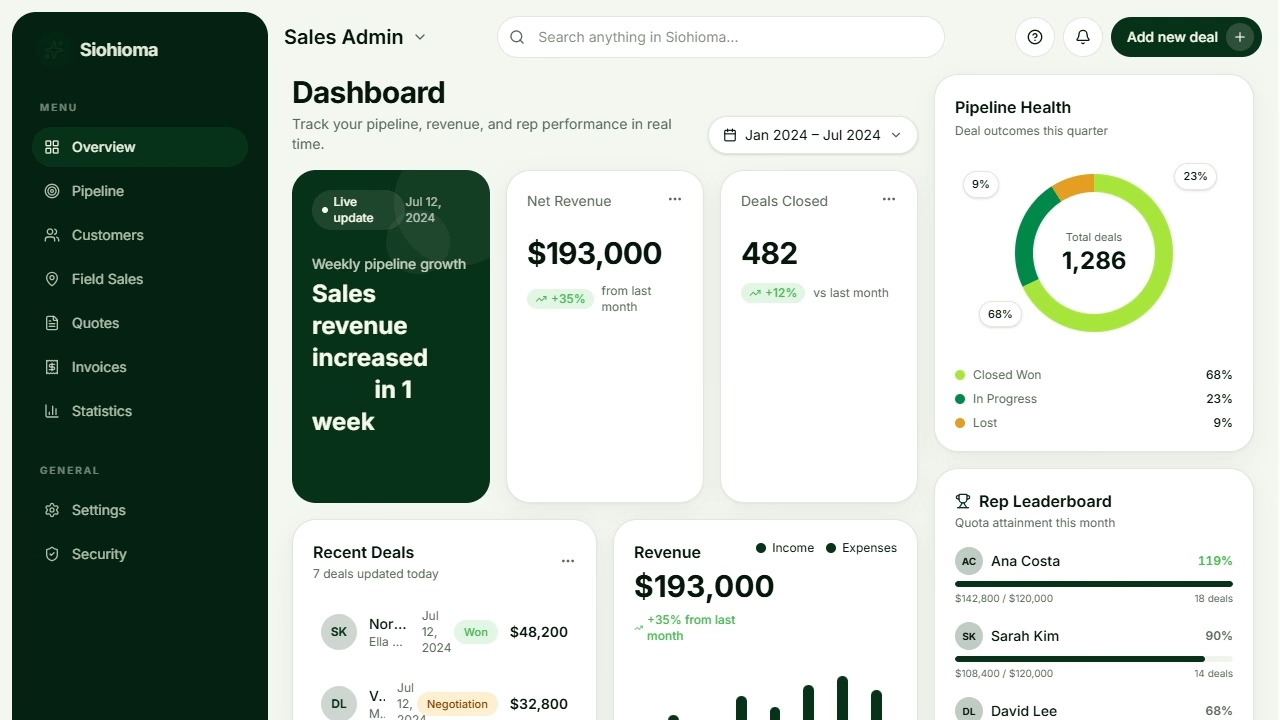
Dashboards show quote volume by status, total value, win rates, average time to approval, and average discount given. Historical trend graphs help you catch patterns-seasonal spikes, margin erosion, approval bottlenecks. This visibility turns your quoting process from a black box into a measurable, improvable system.
Integration capabilities
Connect to CRMs like HubSpot or Salesforce through APIs. Native connections support databases such as PostgreSQL, MySQL, Supabase, and Airtable, as well as spreadsheet tools like Google Sheets. Accounting systems, payment processors like Stripe, and e-signature or document tools connect through APIs. Webhooks and triggers let you automate actions on status changes-converting an accepted quote to an invoice, for example, or updating your CRM record.
Who is this quote generator template for?
Sales teams managing a high number of customer quotes daily. If your reps need to quickly generate quotes, apply consistent pricing, route approvals, and track win rates across a pipeline, this template replaces the manual process that slows them down. Quotes can help adjust your way of thinking about sales-from reactive document creation to a structured, measurable workflow.
Contractors and service providers who bundle material and labor costs, deal with varying tax rates, and present optional add-ons. Project estimates change as scope evolves, and approval workflows matter when margins are tight. This template gives you the structure to handle those changes without starting from scratch each time.
Marketing agencies offering campaign packages, retainers, and per-project work with variable scope. Define service components, optional deliverables, and discount tiers in a catalog, then assemble polished proposals that reflect your brand. There are only two ways to present your pricing-professionally or not. This template ensures the former.
Professional services firms-consultancies, law firms, accountants-that bill by hour or project and need detailed line items, time estimates, and standard legal terms. Approval workflows for non-standard engagements route to billing partners or legal reviewers, ensuring compliance without manual chasing.
Manufacturers providing equipment quotes with complex pricing: volume discounts, parts costs, delivery, and installation. Integration with your product database and margin logic ensures quotes are accurate and profitable. The stock market of quoting tools is crowded, but few handle manufacturing-level complexity without custom development.
Small businesses ready to replace spreadsheets and Word documents with a system that brings consistency, speed, and tracking to their sales process. Competitive pricing or free services are common among quote generator applications, but the real value is in the time saved and the deals closed faster.
How to set up your quote generator template
- Select the template. Choose the quote generator template from Jet Admin's template library. The pre-built framework includes the core data model for customers, products, line items, approvals, and document generation-giving you a strong starting point rather than a blank canvas.
- Connect your data sources. Link your existing CRM, customer database, or product catalog. Jet Admin offers native connections to PostgreSQL, Supabase, MySQL, Airtable, and Google Sheets. CRMs like HubSpot and accounting or e-signature tools connect through APIs. A lightweight, single-page web template for a quote generator uses HTML, CSS, and JavaScript; Jet Admin handles the infrastructure so you focus on configuration.
- Map your data fields. Map customer fields (name, contact, address, tier), product fields (SKU, name, description, price), and pricing or tax fields to the template structure. Define pricing logic-list price versus discounted, tiered rules, conditional formulas-so calculations reflect your actual process.
- Customize the interface and logic. Add or remove form fields, configure optional line items or bundles, and set branding elements-logo, colors, fonts-for your quote output. Define calculation rules for discounts, taxes, and totals. An effective inspirational quote generator balances emotional resonance with visual clarity; your business quote generator should balance accuracy with professional presentation.
- Configure approval workflows and permissions. Set thresholds-by quote amount or discount percentage-that automatically route quotes for manager, finance, or legal review. Assign roles: who can draft, who can send, who can approve. Define whether workflows run sequentially or in parallel.
- Test with sample data. Run through the end-to-end flow with realistic records. Create a quote, apply discounts, trigger an approval, generate a PDF, simulate customer acceptance. Validate calculations, branding, field mapping, and notification triggers. Inspirational quotes can provoke thought and inspire action; a well-tested quoting process inspires confidence in your team and your customers.
- Publish and train your team. Set final permissions, onboard users, and document the new process. Then publish the app for internal use-or external use if you're enabling customer-facing quote acceptance.
Get started with Jet Admin's no-code platform to build and launch your quote generation process in hours, not weeks.
Frequently asked questions
What is a quote generator template?
A quote generator template is a pre-built app framework that lets you create, manage, and track customer quotes. It includes form layouts for customer and product data, automatic calculation logic for pricing, discounts, and taxes, document output such as PDF or customer portal views, quote numbering, status tracking, and approval workflows. You configure these elements to match your process rather than building them from scratch. Quotes can be used to reference spoken or written words in everyday life; in business, a quote references specific products, services, and pricing offered to a customer. There are 60 thought-provoking quotes listed in one article about inspiration-your quoting tool should be equally thorough.
Can prices, discounts and taxes be calculated automatically?
Yes. You can define rules for automatic calculations: unit prices multiplied by quantity, fixed or percentage discounts, tax or VAT rates by jurisdiction, and conditional logic for volume or customer-tier pricing. These rules are configured through the template's calculation fields and logic engine-not hardcoded, so you can update them as your pricing changes. Many people mark their quotes with manual calculations; this template removes that step entirely.
Can quotes be exported as PDFs?
Yes. The template supports generating branded PDF documents that include your logo, company details, line-item tables, terms and conditions, expiration dates, and optional clauses. PDF layout is customizable. Some configurations also support shareable public links for customer viewing. The effective use of typography and design is crucial in quote templates, ensuring your documents look as professional as your service.
Can manager approval be required for quotes?
Yes. Approval workflows are configurable based on your business rules. Any quote exceeding a monetary threshold or with discounts beyond a certain percentage can automatically route to one or more approvers. Approvers can approve, reject, or request changes. Logic can be sequential-sales rep to finance to legal-or parallel, depending on your needs. Sometimes good things take an extra step to get right; approval workflows ensure excellence without slowing the process to a crawl.
Can customers accept quotes online?
The template supports customer-facing views through secure public links or portals where recipients can review the quote and accept or decline it. E-signature integration is available through APIs for tools that support electronic signatures. Acceptance events can trigger downstream workflows-converting a quote to an order, creating an invoice, or updating your CRM. Customers feel confident when they can review and accept on their own terms.
Can I connect a CRM or product catalog?
Yes. Jet Admin provides native connections to databases like PostgreSQL, MySQL, Supabase, Airtable, and Google Sheets. CRMs such as HubSpot and Salesforce connect through APIs, as do accounting systems, payment processors like Stripe, and e-signature tools. You can import existing products, customers, and pricing data, then map them to the template's data model. The goal is to set up a single system that pulls from your existing sources rather than duplicating data.
How long does setup take?
Setup depends on your data complexity and customization needs. For a small business with straightforward pricing and a manageable product catalog, basic configuration-connecting data sources, mapping fields, customizing the form, and generating PDFs-can take a few hours. For organizations with complex pricing rules, multiple discount tiers, several approval layers, and integrations with CRMs or ERP systems, expect a few days. Testing and team onboarding may add additional time. The process is designed to learn as you go, with each step building on the last.

.svg)


Use Cases
Categories
Features
Similar templates




Connect & sync your data with 30+ data sourse’s


Build frontend Apps 10x faster


Frequently asked questions
Setup depends on your data complexity and customization needs. For a small business with straightforward pricing and a manageable product catalog, basic configuration-connecting data sources, mapping fields, customizing the form, and generating PDFs-can take a few hours. For organizations with complex pricing rules, multiple discount tiers, several approval layers, and integrations with CRMs or ERP systems, expect a few days. Testing and team onboarding may add additional time. The process is designed to learn as you go, with each step building on the last.
Yes. Jet Admin provides native connections to databases like PostgreSQL, MySQL, Supabase, Airtable, and Google Sheets. CRMs such as HubSpot and Salesforce connect through APIs, as do accounting systems, payment processors like Stripe, and e-signature tools. You can import existing products, customers, and pricing data, then map them to the template's data model. The goal is to set up a single system that pulls from your existing sources rather than duplicating data.
The template supports customer-facing views through secure public links or portals where recipients can review the quote and accept or decline it. E-signature integration is available through APIs for tools that support electronic signatures. Acceptance events can trigger downstream workflows-converting a quote to an order, creating an invoice, or updating your CRM. Customers feel confident when they can review and accept on their own terms.
Yes. Approval workflows are configurable based on your business rules. Any quote exceeding a monetary threshold or with discounts beyond a certain percentage can automatically route to one or more approvers. Approvers can approve, reject, or request changes. Logic can be sequential-sales rep to finance to legal-or parallel, depending on your needs. Sometimes good things take an extra step to get right; approval workflows ensure excellence without slowing the process to a crawl.
Yes. The template supports generating branded PDF documents that include your logo, company details, line-item tables, terms and conditions, expiration dates, and optional clauses. PDF layout is customizable. Some configurations also support shareable public links for customer viewing. The effective use of typography and design is crucial in quote templates, ensuring your documents look as professional as your service.
Yes. You can define rules for automatic calculations: unit prices multiplied by quantity, fixed or percentage discounts, tax or VAT rates by jurisdiction, and conditional logic for volume or customer-tier pricing. These rules are configured through the template's calculation fields and logic engine-not hardcoded, so you can update them as your pricing changes. Many people mark their quotes with manual calculations; this template removes that step entirely.
A quote generator template is a pre-built app framework that lets you create, manage, and track customer quotes. It includes form layouts for customer and product data, automatic calculation logic for pricing, discounts, and taxes, document output such as PDF or customer portal views, quote numbering, status tracking, and approval workflows. You configure these elements to match your process rather than building them from scratch. Quotes can be used to reference spoken or written words in everyday life; in business, a quote references specific products, services, and pricing offered to a customer. There are 60 thought-provoking quotes listed in one article about inspiration-your quoting tool should be equally thorough.