Marketing Campaign
App
Marketing Campaign
Overview
A marketing campaign template is a structured framework that captures every moving part of your campaigns - goals, target audience, channels, creative assets, timelines, budgets, and KPIs - in one workspace instead of scattered across spreadsheets, docs, and email threads. A marketing campaign promotes a specific message and goal, and without a centralized system, marketing teams lose hours chasing updates, reconciling data, and managing approvals manually.
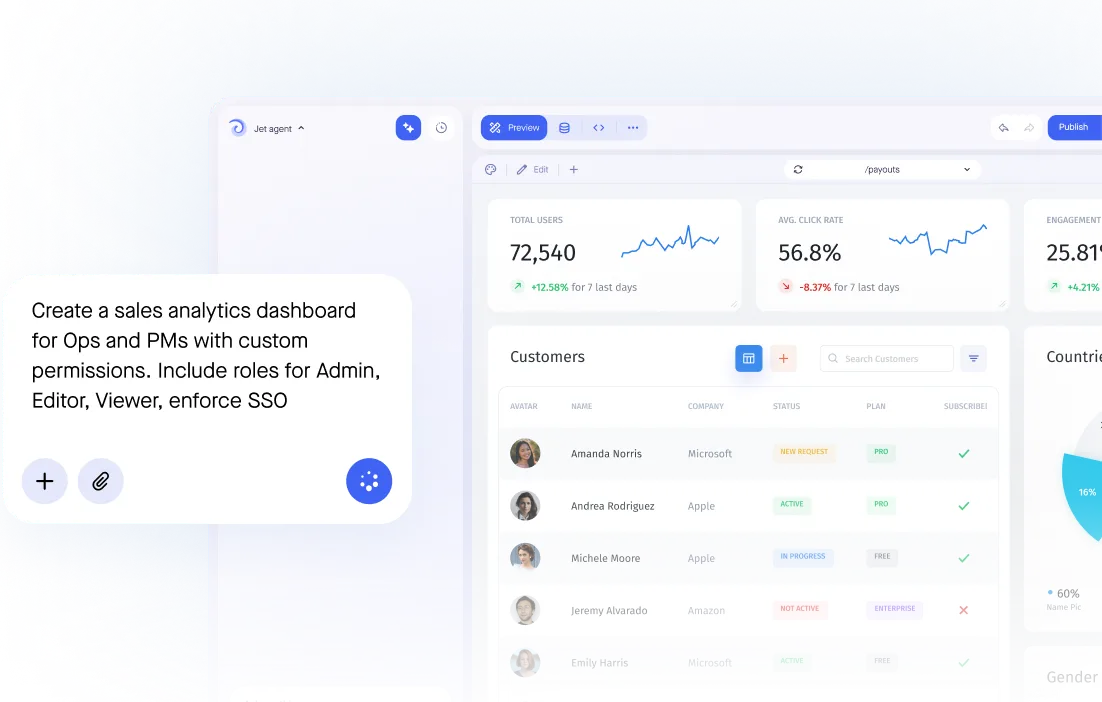
Jet Admin's AI-powered no-code app builder lets you generate a fully customized campaign management solution in minutes. Describe what you need, and the platform scaffolds a working app complete with dashboards, task tables, approval workflows, and KPI reporting - all connected to your existing data. Whether you manage a single channel campaign or coordinate complex marketing campaigns across paid media, email marketing, social media, and content creation, this campaign template gives you comprehensive campaign management without writing code.
The template manages campaigns, briefs, creative assets and files, tasks, owners and editors, budgets, start and end dates, approval stages, target audiences, KPIs and result metrics, and campaign status. You customize every field, view, and workflow to match how your team actually works.
A strong campaign template includes goals, audience, and budget - this one goes further by connecting live campaign data from your existing tools and automating the repetitive tasks that slow marketing teams down.
Ready to centralize your marketing efforts? Start building your campaign management app with Jet Admin today.
Why use this marketing campaign template
Most marketing teams run campaigns across multiple channels - paid media, email campaigns, social media, landing pages, content - and the campaign data ends up fragmented. Briefs live in Google Docs, assets sit in shared drives, tasks are tracked in one project management tool, budgets in a spreadsheet, and performance metrics in yet another platform. Effective campaigns require coordination across multiple channels, and that coordination breaks down when information is scattered.
This marketing campaign template solves that by centralizing everything into a single app.
Eliminate scattered campaign data. Instead of switching between five tools and digging through email threads, every campaign brief, asset, task, and KPI result lives in one workspace. Campaign trackers centralize goals, budgets, and performance data - so nothing falls through the cracks. Your team stops wasting time searching and starts focusing on campaign work that drives business outcomes.
Get real visibility into campaign progress. When campaign status, deadlines, and budget spend are visible on a single dashboard, managers can spot problems before they become expensive. Tracking progress across multi channel campaigns means you know exactly which assets are in review, which deadlines are approaching, and whether spend is on track - without asking anyone for an update.
Enforce consistent campaign planning processes. Templates help streamline workflows and simplify handoffs. When every campaign follows the same structure - defined goals, target audience analysis, messaging strategy, channel selection, timeline, and budget - quality stays high and nothing gets skipped. A marketing campaign template should include goals and audience, and this one makes those fields standard rather than optional.
Improve cross functional collaboration. Clear task assignments, approval workflows, and role-based views mean team members know exactly what they own. Content editors see their assigned campaigns. Managers see everything. Sales teams and stakeholders get the visibility they need without cluttering the workspace. Templates should define KPIs, CTAs, and success metrics so everyone is aligned on what success looks like.
Reduce manual steps with automation features. Automated workflows handle deadline reminders, approval notifications, and status transitions. Campaign management software can automate updates and notifications, which means fewer missed deadlines, fewer "just checking in" messages, and more time spent on marketing strategy. AI features can automate updates and improve campaign organization - Jet Admin's automation capabilities let you configure these without code.
Template features
Campaign Dashboard with Status Overview
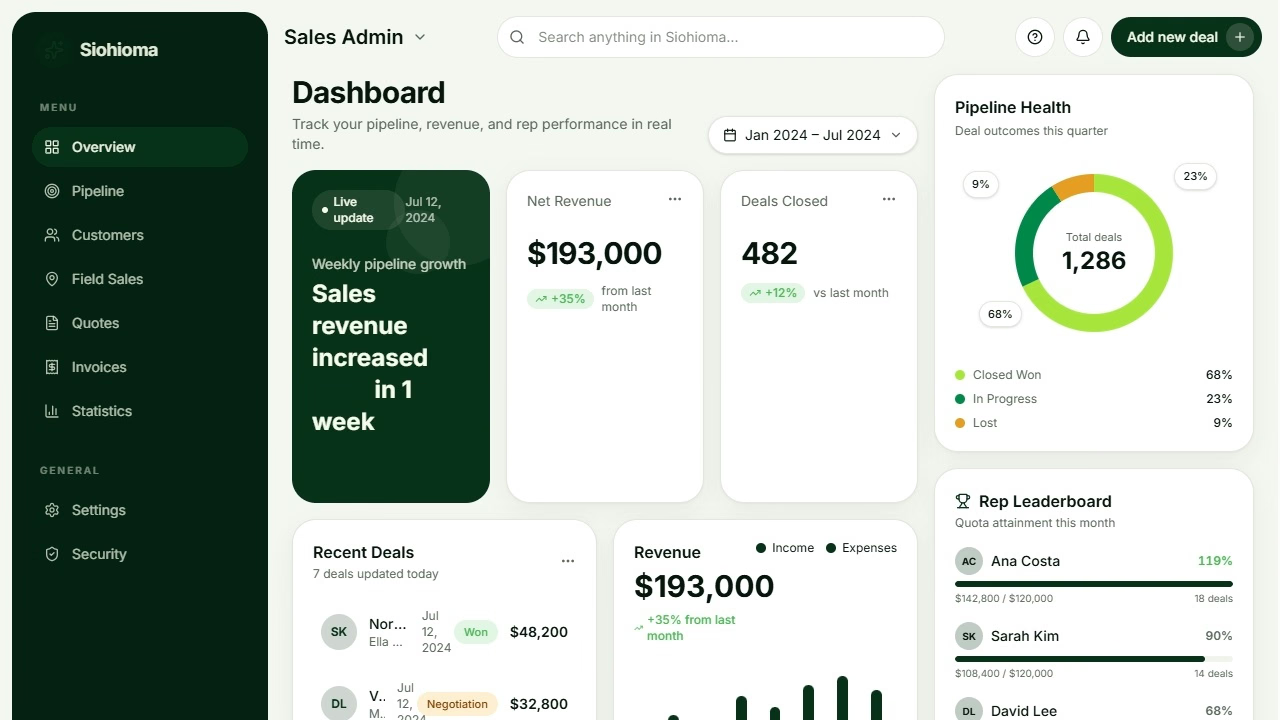
The campaign dashboard gives you a visual command center for all active marketing initiatives. See every campaign's status - planned, in production, live, completed - alongside key data like start and end dates, budget versus spend, and overall progress. Filter by marketing channels, campaign owner, or date range. Charts and KPI cards surface insights at a glance, so you can monitor progress across multiple campaigns without opening individual records.
Automated dashboards display budgeting, spending, and conversions, giving marketing managers the real-time visibility they need to align strategy and adjust tactics mid-flight.
Brief and Asset Management
Every marketing campaign starts with a brief. This template provides structured forms for campaign briefs - objective, target audience, messaging, channels, timeline, and campaign budget - ensuring consistency across all marketing activities. A strong template covers messaging, channels, timeline, and budget, and these fields are built into every campaign record.
Creative assets - images, ad copy, banners, videos - attach directly to campaigns. You can track assets through production stages (draft, in-review, approved), assign owners, and maintain version history through audit logs. No more digging through shared drives or losing the latest version in an email thread.
Task Assignment and Deadline Tracking
Break every campaign into concrete campaign tasks: "create Facebook ad creative," "write email copy," "schedule social media posts," "design landing pages." Assign tasks to specific team members with clear deadlines and ownership. Campaign management software helps teams plan and track campaigns, and task-level tracking ensures nothing slips.
Table views show all tasks with status, owner, and due date. Filter by campaign, assignee, or status to see what needs attention. This replaces the manual work of chasing updates and consolidating progress across disconnected project management tools.
Timeline and Calendar Views
Visualize project timelines and campaign scheduling with calendar and timeline views. See when campaign briefs are due, when assets enter review, when launches happen, and when post campaign analysis begins. A product launch campaign template typically involves pre-launch, launch, and post-launch phases - this calendar view makes those phases visual and trackable.
Content calendars help teams coordinate multi channel launches and avoid scheduling conflicts. Milestones mark critical dates so the entire team knows what's coming next.
Approval Workflow Management
A critical feature for any marketing team: configurable multi-stage approval workflows. Route assets through creative review, legal review, and final signoff with comments at each stage. When an asset is uploaded or its status changes to "needs review," automated workflow actions notify the designated reviewer. If rejected, feedback routes back to the creator with specific comments.
This eliminates the approval bottleneck that delays campaigns. Instead of emailing PDFs back and forth, reviewers approve or reject directly in the app, and everyone sees the current approval status in real time.
Budget and KPI Tracking
Track spend against allocated campaign budget by channel or asset type. Fields capture allocated budget, actual spend, forecasts, and variances - so you can track spend and catch overruns before they happen. The marketing mix identifies tactics and platforms to be used, and budget tracking ensures each tactic stays funded appropriately. Including risks and contingencies in a marketing plan prepares teams for potential obstacles, and budget variance alerts serve as an early warning system.
KPI reporting cards and charts display campaign performance metrics including CPM, CPC, conversions, and ROI. Connect data from HubSpot, Google Ads via REST API, or analytics tools to pull performance data directly into campaign records. Campaign performance is measured against documented plans - this template makes that measurement continuous rather than a post-mortem exercise. Key Performance Indicators for evaluating success include traffic and conversions, and the dashboard makes these visible at all times.
Role-Based Access Control
Not everyone needs to see everything. With role-based access, marketing managers see all campaigns and budgets while content editors access only their assigned work. Agencies managing client campaigns can separate campaign data so each client's team sees only their records - a capability that most campaign management tools lack.
Record-level filtering ensures editors working on Client A never see Client B's data. Audit logs track who changed what and when, providing the governance marketing departments and agencies need.
Automated Reminders and Notifications
Configure deadline alerts, approval notifications, and status-change triggers through Jet Admin's workflow builder. Scheduled reminders fire when deadlines approach or tasks become overdue. Approval requests automatically notify reviewers via email or Slack. If campaign budget burn exceeds a threshold you set, an alert goes to the campaign manager.
Effective tracking tools help keep campaigns data-driven and on track. These automation features replace the manual work of sending reminder emails and checking in on pending reviews - freeing your team to focus on content creation and marketing strategy.
Who is this marketing campaign template for?
Marketing managers coordinating multi-channel campaigns. You're running paid media, email marketing, social media, and content across multiple campaigns simultaneously. You need to manage campaigns from a single dashboard, track campaign performance across channels, and ensure deadlines are met without manually chasing every update. This template gives you the visibility and control to coordinate complex marketing campaigns and align strategy across your entire stack.
Growth teams at startups and scale-ups. Your team moves fast, experiments often, and needs to measure ROI channel by channel. Whether it's demand generation, sales outreach support, or content workflows, you need to organize campaigns, reuse campaign briefs, and pivot based on early performance metrics. Generating leads can involve creating lead magnets and early access offers - this template helps you plan those campaign steps and track results.
Campaign managers at agencies. You manage campaigns for multiple clients and need separated data, permissions, and reporting per client. Each client's editors should see only their campaigns, approval workflows should include client review stages, and reporting should filter by client. This template's data separation and role-based access solve the agency-specific challenges that generic campaign management solutions ignore.
Creative teams tracking asset production. Designers, copywriters, and video producers need to know what assets are due, receive feedback in context, track assets through production stages, and ensure everything is approved before launch. Successful post-launch strategies involve customer testimonials and retargeting ads - and the assets for those need tracking too. This template makes the brief-to-approval pipeline visible and manageable.
In-house marketing departments. Marketing directors overseeing content editors, channel managers, and campaign coordinators need standardized processes. This campaign management template enforces consistent campaign planning - from audience analysis and messaging strategy through execution and post campaign analysis. A post-campaign review helps capture lessons learned and recommendations for future campaigns, and this template supports that workflow.
B2B marketing teams running demand generation. Multi step campaigns spanning paid media, email campaigns, webinars, and content require tight coordination. You need to nurture leads across channels, assign tasks to cross-functional team members, and surface insights on what's working. A marketing campaign tracker centralizes content, spending, and conversions - exactly what this template delivers.
How to set up your marketing campaign template
Step 1: Select the marketing campaign template from Jet Admin's template library. Choose the marketing campaign template. Jet Admin's AI-powered builder scaffolds a working app with campaign records, asset tracking, task management, approval workflows, and KPI dashboards - giving you a functional starting point immediately.
Step 2: Connect your data sources. Link your existing data using native integrations - Google Sheets, Airtable, HubSpot, PostgreSQL, Supabase, MySQL, or BigQuery. For ad platforms like Google Ads or Meta, connect via REST API to pull in performance data. Jet Admin connects to 200+ data sources, so your campaign data stays where it lives while the app provides a unified view.
Step 3: Map your existing campaign data fields or use the pre-built structure. The template comes with fields for campaigns, channels, briefs, creative assets, tasks, owners, budgets, dates, approval stages, target audiences, KPIs, and status. Map these to your existing data columns, or use the default structure and start fresh. JavaScript and formula transformations handle budget calculations, date logic, and custom metric formatting.
Step 4: Customize the interface with your preferred views, forms, and dashboard layouts. Use drag and drop functionality to rearrange dashboard components, add or remove chart types, configure table columns, and set up calendar views. Build forms for brief creation and asset submission. Add filters for channels, dates, and campaign owners. The visual builder lets you tailor everything without code - matching your team's workflow rather than forcing a generic layout.
Step 5: Configure role-based permissions for managers, editors, and stakeholders. Define roles - Marketing Manager, Content Editor, Client Editor, Stakeholder - and set record-level permissions so each role sees only relevant data. Managers access all campaigns and budgets. Editors see only assigned campaigns. Agency clients see only their own data. This ensures data security and reduces noise for every user.
Step 6: Set up approval workflows and automated reminder notifications. Build approval workflows that route assets through review stages with notifications at each step. Configure scheduled reminders for upcoming deadlines and overdue tasks. Set up alerts when budget spend crosses defined thresholds. AI features in campaign management software enhance automation capabilities - and Jet Admin's workflow builder lets you define these triggers, conditions, and actions without writing code.
Step 7: Test the app with sample campaigns and publish for your team. Create sample campaign records, run through the approval workflow, verify that reminders fire correctly, and confirm that permissions work as expected. Once validated, publish the app and invite your team. Jet Admin supports responsive publishing, so your campaign management app works on desktop and mobile.
Ready to replace scattered spreadsheets with a real campaign management app? Start building with Jet Admin now.
Frequently asked questions
What is a marketing campaign template?
A marketing campaign template is a structured framework for organizing every element of campaign planning and execution - campaign goals, target audience, messaging, marketing channels, creative assets, timelines, campaign budget, task assignments, approval stages, and key performance indicators. It replaces ad hoc planning with a repeatable process that keeps marketing efforts consistent and trackable. The key elements of a marketing plan include audience analysis and messaging strategy, and a good template captures all of these.
Can I manage multiple channels and campaigns in one app?
Yes. The template supports multiple campaigns running simultaneously, each with its own channels, assets, tasks, and budgets. Filter and organize campaigns by status, channel, owner, or date range. Whether you're running a paid media campaign on Google Ads, an email marketing sequence, social media content, or multi channel launches, everything lives in one app. Effective campaign management requires tracking tools to centralize data across all marketing channels.
Can creative assets be attached to campaigns?
Yes. Upload files - images, videos, documents, ad copy - directly to campaign records. Each asset includes status tracking (draft, in-review, approved), owner assignment, and comments. This creates a centralized asset hub where team members can track assets from brief through final approval without losing files in email or shared drives.
Can I track budgets and KPI results?
Yes. Budget fields capture allocated amounts by channel or tactic, actual spend, and variances. KPI reporting cards and charts display performance metrics like conversions, CPC, ROAS, and leads generated. Connect analytics tools or ad platforms via REST API to pull live campaign analytics into your dashboard. Campaign management software can monitor performance across outreach platforms, and this template makes that monitoring visual and continuous.
Can agencies separate client campaign data?
Yes. Role-based access control and record-level filtering let agencies create client-specific views. Editors assigned to Client A see only Client A's campaigns, assets, and budgets. Managers and agency leads retain full visibility across all clients. This data separation is built into Jet Admin's permissions system - no workarounds needed.
Can approvals and deadline reminders be automated?
Yes. Configure automated workflows that trigger notifications when assets need review, approvals are pending, or deadlines are approaching. Set up multi-stage approval processes with conditional logic - if an asset is rejected, it routes back to the creator with feedback. Scheduled jobs can send daily or weekly digest reminders for overdue campaign tasks. These workflows eliminate the manual follow-up that slows campaign execution.
What data sources can I connect to my campaign management app?
Jet Admin natively connects to Google Sheets, Airtable, HubSpot, PostgreSQL, Supabase, MySQL, MongoDB, and BigQuery. For tools like Google Ads, Meta Ads, or Google Analytics, connect via REST or GraphQL API. You can also use webhooks and scheduled jobs to sync data from any platform that exposes an API. This means your campaign management app pulls from your entire stack - no manual CSV imports or copy-pasting between tools.
Data sources

.svg)


Use Cases
Categories
Features
Similar templates




Connect & sync your data with 30+ data sourse’s


Build frontend Apps 10x faster


Frequently asked questions
Jet Admin natively connects to Google Sheets, Airtable, HubSpot, PostgreSQL, Supabase, MySQL, MongoDB, and BigQuery. For tools like Google Ads, Meta Ads, or Google Analytics, connect via REST or GraphQL API. You can also use webhooks and scheduled jobs to sync data from any platform that exposes an API. This means your campaign management app pulls from your entire stack - no manual CSV imports or copy-pasting between tools.
Yes. Configure automated workflows that trigger notifications when assets need review, approvals are pending, or deadlines are approaching. Set up multi-stage approval processes with conditional logic - if an asset is rejected, it routes back to the creator with feedback. Scheduled jobs can send daily or weekly digest reminders for overdue campaign tasks. These workflows eliminate the manual follow-up that slows campaign execution.
Yes. Role-based access control and record-level filtering let agencies create client-specific views. Editors assigned to Client A see only Client A's campaigns, assets, and budgets. Managers and agency leads retain full visibility across all clients. This data separation is built into Jet Admin's permissions system - no workarounds needed.
Yes. Budget fields capture allocated amounts by channel or tactic, actual spend, and variances. KPI reporting cards and charts display performance metrics like conversions, CPC, ROAS, and leads generated. Connect analytics tools or ad platforms via REST API to pull live campaign analytics into your dashboard. Campaign management software can monitor performance across outreach platforms, and this template makes that monitoring visual and continuous.
Yes. Upload files - images, videos, documents, ad copy - directly to campaign records. Each asset includes status tracking (draft, in-review, approved), owner assignment, and comments. This creates a centralized asset hub where team members can track assets from brief through final approval without losing files in email or shared drives.
Yes. The template supports multiple campaigns running simultaneously, each with its own channels, assets, tasks, and budgets. Filter and organize campaigns by status, channel, owner, or date range. Whether you're running a paid media campaign on Google Ads, an email marketing sequence, social media content, or multi channel launches, everything lives in one app. Effective campaign management requires tracking tools to centralize data across all marketing channels.
A marketing campaign template is a structured framework for organizing every element of campaign planning and execution - campaign goals, target audience, messaging, marketing channels, creative assets, timelines, campaign budget, task assignments, approval stages, and key performance indicators. It replaces ad hoc planning with a repeatable process that keeps marketing efforts consistent and trackable. The key elements of a marketing plan include audience analysis and messaging strategy, and a good template captures all of these.