Equipment Tracker
App
Equipment Tracker
Overview
An equipment tracker template is a pre-configured application that gives your team a centralized system to register, assign, locate, maintain, and audit every piece of physical equipment your organization owns. Instead of scattered spreadsheets, paper logs, or guesswork, it defines the database structure, workflows, and user interfaces needed to manage assets from procurement through retirement-all in one place.
Manual equipment tracking creates predictable problems. Assets go missing because no one recorded who took them or where they went. Assignments are unclear, leading to duplicate purchases and idle resources. Maintenance gets missed when reminders live in someone's inbox or on a sticky note, and fragmented data across multiple files means no single source of truth exists. Equipment tracking templates can range from simple spreadsheets to detailed tracking systems, but basic spreadsheet templates are suitable only for small businesses with simple needs-they break down once you add multiple locations, frequent transfers, or audit requirements.
The core benefit of a centralized, real-time equipment management system is complete visibility: you see where every asset is, who has it, what condition it's in, and when maintenance is due. Real-time updates ensure accurate equipment tracking across your entire organization. Automated templates reduce manual errors in inventory management, and comprehensive asset management tracks equipment location and status without constant human intervention.
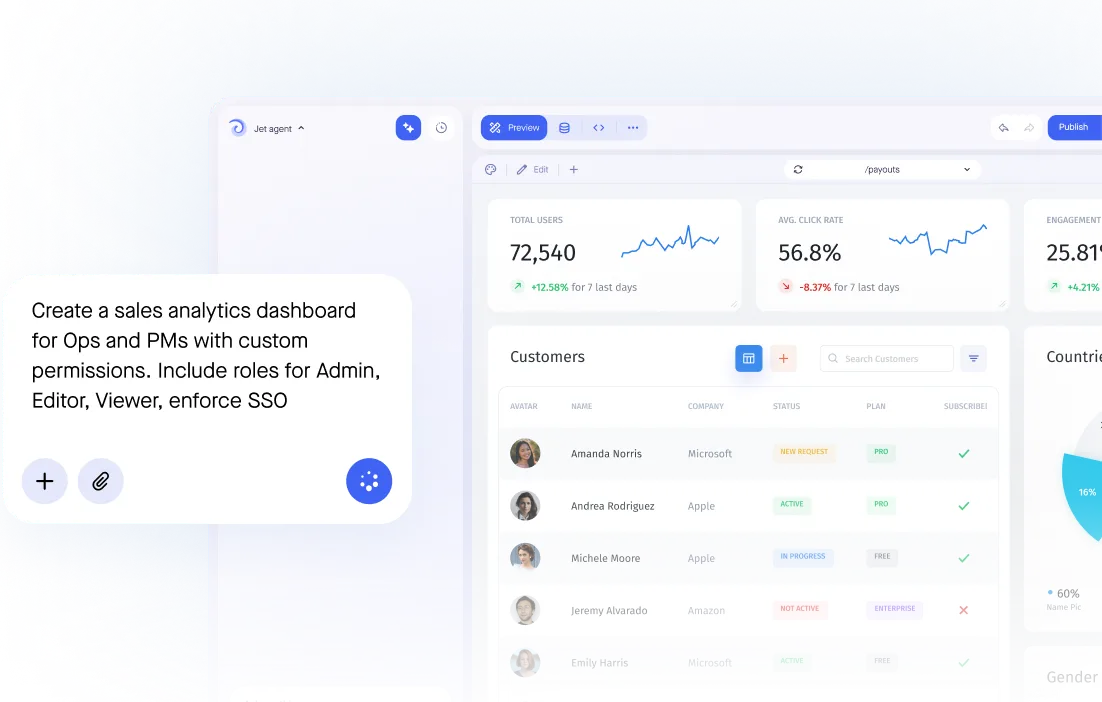
Jet Admin is an AI-powered no-code app builder that lets you generate a fully functional equipment tracking app from this template, connect your existing data sources, customize the interface and logic, and publish-without writing code. The platform supports native connections to PostgreSQL, MySQL, Airtable, Google Sheets, and Supabase, plus API-based integrations with ERP, inventory, and mapping systems. You can customize every field, workflow, permission, and dashboard to match your industry, team structure, and operational processes.
Start using Jet Admin's equipment tracker template today to replace scattered records with a centralized, real-time asset management app your whole team can rely on.
Why use this equipment tracker template
Every organization that manages physical assets faces the same friction: equipment disappears, nobody knows who has what, and maintenance falls through the cracks. This template addresses each of those pain points with specific, practical solutions.
- Eliminate equipment loss and unclear assignments. A centralized asset registry ties every piece of equipment to a custodian or location. Recording check-outs and check-ins immediately can prevent inventory blind spots. When an asset moves from one site to another, the transfer is logged with timestamps, responsible parties, and reasons-creating accountability that manual processes cannot match.
- Gain visibility into location and condition. Templates include fields for item ID, location, and condition, giving you a live picture of your total inventory. Instead of calling around to find a specific tool or device, you filter by location and equipment status to see exactly what's where. Condition ratings, inspection histories, and attached photos let you evaluate wear and plan repairs before failures happen.
- Ensure consistency across teams and sites. Standardized data fields-asset ID, item name, serial numbers, category, model-mean every department follows the same process. Use dropdown menus for status fields to prevent typos in equipment tracking, and enforce required fields through data validation to maintain data quality across your organization.
- Improve collaboration between departments and field teams. Operations, IT, facilities, and field technicians all access the same centralized data, each with appropriate access controls. Alerts and notifications reach the right people-maintenance supervisors, procurement, or site managers-when events occur, like a maintenance window approaching or an asset being returned.
- Reduce manual administrative work. Instead of manually updating spreadsheets, generating reports by hand, or chasing down equipment details via email, the template automates maintenance reminders, standardizes check-out workflows, and provides dashboards that surface insights without manual compilation. Cloud-based access enables easy updates from anywhere, whether your team is in an office or on a job site.
- Make data-driven decisions. Customizable reporting features provide insights into equipment usage, costs, downtime, and utilization patterns. You can identify under-utilized assets for redeployment, compare repair costs against replacement value, and forecast budget needs-all from detailed records your team generates during normal operations.
Template features
Asset registry and cataloging
Build a complete database for every asset your organization manages. An equipment tracking template requires core fields including an Asset ID and item name, and core columns in an equipment tracking spreadsheet include serial number, assigned user, and purchase date. Beyond those essentials, the registry supports manufacturer, model, warranty expiration, cost, life expectancy, category, and criticality level. Basic equipment inventory lists track item ID, location, value, and depreciation, but this template goes further-custom fields can be added to fit specific inventory needs, including descriptions, vendor information, and quantity tracking. Data validation can prevent errors in template entries by enforcing dropdown selections, date formats, and required fields.
Assignment and check-out workflow
Track which employee or location has each piece of equipment at any moment. The check-out process captures the responsible user, date, expected return, and current status. When assets are returned, the check-in workflow updates equipment status automatically. You can configure approval steps for high-value items and set notifications if an asset is not returned by its due date. This replaces informal sign-out sheets and email chains with a structured process that maintains a transaction log-essential to record stock changes in equipment tracking. Avoid deleting retired equipment; instead, change its status to "Retired" to preserve history and maintain your audit trail.
QR code and barcode integration
Attach QR codes or barcodes to physical assets so field personnel can scan and instantly load the full record-equipment details, status, maintenance history, and attached documents. Templates can track SKUs, barcodes, and suppliers in dedicated fields. Quick scanning eliminates mis-typed serial numbers and speeds up identification during audits or field inspections. Mobile form support means technicians can scan, update condition, and move on-reducing data entry lag significantly.
Location and condition history
Every time an asset moves between sites, buildings, or rooms, the system records the previous location, new location, date, and who made the transfer. Similarly, condition changes-inspections, damage reports, repairs-are logged with timestamps and supporting photos. This complete audit trail supports loss investigations, warranty claims, and compliance documentation. Real-time updates allow tracking equipment across multiple locations without relying on anyone's memory. Templates help track equipment across multiple locations with full historical context preserved for the life of each asset.
Maintenance scheduling
Automated maintenance scheduling reduces downtime for equipment by ensuring nothing falls through the cracks. Configure scheduling models that match your operations: calendar-based triggers (every 30, 60, or 90 days), usage-based triggers (after certain hours or cycles), or condition-based triggers driven by inspection findings. The template can send automated reminders via Gmail or Slack alerts when maintenance windows approach, and you can generate work orders directly from the maintenance schedule. Each completed service is recorded with date, parts, labor, and outcome-building the detailed records needed for lifecycle cost analysis.
Document and photo storage
Attach manuals, warranties, inspection reports, vendor documentation, and photos directly to each equipment record. Capture "before and after" maintenance photos, document damage on return, or store compliance certificates-all searchable within the asset's profile. This eliminates the problem of hunting through file cabinets or shared drives for a warranty document. Mobile upload support lets field teams capture and attach photos on-site, ensuring resources are documented in real time.
Advanced filtering and search
Find any piece of equipment instantly by filtering on category, location, equipment status, condition, custodian, or date range. Search by serial number, model name, or asset ID to locate specific items across your total inventory. Saved views let different roles see what matters most to them-an operations manager might filter to "all assets under maintenance," while a site supervisor views "all tools assigned to Job Site C." Without strong filtering, an inventory list becomes unwieldy and difficult to act on.
Utilization dashboard
Visual reports transform raw data into actionable insights. Track equipment usage rates, cost per asset, downtime statistics, and availability across locations. Identify which assets spend the most time idle (candidates for redeployment or sale) and which carry the highest maintenance costs (candidates for replacement). These dashboards let you control spending, optimize stock levels, and make informed decisions about purchases and reorder points-without building reports from scratch.
Who is this equipment tracker template for?
- Operations managers overseeing equipment across multiple sites. You need to know which site has which assets, manage transfers between locations, and ensure optimal utilization. This template gives you a single dashboard to track inventory, monitor equipment status, and prevent site outages caused by missing or broken tools.
- IT departments managing computers, servers, and technical assets. Track serial numbers, warranty dates, depreciation, firmware update schedules, and the full lifecycle from procurement to retirement. When devices are assigned to employees or moved between departments, every transfer is logged with timestamps and custodian details.
- Facilities teams tracking building equipment, tools, and maintenance items. HVAC units, safety devices, building maintenance tools, and inspection equipment all need scheduled preventive maintenance and condition monitoring. This template lets you organize maintenance calendars, store inspection documentation, and ensure compliance with safety standards.
- Construction companies managing tools and machinery across job sites. High-value assets move frequently between sites, making check-out workflows and condition tracking essential. QR code scanning at job sites speeds up identification, and usage-based maintenance scheduling keeps heavy machinery running. The template provides the accountability and audit trail that construction operations demand.
- Field service organizations tracking service equipment and tools. Technicians need mobile access to equipment records, the ability to attach inspection photos and repair documentation, and offline-capable forms for sites with limited connectivity. This template supports field workflows that keep data current regardless of where work happens.
- Rental businesses monitoring inventory availability and customer assignments. Track rental periods, customer assignments, condition at check-out and return, and damage assessments. Utilization metrics show how efficiently your inventory is deployed, helping you manage reorder status and ensure assets are available when customers need them.
How to set up your equipment tracker template
- Select the equipment tracker template from Jet Admin's template gallery. Choose the base template that includes the asset registry, maintenance scheduling, check-in/out workflows, and document attachment features. Confirm that it supports the fields you need-barcode/QR code values, status dropdowns, mobile form views, and location tracking.
- Connect your existing data sources. Link your current inventory or equipment data from PostgreSQL, MySQL, Supabase, Airtable, or Google Sheets natively. For ERP, inventory management, or mapping systems, connect through APIs. Before importing, clean your data-resolve duplicates, fill missing serial numbers, and standardize field formats. Excel templates can be customized to reflect business operations, making them a good intermediate step if your data currently lives in spreadsheets.
- Map your equipment data fields to the template structure. Align your existing columns to the template's structure: Asset ID, serial number, model, location, warranty expiry, custodian, status, and condition. Define any custom fields your organization requires-criticality ratings, usage meters, supplier information, or department assignments. Enforce required fields and use dropdown menus for status fields to prevent typos in equipment tracking entries.
- Customize the interface layout and add your company branding. Adjust views to match how each role works. Managers might need a utilization dashboard; field technicians need streamlined mobile forms. Rename labels, configure form layouts, and apply your company logo and color theme. The platform lets you customize every element of the interface without code.
- Configure assignment workflows and maintenance reminder automation. Set up check-out and check-in workflows: define who can approve assignments, what fields are required at each step, and what happens when an asset is overdue. Configure maintenance triggers-time-based intervals, usage-based thresholds, or condition-based rules-and set up automated alerts via Gmail or Slack. Regular audits should compare physical inventory against your digital records to maintain accuracy.
- Set user permissions and access levels for different team roles. Define roles such as admin, operations manager, field technician, IT support, and site supervisor. Restrict editing of sensitive fields like costs and assignment approvals. Control which users can view, create, approve, or close tasks, and who can upload documents or generate reports. Strong access controls ensure data integrity and security.
- Test the template with sample equipment records and publish your app. Enter several real or representative assets and walk them through the full lifecycle-registration, assignment, maintenance event, document attachment, check-out, check-in, location transfer, and status change. Verify that alerts fire correctly, filters return accurate results, and mobile scanning works as expected. Once confident, publish your app and onboard your team.
Get started now by customizing your equipment tracker template in Jet Admin-connect your data, configure your workflows, and publish a working app your team can use immediately.
Frequently asked questions
What is an equipment tracker template?
An equipment tracker template is a pre-built application configuration within a platform like Jet Admin that defines the record types, data fields, workflows, and user interfaces needed to manage physical assets. It covers equipment registration (with fields for serial numbers, locations, condition, and value), assignment workflows, maintenance scheduling, and reporting dashboards. Free templates for inventory tracking are available from Microsoft and Smartsheet as basic starting points, but Jet Admin's no-code template lets you generate a full application that goes beyond what any spreadsheet template can offer-with real-time updates, automated workflows, and role-based access.
Can assets be assigned to employees or sites?
Yes. Each asset can be assigned to a specific employee or location, and the template tracks both the current assignment and the complete history of past assignments. Every transfer is logged with the date, source, destination, responsible party, and reason. This creates the accountability chain needed to prevent equipment loss and ensure every item in your inventory list has a clear custodian.
Can maintenance be scheduled?
Yes. The template supports multiple scheduling models: calendar-based (every X days or months), usage-based (after certain hours or operational cycles), and condition-based (triggered by inspection findings). You can configure automated reminders that notify the appropriate team members when maintenance is due, and the system captures full maintenance history-dates, parts used, labor, and outcomes-for every asset.
Can QR or barcode values be stored?
Yes. The template includes dedicated fields for QR codes and barcodes. You can generate codes for each asset, attach them physically, and use mobile scanning to instantly pull up the full equipment record. Scanning can trigger status updates, location changes, or condition assessments, eliminating manual data entry and reducing identification errors during audits or field work.
Can photos and documents be attached?
Yes. You can attach warranties, manuals, inspection reports, vendor documentation, and photos directly to any equipment record. Upload from desktop or mobile devices, including smartphone cameras for capturing condition photos on-site. Date-stamped attachments are viewable within the asset profile, making it straightforward to review history, support warranty claims, or verify compliance during audits.
Can I track rental or check-out history?
Yes. The check-out and check-in workflow maintains a complete historical log: checkout date, assigned user or customer, condition at checkout, return date, condition at return, and any noted damages or exceptions. Transaction logs are essential to record stock changes in equipment tracking, and this history enables utilization calculations, cost recovery for damages, and clear accountability across rental periods or internal assignments.
What integrations are available?
Jet Admin supports native data connections to PostgreSQL, Supabase, MySQL, Airtable, and Google Sheets. For systems not natively supported-ERP platforms, inventory management tools, mapping services, or telemetry systems-you can connect through APIs. Notification integrations with Gmail and Slack enable automated alerts for maintenance reminders, overdue check-outs, and status changes, keeping your entire team informed without manual follow-up.

.svg)



Use Cases
Categories
Features
Similar templates




Connect & sync your data with 30+ data sourse’s


Build frontend Apps 10x faster


Frequently asked questions
Jet Admin supports native data connections to PostgreSQL, Supabase, MySQL, Airtable, and Google Sheets. For systems not natively supported-ERP platforms, inventory management tools, mapping services, or telemetry systems-you can connect through APIs. Notification integrations with Gmail and Slack enable automated alerts for maintenance reminders, overdue check-outs, and status changes, keeping your entire team informed without manual follow-up.
Yes. The check-out and check-in workflow maintains a complete historical log: checkout date, assigned user or customer, condition at checkout, return date, condition at return, and any noted damages or exceptions. Transaction logs are essential to record stock changes in equipment tracking, and this history enables utilization calculations, cost recovery for damages, and clear accountability across rental periods or internal assignments.
Yes. You can attach warranties, manuals, inspection reports, vendor documentation, and photos directly to any equipment record. Upload from desktop or mobile devices, including smartphone cameras for capturing condition photos on-site. Date-stamped attachments are viewable within the asset profile, making it straightforward to review history, support warranty claims, or verify compliance during audits.
Yes. The template includes dedicated fields for QR codes and barcodes. You can generate codes for each asset, attach them physically, and use mobile scanning to instantly pull up the full equipment record. Scanning can trigger status updates, location changes, or condition assessments, eliminating manual data entry and reducing identification errors during audits or field work.
Yes. The template supports multiple scheduling models: calendar-based (every X days or months), usage-based (after certain hours or operational cycles), and condition-based (triggered by inspection findings). You can configure automated reminders that notify the appropriate team members when maintenance is due, and the system captures full maintenance history-dates, parts used, labor, and outcomes-for every asset.
Yes. Each asset can be assigned to a specific employee or location, and the template tracks both the current assignment and the complete history of past assignments. Every transfer is logged with the date, source, destination, responsible party, and reason. This creates the accountability chain needed to prevent equipment loss and ensure every item in your inventory list has a clear custodian.
An equipment tracker template is a pre-built application configuration within a platform like Jet Admin that defines the record types, data fields, workflows, and user interfaces needed to manage physical assets. It covers equipment registration (with fields for serial numbers, locations, condition, and value), assignment workflows, maintenance scheduling, and reporting dashboards. Free templates for inventory tracking are available from Microsoft and Smartsheet as basic starting points, but Jet Admin's no-code template lets you generate a full application that goes beyond what any spreadsheet template can offer-with real-time updates, automated workflows, and role-based access.