Employee Directory
App
Employee Directory
Overview
An employee directory template is a ready-to-use app framework for organizing employee information into a centralized, searchable directory - replacing the scattered contact details buried across emails, spreadsheets, and disconnected systems that slow teams down every day. An employee directory is a centralized database of employee information, and this template gives you the structure to build one without starting from scratch.
The core problem is familiar: employee data lives in too many places. HR has one spreadsheet, managers keep their own contact list, and new hires have no idea where to look. The result is wasted time, misrouted requests, and outdated records that erode trust. This directory template solves that by providing a single source of truth - a searchable, filterable employee database where names, departments, contact details, roles, and reporting structures stay current and accessible to the whole company.
What makes this template genuinely useful is its customizable nature. Whether you're a small business with 20 people or a distributed team spanning multiple offices and time zones, you can adapt every field, filter, and permission to your specific needs. Add custom fields for skills, employment status, or communication preferences. Remove what you don't need. Make it yours.
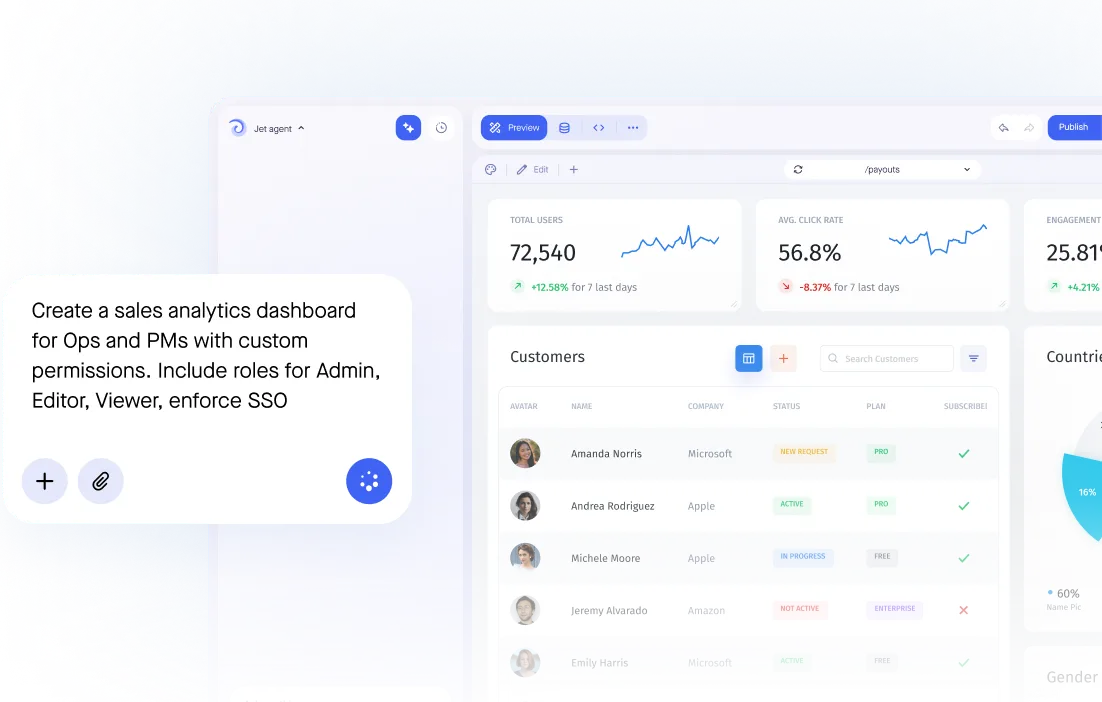
Jet Admin is an AI-powered no-code platform that lets you generate this directory app, connect your existing HR data sources, customize the interface and logic, and publish a responsive internal tool - all without writing code. You can start building your employee directory in minutes, not months.
Why use this employee directory template
Every organization reaches a point where keeping track of employee details in a spreadsheet becomes unsustainable. Here's why teams switch to a centralized employee directory template:
- Employees waste time searching for contact info. Without a central location for team's information, people spend minutes (sometimes hours) digging through emails, Slack threads, and outdated documents just to find the right person's phone number or email. A centralized directory reduces time spent searching for employee information dramatically. Employee directories help employees quickly find and connect with colleagues.
- New hires can't figure out who does what. Onboarding friction multiplies when new employees join and have no way to understand organizational structures, reporting lines, or who handles specific responsibilities. An employee directory can improve onboarding for new hires by giving them immediate visibility into team members, roles, and departments.
- Spreadsheet directories go stale fast. Static employee contact list templates in Google Sheets or Excel start strong but degrade quickly. People change roles, teams restructure, and nobody updates the file. Directories should maintain a single source of truth to avoid mismatched information across multiple systems. Templates improve organization and efficiency in managing employee data.
- Manual maintenance drains HR teams. HR professionals spend disproportionate time answering repetitive questions - "Who's the team lead for marketing?" or "What's the new hire's email?" A self-service directory eliminates that overhead and gives everyone easy access to essential information.
- Remote and hybrid teams lack visibility. When your team spans different locations and time zones, knowing who's where, what they do, and how to reach them becomes critical. Remote team directories help distributed teams stay aligned across locations and collaborate effectively.
- Data consistency and compliance suffer. When employee data lives in multiple places, inconsistencies emerge. Sensitive information like emergency contacts or home address details may end up in shared documents without proper access controls. A centralized directory with role-based permissions solves both problems - keeping data accurate and keeping sensitive information restricted.
Template features
Searchable employee directory
Search functionality is important for navigating employee directories - especially as your organization grows. This template includes instant search across employee names, departments, job title, skills, and contact information. Advanced filtering lets you narrow results by office location, team, expertise, or employment status. Instead of scrolling through hundreds of rows in a spreadsheet, you type a name or keyword and get results immediately.
Employee profile pages
Each employee gets a comprehensive profile page displaying their contact details, role, department, manager, and start date. Employee headshots and short bios can enhance the directory's effectiveness by putting a face to every name - particularly valuable for distributed teams who rarely meet in person. Incorporating personal details helps build a people-first company culture, and modern directories often include optional fields for personal interests and birthday celebrations.
Department and location filters
Organize your employee directory by department, office location, or business unit with built-in filter views. Managers and team leads get quick access to their team structures and reporting relationships. For companies with multiple offices, filtering by location makes it simple to see who's in which office, who's remote, and how teams are distributed. Employee directories should outline reporting lines and start dates to give everyone clarity on the organizational hierarchy.
Skills and expertise tags
Tag employees with skills, certifications, and domain expertise to build a searchable knowledge base within your directory. In a directory, skills and interests can help identify experts within the company - whether you need someone with SQL experience for a project or want to find who holds a specific certification. This transforms your employee contact list into a powerful tool for cross-team collaboration and internal talent discovery.
Contact action buttons
Direct communication links are built in to every profile. Initiate an email, make a phone call, or send a Slack message directly from an employee's profile page - no copying and pasting contact info between apps. These contact actions connect through Gmail, Slack, and other communication tools so reaching the right person takes one click.
Admin edit forms
HR-friendly forms let administrators add new employees, update existing records, and manage employee data without touching a database directly. Bulk import capabilities pull data from existing HR systems, so you don't re-enter information you already have. When employees join or roles change, updates happen through structured forms that keep your directory template consistent and accurate.
Role-based permissions
Not all employee information should be visible to everyone. This template supports configurable access levels - basic employee information should be accessible to all employees, while sensitive data is restricted to HR only. Emergency contact information is critical in an HR-only section of the directory. You can set permissions at the field level, ensuring that employee details like personal phone numbers, home addresses, or emergency contacts stay protected while general contact info remains available company-wide.
Mobile-responsive design
The directory works on any device - desktop, tablet, or phone. A user friendly, responsive design ensures employees can look up colleagues, check reporting structures, or find contact info whether they're at their desk or on the go. For organizations where team members are frequently away from their workstations, mobile access keeps the directory useful everywhere.
Who is this employee directory template for?
- HR teams managing employee data across multiple systems who need a centralized employee database. If you're tired of maintaining parallel spreadsheets and answering the same "who handles this?" questions, this template gives your team a single, reliable directory.
- People operations professionals automating onboarding workflows and organizing employee information for new hires. When new employees arrive, they should have immediate access to colleague profiles, team structures, and contact info - not a PDF from 2023.
- Remote and hybrid teams requiring easy access to colleague contact information, time zones, and expertise. Time zone information is essential for hybrid teams to prevent scheduling conflicts, and a directory that shows who's where prevents unnecessary coordination overhead.
- Growing companies scaling beyond spreadsheets but not ready for enterprise HR software. If you've outgrown your Google Sheets employee contact list template but don't need a full HRIS, this template sits in the sweet spot - powerful enough to handle hundreds of records, simple enough to manage without a dedicated IT team.
- Managers and team leads who need quick access to team member details, reporting structures, and organizational hierarchy. Rather than asking HR for a current org chart, managers can see their direct reports, cross-functional collaborators, and department structures in real time.
- Internal communications teams fostering employee connection and company culture. Directories often include employee photos for better recognition, and features like short bios and interest tags help people across the organization discover common ground and build relationships.
How to set up your employee directory template
- Select the employee directory template from Jet Admin's template gallery. The template comes pre-configured with common directory fields and layouts, giving you a functional starting point. Employee directory templates come in various formats, but this one generates a fully interactive app - not a static spreadsheet.
- Connect your data source. Link your existing employee data from Google Sheets, Airtable, PostgreSQL, MySQL, Supabase, or your HRIS through API connections. Jet Admin's native integrations handle the connection, so your directory pulls from the data you already maintain rather than requiring duplicate entry.
- Map your employee data fields. Define which fields appear in your directory: employee names, job titles, departments, contact info, office location, start date, skills, and any custom fields your organization needs. Collect employee data like names, titles, and contact details, then customize fields to match your organization's specific needs. Essential fields include name, job title, department, email addresses, and phone numbers. Organize the directory by name, department, or job function.
- Customize the interface. Add company branding, configure search filters, and design employee profile layouts using Jet Admin's visual builder. Arrange profile cards, choose which fields display in list views versus detail pages, and add employee photos to profiles. A directory template provides a consistent layout for employee information while letting you control how it looks and feels.
- Set up permissions. Define who can view, edit, and manage employee information. Create access tiers - all employees see basic profiles and contact info, managers access reporting structures, and HR teams see complete records including sensitive information like emergency contacts and employment status. Share the directory with appropriate access permissions for users.
- Configure workflows. Automate new employee onboarding data entry, set up sync schedules with your connected data sources, and create notification workflows for profile updates. For example, trigger a workflow when a new record is added so relevant team leads are notified, or schedule regular syncs so directory data stays current as your HRIS data changes.
- Test with sample data. Load example entries - a representative sample of employee records - and test search, filtering, profile views, and permission boundaries. Gather feedback from a few team members on whether they can find the right person quickly and whether the layout feels intuitive.
- Publish your directory app. Deploy the responsive directory for internal team access. Employees can access it immediately from any browser or device. With clear ownership established - HR as the primary admin, employees maintaining their own information where allowed - your directory is live and ready.
Ready to create an employee directory that your team will actually use? Get started with Jet Admin and build yours today.
Frequently asked questions
What fields should I include in my employee directory?
Essential fields include name, job title, department, email address, and phone number. Contact information is a crucial field in employee directories and should be prominent. Beyond the basics, consider adding manager (for reporting structures), office location, start date, employee photos, skills tags, and a short bio. Modern directories often include optional fields for personal interests and birthday celebrations to support company culture. Avoid storing sensitive data like SSN, salary, or home address in the general directory - keep those in an HR-only section with restricted access. Employee directory templates can include customizable fields for specific needs.
Can the directory connect to my existing HRIS system?
Yes. Jet Admin offers native integrations with Google Sheets, Airtable, PostgreSQL, Supabase, and MySQL. For HRIS platforms and other directory systems, you can connect through API integrations. Once connected, you can configure automated sync workflows so your directory stays updated as HRIS data changes - when employees join, change roles, or leave, the directory reflects it.
Can employees update their own profiles?
Yes. You can configure self-service forms that let employees edit their own information - fields like preferred name, communication preferences, skills, profile photo, and short bio. Control which fields employees can modify versus HR-only fields. For sensitive profile changes like department or reporting manager, approval workflows route the update to an administrator before it takes effect.
How do I hide sensitive employee information?
Role-based permissions control access at the field level. Your public-facing directory shows basic contact info, job title, department, and employee photos. HR-only views include complete profiles with emergency contacts, employment status, personal phone numbers, and other restricted data. This granular field-level security helps meet compliance requirements and ensures that basic employee information is accessible to all employees while sensitive data stays protected.
Can I filter employees by department or skills?
Yes. Built-in filtering supports department, location, role, skills tags, and any custom fields you've added. You can search across multiple criteria simultaneously - for example, finding all engineers in a specific office location who have a particular certification. Templates enhance communication across departments by making it easy to discover colleagues across the whole company.
Is the employee directory mobile-friendly?
Yes. The directory uses a fully responsive design that works across all devices and screen sizes. The touch-friendly interface provides a native mobile app experience, giving team members access to the directory whether they're at a desk or in the field. Alumni directories, remote team directories, and traditional employee directories all benefit from mobile accessibility.
How do I keep the directory updated as employees change?
Automated sync from your connected data sources - whether that's a database, Google Workspace spreadsheet, or HRIS API - keeps records current. Configure workflow automation for onboarding and offboarding processes so records are created or archived as people join or leave. An admin dashboard supports bulk updates and data management for larger changes like reorganizations. With clear ownership and automated sync, your directory stays reliable as a single source of truth.

.svg)



Use Cases
Categories
Features
Similar templates



Connect & sync your data with 30+ data sourse’s


Build frontend Apps 10x faster


Frequently asked questions
Automated sync from your connected data sources - whether that's a database, Google Workspace spreadsheet, or HRIS API - keeps records current. Configure workflow automation for onboarding and offboarding processes so records are created or archived as people join or leave. An admin dashboard supports bulk updates and data management for larger changes like reorganizations. With clear ownership and automated sync, your directory stays reliable as a single source of truth.
Yes. The directory uses a fully responsive design that works across all devices and screen sizes. The touch-friendly interface provides a native mobile app experience, giving team members access to the directory whether they're at a desk or in the field. Alumni directories, remote team directories, and traditional employee directories all benefit from mobile accessibility.
Yes. Built-in filtering supports department, location, role, skills tags, and any custom fields you've added. You can search across multiple criteria simultaneously - for example, finding all engineers in a specific office location who have a particular certification. Templates enhance communication across departments by making it easy to discover colleagues across the whole company.
Role-based permissions control access at the field level. Your public-facing directory shows basic contact info, job title, department, and employee photos. HR-only views include complete profiles with emergency contacts, employment status, personal phone numbers, and other restricted data. This granular field-level security helps meet compliance requirements and ensures that basic employee information is accessible to all employees while sensitive data stays protected.
Yes. You can configure self-service forms that let employees edit their own information - fields like preferred name, communication preferences, skills, profile photo, and short bio. Control which fields employees can modify versus HR-only fields. For sensitive profile changes like department or reporting manager, approval workflows route the update to an administrator before it takes effect.
Yes. Jet Admin offers native integrations with Google Sheets, Airtable, PostgreSQL, Supabase, and MySQL. For HRIS platforms and other directory systems, you can connect through API integrations. Once connected, you can configure automated sync workflows so your directory stays updated as HRIS data changes - when employees join, change roles, or leave, the directory reflects it.
Essential fields include name, job title, department, email address, and phone number. Contact information is a crucial field in employee directories and should be prominent. Beyond the basics, consider adding manager (for reporting structures), office location, start date, employee photos, skills tags, and a short bio. Modern directories often include optional fields for personal interests and birthday celebrations to support company culture. Avoid storing sensitive data like SSN, salary, or home address in the general directory - keep those in an HR-only section with restricted access. Employee directory templates can include customizable fields for specific needs.