Client Portal
App
Client Portal
Overview
A client portal template is a pre-built app foundation that gives agencies and service providers a ready-to-customize framework for sharing project updates, documents, invoices, and feedback workflows with clients - without building anything from scratch. Instead of stitching together scattered emails, Google Drive folders, and spreadsheets, you deploy a single branded portal where every client sees only what matters to them.
The core problem is familiar to any team managing multiple clients: project status requests flood your inbox, important files get buried in messy email threads, approvals stall because nobody knows where the latest deliverable lives, and clients lack clear visibility into what's happening with their projects. This fragmented client communication costs hours every week and erodes trust.
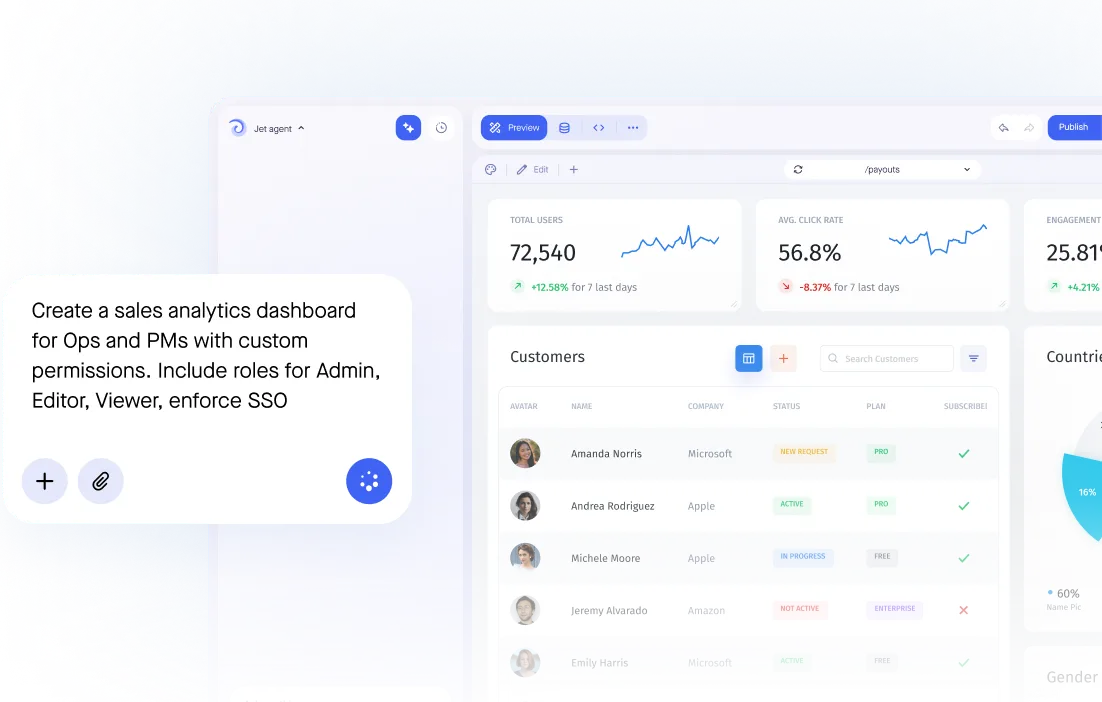
Jet Admin solves this with an AI-powered no-code app builder that generates a complete client portal from a simple prompt. Describe what you need - project dashboards, document sharing, approval workflows, invoice tracking - and Jet Admin scaffolds the UI, data models, and logic. Then connect your existing data sources (PostgreSQL, MySQL, Airtable, or any REST/GraphQL API) so your portal reflects live project information without duplicating data. Record-level filtering ensures each client sees only their own projects, files, and messages, enforced through role-based access controls at every layer.
This isn't a rigid template you're stuck with. Start with the client portal template as your foundation, then modify layouts, add or remove modules, build custom workflows, and apply your own branding - all through a visual editor or AI prompts. The result is a polished, professional customer portal that replaces patchwork tools with a central hub for every client interaction.
Ready to replace scattered emails with a professional client experience? Start building your client portal with Jet Admin's template today.
Why use this client portal template
The pain points are real
Every service provider knows the pattern. A client emails asking "where is my latest deliverable?" and you spend fifteen minutes digging through threads to find the right attachment. Meanwhile, another client's approval request sits unanswered because the feedback was buried in a reply chain three levels deep. Across your portfolio, you're tracking project milestones in spreadsheets, sharing files via Google Docs or email, and manually updating each client on progress - tasks that consume hours that should go toward billable work.
Client portals can streamline project management and communication by centralizing everything in one place. A client portal template serves as a centralized hub for client communication, replacing the chaos of scattered emails with structured, organized interactions.
Centralized data, instant visibility
When all client data lives in a single portal connected to your existing data sources, the "where's my file?" emails disappear. Clients log in and immediately see their project status, upcoming milestones, and latest documents. Using a client portal can improve client experience by providing 24/7 access to project updates and documents - no more waiting for someone on your team to manually send an update.
Centralized document management in client portals reduces email clutter and improves organization. Instead of hunting through email threads, your team and your clients access the same source of truth, which means fewer misunderstandings about what's been delivered, what's pending, and what needs attention.
Collaboration without the back-and-forth
Effective client portals include integrated communication channels for project discussions. Clients can leave comments directly on deliverables, submit feedback tied to specific versions, and approve work through structured workflows - all within the portal. This is fundamentally different from disconnected email threads where context gets lost and feedback arrives without reference to the right file.
Client portals allow for real-time feedback and task management. When a client approves a milestone or requests changes, that action is immediately visible to your internal teams, triggering the next step in your process automatically through workflow automation.
Efficiency your team can feel
Increased efficiency is a common benefit of using client portals due to reduced repetitive inquiries. When clients can track project progress on their own, your team fields fewer status check emails. When files are organized in client-specific folders with version control, nobody wastes time searching. When approvals happen through defined workflows rather than email chains, turnaround times shrink.
A key benefit of client portals is improved transparency in project status and communications. This transparency doesn't just save time - it strengthens client relationships by demonstrating professionalism and reliability.
Governance and security built in
Client portals can enhance security through encrypted data storage and user permissions. With Jet Admin, role-based access ensures that clients, team members, and admins each see exactly what they should. Record-level filtering means client A never accidentally sees client B's data - every query, every UI component, every file access respects these boundaries.
Client portal templates often include secure user authentication and access control. Jet Admin supports SSO/SAML/OIDC authentication, audit logs that track who viewed or changed what and when, and the option to self-host via Jet Bridge so sensitive information never passes through third-party servers. For firms handling legal, financial, or regulated documents, this level of data governance makes sense as a non-negotiable requirement.
Template features:
Client-Specific Project Dashboard
A well-structured client portal typically features a personalized dashboard for clients. Each client gets a home page filtered to show only their projects, tasks, and milestones - powered by record-level filtering tied to their user identity. Status indicators display whether tasks are in progress, awaiting review, or completed. Upcoming deadlines surface automatically. You can configure this view as a table, Kanban board, or visual timeline, pulling live data from your connected data source like PostgreSQL or Airtable. Internal teams see all projects; each client sees only what's theirs.
Secure Document Sharing Hub
Centralized document management replaces the chaos of file sharing through email. This feature provides an organized file library where clients can preview documents in the browser, download files, and see version history - so they always know they're looking at the latest deliverable. Folder structures are controlled per client through access permissions. Storage connects to S3, Google Drive, or Jet's built-in storage, and upload/download rights are managed by role. No more "can you resend that file?" emails.
Task and Milestone Tracker
Client portals enable streamlined project tracking with clear milestones and deliverables. The template includes a visual progress timeline where clients can see task status indicators, project milestones with due dates, and what's coming next. Notifications fire when deadlines approach or when tasks move to a new stage. For your team, this serves as a project tracker that keeps client project details visible without requiring manual status update emails. You can manage tasks, set dependencies, and track completion - all within the same interface your clients access.
Invoice and Payment Status View
Clients can track invoices and make payments directly through portals. This feature connects to Stripe via API to sync invoices, charges, and payment history in real time. Clients see outstanding balances, payment due dates, and completed work billing - eliminating the confusion of invoices scattered across email threads. You can also configure workflow automations to send payment reminders when invoices become overdue, reducing the manual overhead of account management and the sales process around collections.
Approval Workflow System
The template includes a structured sign-off process for deliverables. Submit work for review, the client views and either approves or requests changes, and the status updates automatically. Each approval carries an audit trail - who approved, when, with what comments. For workflows requiring digital signatures, you can integrate DocuSign via API to capture legally binding sign-offs. This replaces the informal "looks good" email with a documented, trackable approval record that protects both parties.
Client File Upload Portal
Portals allow clients to upload files and submit requests easily. Secure upload forms let clients submit project materials, feedback documents, source files, or briefs directly into the portal. Uploaded files are automatically assigned metadata - tagged to the correct client project and organized into the right folder. Access permissions ensure only authorized users can view submissions. This eliminates the messy process of clients emailing attachments that get lost or misfiled, making it clients easy to contribute without technical skills.
Project Communication Threading
Effective client communication reduces email clutter and confusion. The template includes comment threads tied to specific projects or tasks, creating an organized messaging system where every conversation has context. Clients can leave comments on deliverables, your team responds in the same thread, and the full communication history stays easily accessible. Notification alerts keep both sides informed, and you can integrate with Slack for internal teams to receive real-time updates without leaving their workflow.
White-Label Branding Options
Custom branding is possible in client portal setups, and Jet Admin makes it straightforward. Upload your logo, set your color schemes, configure custom domains, and remove any Jet Admin branding to create a seamless client experience under your own brand. Templates for client portals allow customization while maintaining a branded experience. The portal renders with a mobile-responsive design, so clients get a consistent, professional interface whether they access it from desktop or phone. This white-label capability transforms a simple portal into an extension of your brand identity.
Who is this client portal template for?
Client portals are widely used across various industries including consulting and healthcare. This template is designed for any service provider who manages client relationships and needs to share files, track project progress, collect feedback, or provide clients visibility into ongoing work.
Marketing Agencies and Consultancies
Share campaign progress, creative assets, and performance reports with separate views for each client. Collect approval on deliverables through structured workflows rather than email chains. When you're managing multiple clients across different campaign phases, a portal template standardizes your process - every new portal follows the same structure, reducing onboarding time while maintaining a consistent branded client experience. Centralized platforms improve client engagement and project transparency.
Professional Services Firms
Legal, accounting, and consulting firms handle sensitive information daily - contracts, financial statements, case documents. This template provides version-controlled document sharing, secure client file uploads, billing status visibility, and approval workflows for signatures. Audit logs track every interaction, and role-based access ensures strict data separation between clients. A client portal template can standardize processes for onboarding new clients efficiently, which matters when compliance and documentation are critical.
SaaS Companies with B2B Clients
For B2B SaaS teams, the portal becomes part of your customer success motion. Track implementation progress, centralize training videos and onboarding resources, manage support requests, and communicate feature rollouts - all in a customer portal your enterprise customers can access anytime. Client portals can enhance customer experience and simplify processes, giving your customers the self-service access they expect from a modern software partner.
IT Managed Service Providers
Share maintenance schedules, system status dashboards, incident reports, and service ticket updates with business clients. Allow clients to upload logs, approve change schedules, and monitor SLA compliance. The portal provides the transparency clients need without requiring your team to send manual reports after every maintenance window or incident resolution.
Freelancers Managing Multiple Clients
When you're juggling deliverables across several engagements, a simple portal replaces the chaos of managing each client through separate email threads and file sharing tools. Organize project plans, timeline updates, revision requests, and invoices in one place. Clients see their project details without needing to send follow-up emails, and your own branding on the portal adds professionalism that strengthens customer relationships. You don't need technical skills - Jet Admin's visual editor handles the setup.
Real Estate and Property Management Teams
Share property documents, transaction progress, inspection reports, and closing cost breakdowns with buyers, sellers, or property owners. Document signing workflows handle contracts and agreements, while the portal keeps everyone aligned on where each transaction stands. Clients can upload legal documentation directly, and they centralize project plans, deliverables, and training materials all in one access-controlled space.
How to set up your client portal template
1. Generate Your Portal with AI
Start in Jet Admin by selecting the client portal template, or describe your needs in plain language to Jet Admin's AI. Tell it you need client dashboards, project tracking, document sharing, invoice views, and approval workflows. The AI generates the initial app structure - pages, components, data models, and navigation - giving you a working foundation in minutes rather than requiring you to build each screen manually.
2. Connect Your Project Data
Link the portal to your existing data. Jet Admin supports native connections to PostgreSQL, MySQL, MongoDB, and Airtable, plus API-based integrations with tools like Stripe for payment status, HubSpot for CRM data, and custom REST/GraphQL endpoints for your existing project management tools. Zapier's client portal template connects to 6,000+ apps - and through Zapier or Make integrations, Jet Admin can sync with virtually any external system. You can also connect file storage resources like S3 or Google Drive for document management. Softr supports 14+ data sources for client portals, but Jet Admin goes further by supporting 200+ data sources including direct database connections that competitors like Softr (limited primarily to Airtable) cannot match.
3. Configure Record-Level Permissions
This step is critical for data isolation. Define three core roles - admin, team member, and client - and set filtering rules so the client role only sees records where client_id matches their logged-in user identity. This record-level filtering applies to every data query: projects, tasks, documents, messages, and invoices. They provide role-based access for different user groups. Configure authentication through Jet Admin's built-in auth, or connect SSO/SAML/OIDC providers for enterprise clients. Role-based access enhances client communication by personalizing views, ensuring each client sees only what they should.
4. Customize Portal Interface and Branding
Use the visual editor or AI prompts to modify layouts, adjust color schemes, upload your logo, and configure navigation to match your brand identity. Set up a custom domain so clients visit portal.yourcompany.com rather than a generic URL. Preview the mobile-responsive design to ensure the experience works across devices. You can create separate views for different user roles - what your internal team sees versus what a client sees when they log in to their home page.
5. Build Approval and Upload Workflows
Create automated workflows for your core client interactions. Define approval pipelines: deliverable uploaded → client notified → client reviews → approves or requests changes → team notified of outcome. Set up file upload forms where clients can submit materials that get automatically tagged and organized. Configure notification triggers via email or Slack integration so your team stays informed without checking the portal constantly. If you need digital signatures, integrate DocuSign via API to add e-signature steps to your approval workflows. Dock's client portal allows embedding of various resources, and similarly, you can embed external content or link to resources within your workflow steps.
6. Test Client Access and Functionality
Before going live, create test client accounts and verify the entire experience. Log in as a test client and confirm they cannot see other clients' data. Test file uploads and downloads. Verify that approval workflows trigger correctly and notifications arrive. Check that invoice and payment data from Stripe reflects accurately. Test guest access flows if you plan to offer them. Validate the mobile view. This staging phase catches permission misconfigurations before they become security issues.
7. Deploy and Invite Clients
Publish your portal, finalize the custom domain configuration, and remove any default vendor branding if applicable. Set up SSO authentication for enterprise clients who require it. Send branded invitations with login credentials or self-registration links. Client portals often feature self-service resources such as FAQs and support articles - consider adding a resources section or knowledge base to reduce initial support questions from new portal users.
Your client portal can be live and serving clients within days, not weeks. Start building with Jet Admin's free template and see how a centralized portal transforms your client management workflow.
Frequently asked questions
What is a client portal template?
A client portal template is a pre-built app framework that includes the essential data models (clients, projects, tasks, documents, invoices, messages), UI views, and workflow logic needed for professional client interaction. Instead of coding a portal from scratch or assembling it from notion templates, Google Sheets, and email, you use the template as a starting point and customize it to match your specific workflows, branding, and data structure. It's designed to provide project tracking, document sharing, communication tools, and access controls out of the box. Glide's customer portal template offers a secure login area, and Jet Admin similarly provides authentication and role-based access as foundational components of every portal template.
How do I make sure each client only sees their own data?
Jet Admin enforces data isolation through record-level filtering combined with role-based access controls. When you configure the client role, you set permission rules that filter all records - projects, tasks, messages, files, invoices - to only those where the client_id matches the logged-in user. Every data source query and every UI component respects these filters, so a client literally cannot access another client's information. This isn't a workaround or a view-level hide; it's enforced at the data query layer. Combined with audit logs that track who accessed what, you get verifiable data separation across your entire portal.
Can I white-label the portal with my own branding and domain?
Yes. Jet Admin lets you upload logos, set color palettes, modify layouts, and deploy the portal on a custom domain like portal.yourcompany.com. You can remove Jet Admin branding to create a seamless experience under your own brand. The portal is mobile-responsive by default, so your custom branding looks consistent across desktop and mobile devices. HolaBrief allows clients to interact without creating an account - and similarly, you can configure your portal's authentication to balance security with ease of access based on your client needs.
How do I connect this to my existing project management or CRM system?
Jet Admin supports native database connections for PostgreSQL, MySQL, MongoDB, and Airtable. For CRM systems like HubSpot, you integrate via REST API. For project management software like Asana or custom tools, connect through REST/GraphQL API endpoints. Jet Admin's Jet Bridge allows you to host API connectors on your own infrastructure, keeping data access secure. Softr's client portal template supports 14+ data sources, but Jet Admin's broader connectivity - including direct database connections - means you can build your portal on top of whatever data stack you already use, without migrating to a new platform.
Can clients submit files or requests directly through the portal?
Yes. The template includes file upload forms and request submission components that clients can use to upload files directly into the portal. Submitted files are automatically assigned metadata - linked to the correct client and project - and organized into the appropriate folders. Your team receives notification alerts when new submissions arrive. This replaces the process of clients emailing attachments that get lost in threads, making the whole file submission process structured and trackable.
How do I set up approval workflows for client sign-offs?
You model deliverables or tasks with approval status fields (pending, approved, rejected/change requested) and create UI actions - buttons or forms - for "request approval," "approve," and "request changes." Jet Admin's workflow automation triggers notifications when approvals are requested or completed. If you need digital signatures, integrate DocuSign via API to add e-signature steps. Every approval action is logged with timestamps and user identity, creating an audit trail for each sign-off.
Is the client portal secure enough for sharing sensitive documents?
Jet Admin provides enterprise-grade security features: role-based access controls, record-level data filtering, audit logs tracking all user actions, and authentication via SSO/SAML/OIDC. For organizations with strict data residency requirements, Jet Bridge lets you self-host the API layer so client data stays within your own cloud or on-premise environment and never passes through external servers. Client portals can enhance security through encrypted data storage and user permissions. File storage connects to your chosen backend (S3, Google Cloud Storage), and all data transmission uses encryption. For teams handling sensitive client information, these controls provide the governance framework needed for confident document sharing.
Data sources

.svg)





Use Cases
Categories
Features
Similar templates




Connect & sync your data with 30+ data sourse’s


Build frontend Apps 10x faster


Frequently asked questions
Jet Admin provides enterprise-grade security features: role-based access controls, record-level data filtering, audit logs tracking all user actions, and authentication via SSO/SAML/OIDC. For organizations with strict data residency requirements, Jet Bridge lets you self-host the API layer so client data stays within your own cloud or on-premise environment and never passes through external servers. Client portals can enhance security through encrypted data storage and user permissions. File storage connects to your chosen backend (S3, Google Cloud Storage), and all data transmission uses encryption. For teams handling sensitive client information, these controls provide the governance framework needed for confident document sharing.
You model deliverables or tasks with approval status fields (pending, approved, rejected/change requested) and create UI actions - buttons or forms - for "request approval," "approve," and "request changes." Jet Admin's workflow automation triggers notifications when approvals are requested or completed. If you need digital signatures, integrate DocuSign via API to add e-signature steps. Every approval action is logged with timestamps and user identity, creating an audit trail for each sign-off.
Yes. The template includes file upload forms and request submission components that clients can use to upload files directly into the portal. Submitted files are automatically assigned metadata - linked to the correct client and project - and organized into the appropriate folders. Your team receives notification alerts when new submissions arrive. This replaces the process of clients emailing attachments that get lost in threads, making the whole file submission process structured and trackable.
Jet Admin supports native database connections for PostgreSQL, MySQL, MongoDB, and Airtable. For CRM systems like HubSpot, you integrate via REST API. For project management software like Asana or custom tools, connect through REST/GraphQL API endpoints. Jet Admin's Jet Bridge allows you to host API connectors on your own infrastructure, keeping data access secure. Softr's client portal template supports 14+ data sources, but Jet Admin's broader connectivity - including direct database connections - means you can build your portal on top of whatever data stack you already use, without migrating to a new platform.
Yes. Jet Admin lets you upload logos, set color palettes, modify layouts, and deploy the portal on a custom domain like portal.yourcompany.com. You can remove Jet Admin branding to create a seamless experience under your own brand. The portal is mobile-responsive by default, so your custom branding looks consistent across desktop and mobile devices. HolaBrief allows clients to interact without creating an account - and similarly, you can configure your portal's authentication to balance security with ease of access based on your client needs.
Jet Admin enforces data isolation through record-level filtering combined with role-based access controls. When you configure the client role, you set permission rules that filter all records - projects, tasks, messages, files, invoices - to only those where the client_id matches the logged-in user. Every data source query and every UI component respects these filters, so a client literally cannot access another client's information. This isn't a workaround or a view-level hide; it's enforced at the data query layer. Combined with audit logs that track who accessed what, you get verifiable data separation across your entire portal.
A client portal template is a pre-built app framework that includes the essential data models (clients, projects, tasks, documents, invoices, messages), UI views, and workflow logic needed for professional client interaction. Instead of coding a portal from scratch or assembling it from notion templates, Google Sheets, and email, you use the template as a starting point and customize it to match your specific workflows, branding, and data structure. It's designed to provide project tracking, document sharing, communication tools, and access controls out of the box. Glide's customer portal template offers a secure login area, and Jet Admin similarly provides authentication and role-based access as foundational components of every portal template.