Field Sales
App
Field Sales
Overview
A field sales app template is a pre-built mobile framework for managing outside sales operations-from territory mapping and customer visits to order capture and follow-up workflows. Instead of cobbling together spreadsheets, paper forms, and disconnected tools, field sales teams get a single, mobile-first app that centralizes customer data, visit logs, and pipeline updates in one place.
The problem is familiar: field sales reps spend hours on administrative tasks-switching between apps, re-entering CRM data, manually planning routes, and chasing down account details. High-turnover teams are 3x more likely to use 5+ disconnected tools, which fragments data and kills productivity. Managers, meanwhile, lack real-time visibility into rep activity, territory performance, and pipeline accuracy.
This field sales app template solves that by giving your team a centralized hub with real-time data access, automated workflows, and a mobile interface designed for reps who work on the move. Every component-accounts, territories, visits, orders, contacts, products-is ready to use and fully customizable.
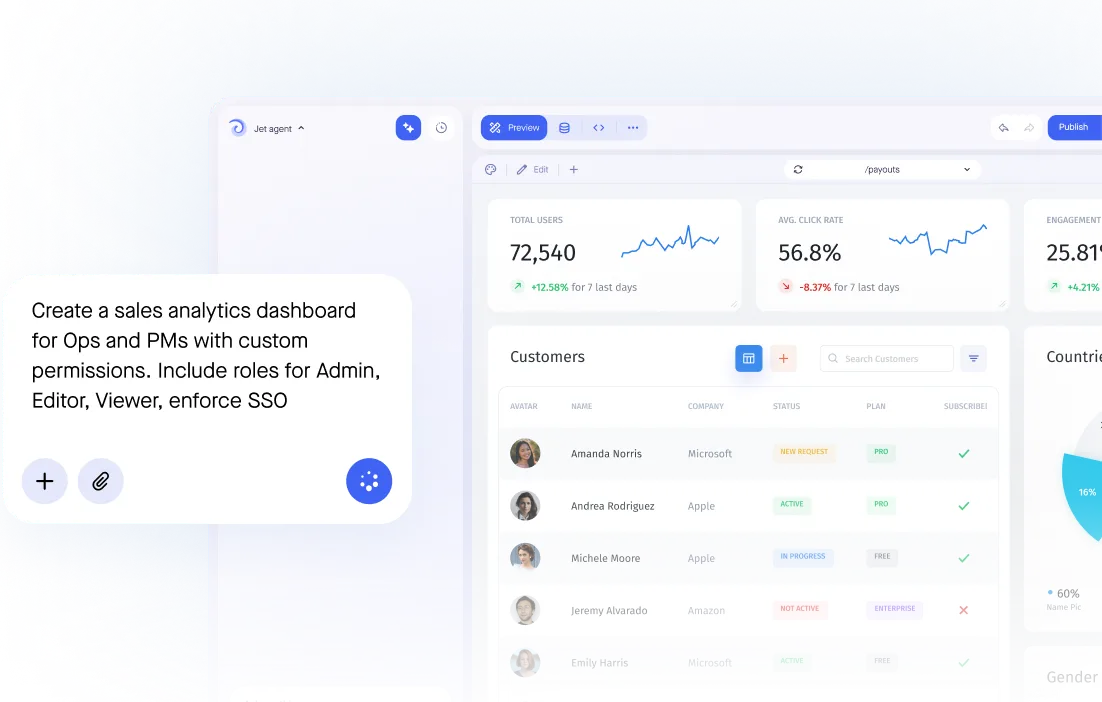
With Jet Admin's AI-powered no-code platform, you can generate your sales app, connect your existing CRM and inventory data, customize the interface and logic, and publish a responsive app-without writing code or waiting on engineering. Explore the template and start building your field sales app today.
Why use this field sales app template
Field sales reps need mobile-friendly interfaces with quick access to information-not desktop-heavy CRMs that slow them down between meetings. Here's why this template makes a measurable difference in how your field teams operate:
- Centralized data access – Stop toggling between your CRM, spreadsheets, Google Sheets, and messaging apps. This template brings accounts, contacts, opportunities, orders, and visit history into a single mobile app. Mobile CRM integration is essential for field sales apps, and this template delivers it natively.
- Real-time visibility – Managers can track territory performance, rep activity, and pipeline status as events happen. Real-time activity logging improves sales tracking efficiency, and performance tracking dashboards allow teams to monitor sales metrics in real-time. Reporting tools in field sales apps enhance visibility into sales activities, enabling better coaching and territory decisions.
- Consistent processes – Standardize how reps log customer visits, capture orders, and create follow-up tasks. Customization options for field sales apps can include sales stages and workflows, so every rep follows the same playbook without sacrificing flexibility.
- Improved collaboration – Share account insights across individual reps and territory managers. When one rep visits a client, notes and order history are immediately accessible to the wider team-no more lost context when accounts change hands.
- Reduced manual work – Field sales software can increase productivity by reducing administrative tasks. CRM integration automates data entry for field sales reps, and automated CRM updates save field reps 7–10 hours weekly. That's time reclaimed for selling, not typing.
- Faster deployment – Rather than building from scratch, you start with a purpose-built template and customize it to your business. No engineering backlog, no months-long development cycles.
Template features
Mobile Account Dashboard
Field reps need instant access to account information without digging through a desktop CRM. The mobile account dashboard surfaces complete contact details, interaction history, open deals, and product/pricing data on any device. Mobile CRM features enable reps to manage contacts and log activities instantly, so reps arrive at every meeting prepared.
Territory Map and Location Tracking
Visual mapping capabilities assist in defining and managing sales territories. This template includes a map view that plots account locations, distinguishes visited from unvisited accounts, and supports GPS-based visit verification. Effective field sales management requires territory visualization and route optimization-managers can filter by territory or sales rep to identify coverage gaps and coordinate field operations efficiently.
Visit Planner and Route Optimization
Route planning tools optimize travel paths to reduce driving time. Reps can schedule customer visits, build daily itineraries, and plan optimized routes to maximize the number of client stops per day. For context, tools like Badger Maps optimize routes for over 100 stops, and SPOTIO builds optimized routes using existing customer data. Dedicated field sales apps automate routing and data entry tasks, and optimized routing allows sales reps to visit more clients daily. Through integration with mapping services, reps can reduce mileage and spend more time with customers.
Order and Lead Capture Forms
Field sales apps can capture orders and generate proposals directly within the app. This template includes customizable forms for lead management, order capture, and opportunity updates-all accessible during field visits. Support for media attachments and GPS/time stamps ensures data integrity. Field sales app templates provide real-time analytics and order processing capabilities, closing the gap between the field and back office.
Notes and Photo Documentation
During customer visits, reps can add detailed visit notes, capture photos for store compliance or merchandising verification, and document client interactions-all with one tap. This eliminates the end-of-day data entry scramble and ensures nothing falls through the cracks.
Follow-up Action Management
Task automation features help manage follow-ups and customer communication. After a visit, the template can trigger automated task creation with reminders, ensuring reps never lose track of next steps. Field sales apps with CRM integration streamline follow-up tasks, and workflow automation keeps the pipeline moving without manual overhead.
Territory Performance Dashboard
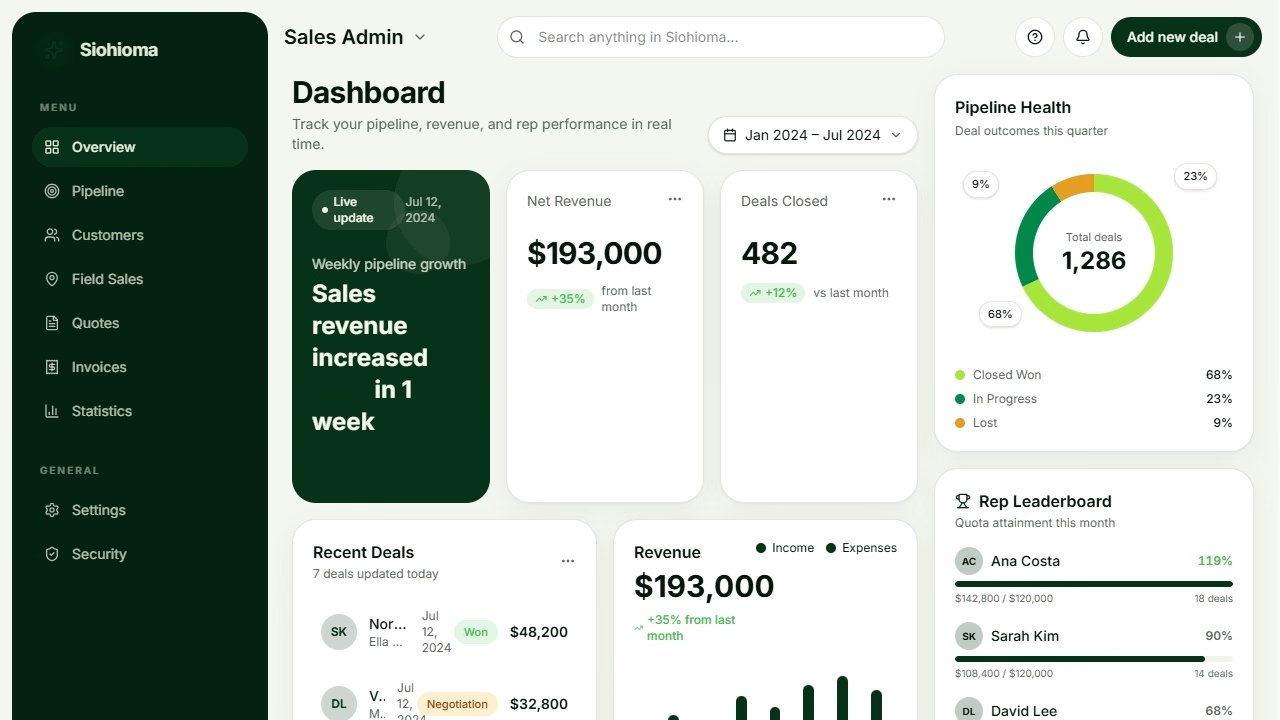
Managers get a dedicated dashboard showing territory metrics, rep activity logs, pipeline status, and quota tracking. Performance tracking dashboards allow teams to monitor sales metrics in real-time, enabling data-driven coaching. Field sales management enhances visibility for tracking team performance and coaching, so managers can quickly spot underperforming territories and rebalance coverage.
CRM and Inventory Integration
Real-time CRM sync improves data accuracy for sales teams. This template supports connections to CRM systems like HubSpot and Salesforce through native integrations or APIs, as well as databases like PostgreSQL, Supabase, MySQL, Airtable, and Google Sheets. Inventory and pricing data flow into the app so reps always have current stock levels and pricing tiers during client conversations. Effective CRM integration enhances visibility into sales activities across the entire organization.
Who is this field sales app template for?
- Field Sales Representatives – Manage daily customer visits, capture orders, update opportunities, and log activities from a mobile app. Field sales apps can reclaim several hours per week for reps by eliminating redundant data entry and scheduling friction. Whether you're covering a dense urban territory or a sprawling rural region, this template keeps everything accessible on your device.
- Territory Managers – Oversee regional performance, coordinate coverage across field reps, and track rep activity against quotas. Territory mapping and performance dashboards give managers the insights they need to rebalance territories, coach individual reps, and close deals faster. SPOTIO reported a 21% increase in customer activation within eight months by improving field visibility and territory coordination.
- Account Managers – Maintain client relationships with full interaction history at your fingertips. Access account details, schedule follow-ups, and coordinate with inventory or support teams-all without returning to the office. This template ensures no client conversation happens without context.
- Sales Operations Teams – Standardize field processes, generate reporting across territories, and integrate the template with existing CRM and ERP systems. Customization options cover sales stages, workflow automation, and user permissions, enabling sales ops to enforce consistency while reducing training time.
- Distributors and Wholesale Teams – Manage retailer relationships, process orders during visits, and track inventory levels. Van sales operations, route planning for delivery windows, and pricing tier management are all supported through customizable forms and data connections.
- Retail Sales Teams – Coordinate store visits, check compliance with merchandising standards, capture market intelligence through photos and notes, and report competitive insights. Small teams and enterprise operations alike benefit from a standardized, mobile-first approach to field data collection.
How to set up your field sales app template
- Select the field sales template – Open Jet Admin's template library and choose the Field Sales App Template. The pre-built structure includes accounts, contacts, territories, visits, orders, and activity records ready for customization.
- Connect your data sources – Link your existing CRM systems (HubSpot, Salesforce via API), databases (PostgreSQL, Supabase, MySQL, Airtable, Google Sheets), and inventory management tools. Distinguish between native connectors and API-based integrations based on your stack. Mobile CRM integration is essential for field sales apps, and Jet Admin supports connecting the tools your teams already use.
- Map your data fields – Align your data fields to template components: accounts, territories, products, activities, contacts, and pricing. This ensures existing customer data, CRM data, and inventory records flow correctly into the app's interface and forms.
- Customize the interface – Adjust forms, dashboards, mobile layouts, and detail pages to match your workflows. Add or remove fields on order capture forms, configure territory map filters, and tailor the account dashboard to surface the information your field reps need most. AI-powered apps can discover new high-potential leads-configure lead scoring or filtering logic if your workflow supports it.
- Configure user permissions and territory assignments – Set role-based access for reps, managers, and sales ops. Assign territories so individual reps see only their accounts, while managers access cross-territory views. User-friendly apps improve adoption rates among sales teams, so keep permissions straightforward.
- Set up automated workflows – Create workflow automation rules for follow-up task creation, CRM updates, and reporting triggers. For example, automatically generate a follow-up task when a visit is logged, or push order data back to your inventory system. Offline functionality allows work without internet access-configure sync behavior for reps working in low-connectivity areas.
- Test and publish – Run the app with sample data to verify forms, integrations, permissions, and dashboards. Once validated, publish for your team's access on any device. Reps can begin using the mobile app immediately.
Ready to eliminate the manual work slowing your field teams down? Start building your field sales app with Jet Admin's template today.
Frequently asked questions
What is a field sales app template?
A field sales app template is a pre-built, customizable mobile framework for managing outside sales operations. Field sales app templates typically include territory mapping and lead management tools, along with visit logging, order capture, account management, and performance dashboards. It provides the structure so you can focus on connecting your data and tailoring the app to your business rather than building from scratch.
Can sales reps use this template on mobile devices?
Yes. The template is designed with mobile first design principles so field sales reps can access account data, log visits, capture orders, and update opportunities from any mobile device. Offline functionality allows work without internet access-data syncs automatically when connectivity returns, ensuring reps stay productive regardless of location.
Can accounts be filtered by territory or sales rep?
Absolutely. Territory-based access controls let you assign accounts to specific territories and individual reps. Managers can filter the territory map and account lists by rep, region, or custom criteria to monitor coverage and identify gaps.
Can visits and orders be logged automatically?
The template supports GPS-based visit verification and customizable logging workflows. Visits can be logged with location and time stamps, and order capture forms let reps create orders during customer visits. AI-powered apps automate route planning and data entry, and you can configure automation rules to reduce manual steps-though specific logging triggers depend on how you customize the workflow.
Can the template connect to existing CRM and inventory systems?
Yes. Jet Admin supports connections to HubSpot, Salesforce, and other CRMs through native integrations or APIs. You can also connect PostgreSQL, Supabase, MySQL, Airtable, Google Sheets, and inventory or pricing databases. Real-time CRM sync improves data accuracy for sales teams, and two-way sync ensures your field app and back-office systems stay aligned.
Can follow-up actions be automated?
Yes. You can configure workflow automation to create follow-up tasks automatically after visits, set reminder schedules, and trigger CRM updates or email notifications. Task automation features help manage follow-ups and customer communication, keeping your pipeline active without relying on manual tracking.
How quickly can we deploy this field sales template?
Deployment speed depends on the complexity of your data sources, integration requirements, and customization needs. Because the template provides a ready-made structure and Jet Admin's no-code builder handles the interface and logic, companies typically move from setup to a working app significantly faster than custom development. Start with the template, connect your data, customize, and test-your team can be in the field with a working app in a fraction of the time a traditional build would require.

.svg)


Use Cases
Categories
Features
Similar templates




Connect & sync your data with 30+ data sourse’s


Build frontend Apps 10x faster


Frequently asked questions
Deployment speed depends on the complexity of your data sources, integration requirements, and customization needs. Because the template provides a ready-made structure and Jet Admin's no-code builder handles the interface and logic, companies typically move from setup to a working app significantly faster than custom development. Start with the template, connect your data, customize, and test-your team can be in the field with a working app in a fraction of the time a traditional build would require.
Yes. You can configure workflow automation to create follow-up tasks automatically after visits, set reminder schedules, and trigger CRM updates or email notifications. Task automation features help manage follow-ups and customer communication, keeping your pipeline active without relying on manual tracking.
Yes. Jet Admin supports connections to HubSpot, Salesforce, and other CRMs through native integrations or APIs. You can also connect PostgreSQL, Supabase, MySQL, Airtable, Google Sheets, and inventory or pricing databases. Real-time CRM sync improves data accuracy for sales teams, and two-way sync ensures your field app and back-office systems stay aligned.
The template supports GPS-based visit verification and customizable logging workflows. Visits can be logged with location and time stamps, and order capture forms let reps create orders during customer visits. AI-powered apps automate route planning and data entry, and you can configure automation rules to reduce manual steps-though specific logging triggers depend on how you customize the workflow.
Absolutely. Territory-based access controls let you assign accounts to specific territories and individual reps. Managers can filter the territory map and account lists by rep, region, or custom criteria to monitor coverage and identify gaps.
Yes. The template is designed with mobile first design principles so field sales reps can access account data, log visits, capture orders, and update opportunities from any mobile device. Offline functionality allows work without internet access-data syncs automatically when connectivity returns, ensuring reps stay productive regardless of location.
A field sales app template is a pre-built, customizable mobile framework for managing outside sales operations. Field sales app templates typically include territory mapping and lead management tools, along with visit logging, order capture, account management, and performance dashboards. It provides the structure so you can focus on connecting your data and tailoring the app to your business rather than building from scratch.