Donation Tracker
App
Donation Tracker
Overview
A donation tracker template is a pre-built, customizable framework that nonprofits and charitable organizations use to record, organize, and analyze every aspect of their fundraising operations-from individual charitable donations and donor profiles to campaign performance and fund restrictions. Effective donation trackers generally include donation logs, donor directories, dashboards, and reports, all unified in a single system. A donation tracker template should combine donor management with visual financial data so teams can see exactly where they stand at any moment.
The core problem this template solves is straightforward: most nonprofits still manage donor data across disconnected spreadsheets, email threads, and payment platforms. That fragmented approach leads to duplicate records, missed acknowledgments, delayed tax deductible receipt generation, and hours of manual reconciliation each month. When 73% of donations in the US come from individuals-and in 2011, Americans donated $298 billion to charities-the volume of data flowing into even a small organization demands a better system.
This donation tracker template centralizes every donation, donor record, campaign, and receipt status into one place with automated workflows that reduce manual steps and reduce waste in your team's time. Because every organization operates differently-whether you manage restricted funds for education programs, coordinate donation centers for clothing and electronics, or track memorial donations that honor a loved one's legacy through charity-the template is fully customizable to match your specific workflows, fields, and reporting needs.
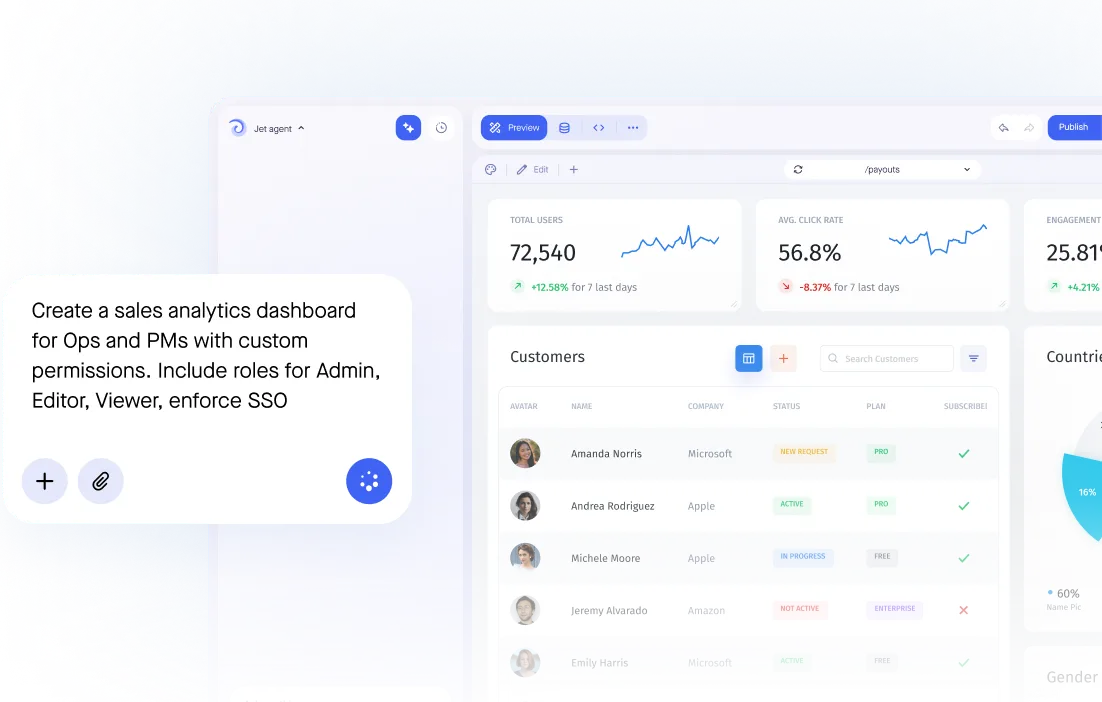
With Jet Admin, you can generate this donation tracker as a no-code app, connect your existing data sources, and tailor everything to your mission without writing a single line of code.
Why use this donation tracker template
Manual donation tracking creates real, measurable pain. Consider that manual data entry in one nonprofit case study accounted for over 20 hours per month of staff time-time spent copying data between payment platforms, spreadsheets, and email instead of building relationships with donors and supporters.
Scattered donor data costs you visibility. When donor records live in one spreadsheet, campaign totals in another, and payment confirmations in an email inbox, no single person can answer basic questions: How much has a specific donor given this year? Which campaign is closest to its goal? Has every donor received a tax deductible receipt? This template brings all that data together so your team can respond to questions instantly rather than spending hours assembling a report.
Inconsistent follow-up erodes donor relationships. 57% of donors are enrolled in recurring donation programs, and those people expect timely acknowledgments and accurate records. When acknowledgment processes depend on someone remembering to send a thank-you email, gifts fall through the cracks. Follow-up reminders help track acknowledgment and thank-you notes, ensuring no donor feels forgotten. Receipt and acknowledgment tracking ensures timely communication with donors across every campaign.
Collaboration breaks down without a shared system. Fundraising teams, finance staff, and volunteers all need access to donation data-but at different levels. Without centralized records, teams duplicate work, overwrite each other's updates, or miss critical status changes. A good donation tracker template should enable collaboration among users while keeping sensitive information protected through role-based access.
Manual reconciliation wastes energy your team doesn't have. Auto-sum and totals provide automatic calculations for total funds raised, eliminating the need to manually add columns or cross-reference payment gateway exports. Automatic summaries calculate total donations and average donation size, giving leadership the numbers they need without a single formula.
By centralizing data, automating routine tasks, and providing real-time visibility, this template lets your team focus on what creates a big impact: building relationships, running campaigns, and advancing your cause.
Template features
Donation Entry and Import
Record every gift as it arrives-whether online, by mail, or in person. Donation logs should include fields for date received, donor name, amount, campaign, payment method, and restriction type. Enter donations manually through structured forms or import them in bulk via CSV. For organizations processing high volumes, Jet Admin connects natively to data sources like Google Sheets, Airtable, PostgreSQL, MySQL, and Supabase, so payment data can flow directly into your tracker without re-keying. Online giving grew by 11% year-over-year in 2012, and online donations increased by 9% in 2015 compared to 2014-the volume of digital giving makes automated import essential.
Donor Profile Management
Donor management involves tracking contact information and total lifetime giving across every interaction. Each donor profile stores contact details, preferred communication channels, giving history with dates and amounts, first and most recent gift dates, and relationship notes. Core data and donor management should include donor details and transaction details in a single view. Donation tracking apps help manage donor profiles and records so your team can see a complete picture of each person's relationship with your organization-whether they're a first-time supporter or a long-standing member of your community.
Campaign and Fund Tracking
Organize every donation by the specific campaign, appeal, or event it supports. Campaign categorization allows donations to be grouped by multiple criteria-restricted versus unrestricted funds, annual appeals, capital campaigns, or special events like disaster response and memorial giving. DonationMatch has supported 133,000 events since 2010 and streamlined $263 million in in-kind donations, demonstrating the scale that campaign-level tracking needs to handle. Track target amounts, start and end dates, and real-time progress for each campaign so your fundraising team knows exactly where to focus energy.
Receipt and Acknowledgment Status
Never wonder whether a donor received their tax documentation. Receipt tracking allows uploading or linking receipts for tax documentation, and each donation record shows whether a receipt has been issued and an acknowledgment sent. Tax documentation features help organize charity names and deductible amounts-critical when you consider that in 2022-2023, Australians claimed $9.1 billion in tax-deductible donations. In the U.S., 32% of donations go to religious organizations, many of which must provide year-end giving statements. This feature keeps every status visible so nothing slips through.
Recurring Gift Management
With 57% of donors enrolled in a recurring donation program, managing monthly, quarterly, and annual gifts is fundamental. Track each recurring schedule, monitor payment status, flag failed transactions for follow-up, and calculate lifetime value per donor. Whether supporters donate monthly to fund ongoing programs or pledge a multi-year gift to a capital campaign, this view keeps every commitment visible and actionable.
Advanced Filters and Search
Quickly segment your data by donor name, campaign, date range, amount, restriction type, or gift status. Filters and search functionalities aid in fast report generation-whether you need a list of all donors who gave to a specific campaign, all lapsed supporters who haven't given this year, or all restricted funds awaiting allocation. These tools make it possible to create targeted outreach lists, generate compliance reports, or submit board-ready summaries in minutes.
Fundraising Dashboard
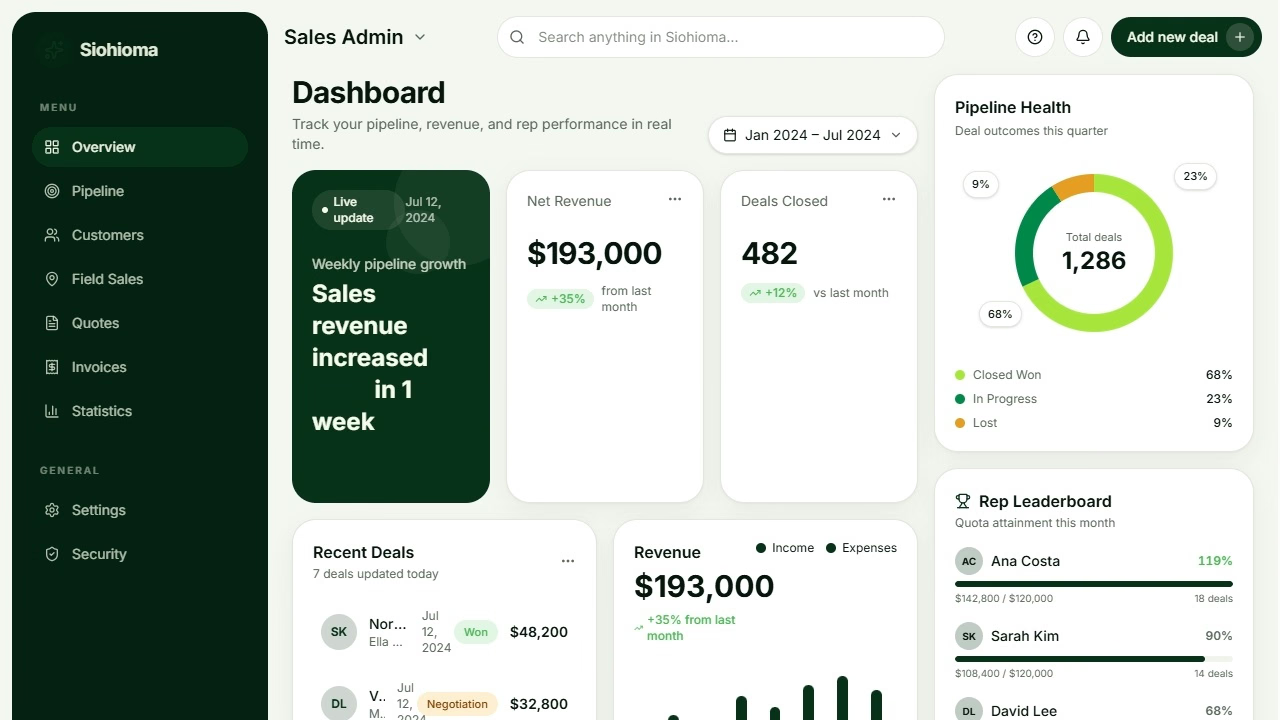
A visual dashboard displays progress towards fundraising targets with charts and key metrics at a glance. Goal tracking should visually summarize fundraising progress with key metrics including total raised, percentage of goal reached, top donors, and recurring revenue trends. Dashboards make trends easy to spot with charts and visual indicators, so leadership can make informed decisions without waiting for a monthly report. A donation tracker app centralizes fundraising campaign management into a single, real-time view.
Role-Based Permissions
Control who can view, edit, or manage specific records. Staff members might have full access to donor profiles and financial data, while volunteers see only the forms they need to submit donations. Leadership can access dashboards and reports without editing underlying records. This protects sensitive donor information while enabling the collaboration that fundraising requires across teams and groups.
Who is this donation tracker template for?
- Nonprofit organizations managing multiple fundraising campaigns, thousands of individual donors, and complex reporting requirements. Whether your mission focuses on families, education, employment services, or disaster relief, this template adapts to track every gift and its impact on the people you serve.
- Charitable foundations tracking both grants received and funds distributed, with restricted fund accounting that separates money designated for specific programs from unrestricted operating support. Foundations need clear records of how every dollar moves-this template provides that transparency.
- Community organizations coordinating local fundraising events, member donations, and public giving campaigns. From food drives to neighborhood improvement projects, these groups need a simple way to manage donors, track items and funds raised, and report results to their community.
- Churches and religious organizations managing tithes, offerings, special collections, and restricted building or mission funds. You can donate clothing, furniture, and electronics to charities-and many faith-based groups also accept vehicle donations that help fund recovery programs for individuals. Tracking these diverse gift types requires flexible donation categories and reliable tax documentation.
- Educational institutions and alumni offices handling scholarship funds, annual giving campaigns, and multi-year pledges from graduates and companies. Alumni relations teams need to track lifetime giving, manage recurring gifts, and coordinate acknowledgments across large donor populations.
- Healthcare foundations managing patient assistance funds, research donations, and blood drive support programs. These organizations often deal with restricted funds, compliance requirements, and the need to report impact to both donors and the public.
If your organization accepts charitable donations from individuals, companies, or groups and needs to manage that data with accuracy and accountability, this template meets those requirements.
How to set up your donation tracker template
- Select the donation tracker template from Jet Admin's template library. Browse to the template page, select the donation tracker, and Jet Admin's AI-powered builder will generate a fully structured app with donation logs, donor directories, campaign views, dashboards, and receipt tracking already configured.
- Connect your existing data sources. Link the template to where your data already lives-whether that's Google Sheets, Airtable, PostgreSQL, MySQL, or Supabase. For payment platforms like Stripe or PayPal, connect through APIs to import transaction records. CRM tools and Gmail can also be integrated to keep donor communications in sync. DonationMatch reduces donation request processing time to one hour monthly through this kind of integration-your setup can achieve similar efficiency.
- Map your fields and data structure. Align your existing donor fields, donation amounts, campaign names, date information, and restriction categories to the template's structure. Ensure donation logs include fields for date received, donor name, amount, campaign, payment method, and gift type. Define how restricted and unrestricted funds are categorized so reporting is accurate from day one.
- Customize the interface and workflows. Adjust the layout, forms, and views to match your organization's branding and specific needs. Add custom fields for property donations, in-kind gifts, memorial donations, or any data unique to your operations. Build the forms your team will use to enter and submit donation records, and configure the donor-facing pages if you want supporters to view their giving history.
- Configure automated workflows for acknowledgments and receipts. Set up triggers so that when a donation is logged, the system flags it for acknowledgment or generates a receipt record. Automate email notifications through connected services like Gmail to ensure every donor receives a timely response and proper tax documentation.
- Set up role-based permissions. Define access levels for different team members-full edit access for fundraising staff, view-only dashboards for leadership, and limited form access for volunteers. This keeps donor data secure while enabling the collaboration your team needs.
- Test with sample data and publish. Enter a set of test donations across different campaigns, restriction types, and donor profiles. Verify that dashboards calculate correctly, receipts are tracked properly, and permissions work as expected. Once validated, publish the app and share access with your team.
Ready to build your donation tracker without code? Start with Jet Admin's template and have your fundraising team managing data in a centralized, customizable app that fits your organization's unique workflows.
Frequently asked questions
What is a donation tracker template?
A donation tracker template is a pre-configured application framework designed to help nonprofits and charities record, organize, and analyze donations, donors, campaigns, and related workflows. It replaces scattered spreadsheets and manual processes with a centralized system that includes donation logs, donor directories, campaign tracking, dashboards, and receipt management. With Jet Admin, you customize this template to match your specific data, workflows, and reporting needs-no coding required.
Can donors and campaigns be linked?
Yes. Every donation record connects to both a donor profile and a specific campaign or fund. This relational structure lets you see total giving per campaign, identify which donors support which causes, and generate reports that show campaign performance alongside donor engagement. Campaign categorization allows donations to be grouped by multiple criteria, so you can track progress toward goals at every level.
Can recurring and restricted gifts be tracked?
The template includes dedicated views for recurring gift management-tracking schedules, payment status, and lifetime value for each donor. Restricted funds are categorized separately from unrestricted giving, so you always know how much money is designated for specific programs versus general operations. This is essential for organizations managing designated gifts for education, disaster relief, building funds, or other specific purposes.
Can receipts be generated or recorded?
Receipt tracking allows uploading or linking receipts for tax documentation within each donation record. You can track whether a tax deductible receipt has been issued, when it was sent, and to whom. While Jet Admin doesn't auto-generate PDF receipts natively, you can configure workflows that flag donations needing receipts and connect to document generation tools through APIs to automate the process.
Can acknowledgments be automated?
Through Jet Admin's workflow automation capabilities, you can set up triggers that initiate acknowledgment steps when a donation is recorded-such as sending a notification to staff, queuing a thank-you email via Gmail integration, or updating the acknowledgment status on the donation record. Follow-up reminders help track acknowledgment and thank-you notes so no gift goes unrecognized.
Can I connect payment or CRM data?
Jet Admin connects natively to databases like PostgreSQL, MySQL, and Supabase, and to tools like Google Sheets and Airtable. Payment platforms such as Stripe and PayPal, along with CRM and accounting tools, can be connected through APIs. This means donation data, donor profiles, and payment records can flow into your tracker from the sources you already use-reducing manual data transfer and keeping records current.
How secure is donor information?
Donor data is protected through role-based permissions that control who can view, edit, or manage specific records. Jet Admin supports access controls at the field and page level, so sensitive information like donor contact details, giving amounts, and payment methods are visible only to authorized team members. Audit trails track changes to records, supporting compliance with data protection requirements and giving your organization confidence that donor trust is maintained.

.svg)



Use Cases
Categories
Features
Similar templates




Connect & sync your data with 30+ data sourse’s


Build frontend Apps 10x faster


Frequently asked questions
Donor data is protected through role-based permissions that control who can view, edit, or manage specific records. Jet Admin supports access controls at the field and page level, so sensitive information like donor contact details, giving amounts, and payment methods are visible only to authorized team members. Audit trails track changes to records, supporting compliance with data protection requirements and giving your organization confidence that donor trust is maintained.
Jet Admin connects natively to databases like PostgreSQL, MySQL, and Supabase, and to tools like Google Sheets and Airtable. Payment platforms such as Stripe and PayPal, along with CRM and accounting tools, can be connected through APIs. This means donation data, donor profiles, and payment records can flow into your tracker from the sources you already use-reducing manual data transfer and keeping records current.
Through Jet Admin's workflow automation capabilities, you can set up triggers that initiate acknowledgment steps when a donation is recorded-such as sending a notification to staff, queuing a thank-you email via Gmail integration, or updating the acknowledgment status on the donation record. Follow-up reminders help track acknowledgment and thank-you notes so no gift goes unrecognized.
Receipt tracking allows uploading or linking receipts for tax documentation within each donation record. You can track whether a tax deductible receipt has been issued, when it was sent, and to whom. While Jet Admin doesn't auto-generate PDF receipts natively, you can configure workflows that flag donations needing receipts and connect to document generation tools through APIs to automate the process.
The template includes dedicated views for recurring gift management-tracking schedules, payment status, and lifetime value for each donor. Restricted funds are categorized separately from unrestricted giving, so you always know how much money is designated for specific programs versus general operations. This is essential for organizations managing designated gifts for education, disaster relief, building funds, or other specific purposes.
Yes. Every donation record connects to both a donor profile and a specific campaign or fund. This relational structure lets you see total giving per campaign, identify which donors support which causes, and generate reports that show campaign performance alongside donor engagement. Campaign categorization allows donations to be grouped by multiple criteria, so you can track progress toward goals at every level.
A donation tracker template is a pre-configured application framework designed to help nonprofits and charities record, organize, and analyze donations, donors, campaigns, and related workflows. It replaces scattered spreadsheets and manual processes with a centralized system that includes donation logs, donor directories, campaign tracking, dashboards, and receipt management. With Jet Admin, you customize this template to match your specific data, workflows, and reporting needs-no coding required.