Intranet
App
Intranet
Overview
An intranet template is a pre-designed framework for building a private network portal where only employees can access internal resources, company news, policies, directories, and workflows - all from a single, centralized hub. Instead of assembling pages, data models, and permissions from scratch, this intranet template gives you ready-to-use layouts, components, and logic that you customize to match your organization's structure, branding, and processes.
The core problem it addresses is familiar to most organizations: internal communications scattered across email threads, shared drives, chat channels, and disconnected business systems. Employees waste a significant portion of their day trying to find relevant documents, company policies, or the right person to contact. HR teams field repetitive questions. Department updates get buried. Knowledge sharing breaks down across distributed teams. Intranets evolved from static file repositories in the late 1990s, through the rise of interactive intranets with social features in the 2000s, to today's cloud-native and mobile-first platforms - yet many organizations still struggle with fragmented information access.
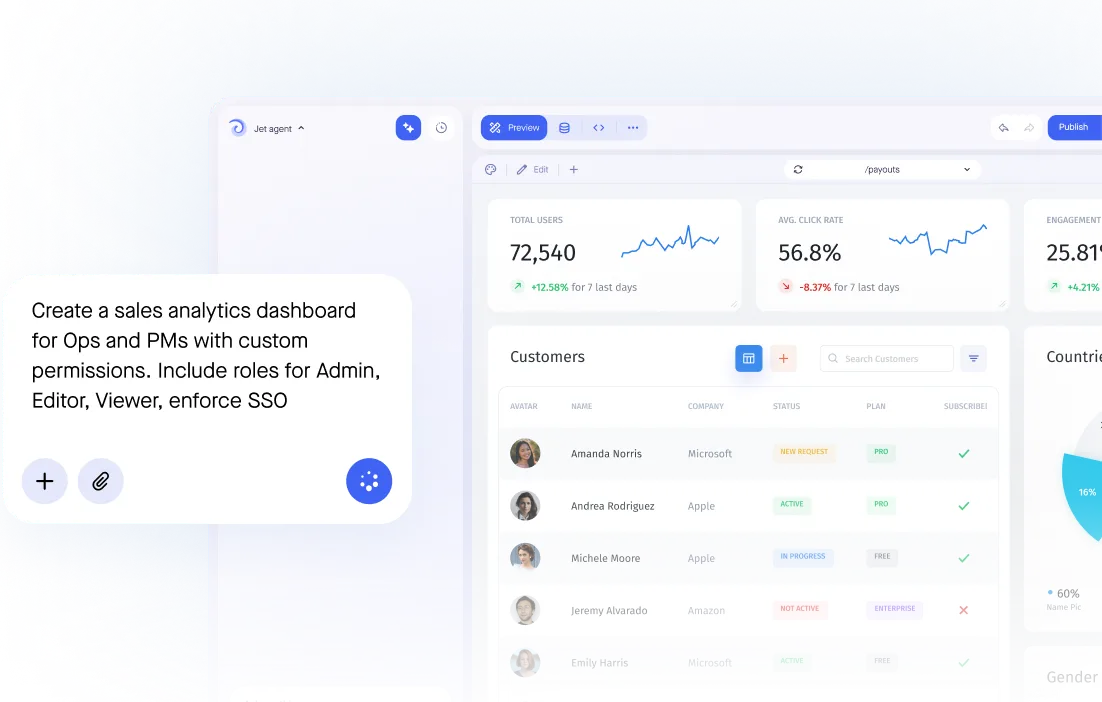
This intranet template solves that by providing a single source of truth: a centralized company intranet where employees find everything from announcements and employee directories to request forms and department-specific resources. Built on Jet Admin's AI-powered no-code app builder, the template connects to your existing data sources - Google Sheets, Airtable, PostgreSQL, MySQL, Supabase, or HRIS and content systems through APIs - so you don't need to migrate content or rebuild what already works. You generate the internal portal, customize the interface and logic, configure team-level access, automate announcements and requests, and publish a responsive app accessible on desktop and mobile devices.
Every element is customizable. Adjust the homepage layout, add department pages, map employee data fields, configure role based access controls, set up workflow automation for HR processes, and brand the entire experience with your colors, logo, and custom domain. Whether you're a 50-person startup or a multi-location enterprise, the template adapts to your organizational needs.
Explore the intranet template to start building your digital workplace today.
Why use this intranet template
Most organizations already have an intranet of some kind - according to Simpplr's 2025 research, 91% of organizations report having one. Yet many of these intranets fail to help people work better. Poor search optimization is a common complaint with outdated intranets. Information overload can occur if intranets are not well-governed. And only 25% of communicators actually use intranets for employee communication, relying instead on email, instant messaging, or ad hoc communication channels.
The pain points are concrete and measurable:
- Employees can't find what they need. Company policies live in one shared drive, onboarding documents in another, and the latest announcement was sent via email three weeks ago. Employees waste time searching multiple systems, or they give up and message HR directly. 80% of IT leaders believe lack of access reduces frontline productivity.
- Communication is inconsistent. Without a centralized communications strategy, different departments share updates through different communication tools - some via email, some in Slack, some on bulletin boards. Remote workers and frontline workers miss critical information entirely.
- HR and IT are buried in repetitive requests. Leave requests arrive by email. Policy questions come through chat. IT support tickets are submitted inconsistently. Each manual interaction takes time that could be automated.
- Knowledge stays siloed. When department-specific resources aren't visible to other teams, collaboration suffers. New hires can't discover institutional knowledge. Document repositories become outdated because no one owns them.
This intranet template addresses each of these problems by centralizing data into a structured, searchable, permission-aware hub:
- Centralized information acts as a single source of truth for company updates, alerts, policies, and resources - eliminating the need to check multiple systems. Effective internal communications can increase productivity by 20-25%.
- Improved visibility across departments means teams can browse each other's pages, find subject-matter experts through the employee directory, and discover relevant documents without knowing exactly where to look.
- Consistent employee experience ensures that every employee - whether remote, in-office, or on the frontline - accesses the same information through the same intranet portal, on any device.
- Fewer manual steps for HR and IC teams through request forms with built-in workflow automation. Intranets support workflows like PTO, expenses, and onboarding - replacing email chains with structured submissions and approvals.
- Enhanced collaboration through shared spaces, employee directories, and department pages that build community and keep employees informed across the organization.
Modern intranets integrate with 10-30+ disconnected tools. Rather than replacing your existing systems, this template connects to them - pulling employee data from your HRIS, policies from your document management system, and content from collaboration tools you already use.
Template features
This intranet template includes eight core feature areas, each built with Jet Admin's drag-and-drop components and configurable through the no-code interface. Intranet templates provide ready-to-use layouts and design themes for internal sites, and every feature below can be customized to your organization's workflows, data structure, and branding.
Homepage and Announcements
The homepage serves as the central landing page of your company intranet - the first thing intranet users see when they log in. It surfaces company news, urgent alerts, leadership messages, and pinned announcements using card and banner components. Templates can improve communication by reducing email overload through posted announcements. You configure which announcement records appear, set audience targeting by role or department to facilitate targeted communication, and schedule posts to keep the news feeds fresh. Centralized information acts as a single source of truth for company updates and alerts, so employees no longer need to dig through email to find the CEO's latest message.
Employee Directory
A searchable employee directory connects to your existing HR data - whether that lives in Google Sheets, Airtable, PostgreSQL, or an HRIS accessed through REST APIs. Each employee profile displays fields you map during setup: name, job title, department, location, manager, contact information, and photo. User profiles are displayed via table, grid, or card views, and relationships between employees and departments are maintained through linked records. This is how employees find the right colleague by name, expertise, team, or location - turning the directory into a practical knowledge management and discovery tool.
Policy and Resource Library
Document centers allow searches for forms, templates, and policies within intranet templates. The policy and resource library organizes company policies, procedures, guidelines, and reference materials with metadata tags by department, document type, and effective date. You configure permission controls so sensitive policies - compensation frameworks, legal guidelines, regulatory documents - are visible only to authorized roles. Version history, document previews, and download options keep the library current and accessible, replacing scattered document repositories with structured, controlled access.
Enterprise Search
Enterprise search is what makes or breaks an intranet platform. This template's search functionality spans all connected content: announcements, policies, employee profiles, department pages, forms, and events. You define which collections and fields are searchable, configure metadata filters, and ensure search results respect role based access controls - so users only see content they're permitted to access. AI enterprise search understands intent and returns direct answers, moving beyond simple keyword matching. When employees can find what they need in seconds, they stop sending repetitive requests to HR and IT.
Department Pages
Each department or team gets dedicated pages with their own content, resources, announcements, and workflows. Marketing's page might feature campaign calendars and brand assets. Engineering's might surface sprint documentation and architecture guides. You build each page using Jet Admin's layout components, restrict visibility to team members or make selected content available organization-wide, and maintain consistency through shared design patterns while allowing team-specific customization. This is how modern intranets replace the disorganized shared drives that traditional intranets relied on.
Request Forms
Intranet templates can streamline HR processes by providing centralized access to employee resources - and request forms are a major part of that. Build structured forms for leave requests, expense claims, IT support tickets, equipment orders, onboarding checklists, or any internal submission. Each form connects to actions and automation: route submissions to the right approver, trigger Slack or Gmail notifications, update status fields, and log the request for tracking. This replaces the email-based, manual workflows that consume HR and IT bandwidth, empowering employees to self-serve.
Role-Based Access
Not every piece of content should be visible to every employee. Role-based access controls let you define who sees which pages, records, and fields based on their role, department, location, or team membership. Configure visibility at the page level (entire department pages restricted to team members), the record level (only managers see performance documents), or the field level (salary data hidden from non-HR users). Jet Admin supports SSO, two-factor authentication, and audit logging - and offers self-hosting via Jet Bridge behind a VPN or VPC for organizations that need their data to stay within a secure network. Role-based access controls enhance security in modern intranets and help meet compliance requirements in regulated industries.
Events and Quick Links
A shared events calendar displays town halls, training sessions, deadlines, team socials, and company milestones. Events are stored as records with date, description, audience, and location fields - filterable by department or event type. Quick links provide one-click access to frequently used internal and external resources: the expense form, IT support portal, benefits enrollment, company directory, or any tool employees reach for daily. These components reduce friction in daily workflows and keep the intranet portal relevant beyond just reading announcements.
Who is this intranet template for?
A practical intranet can include templates for homepages, onboarding, HR, department hubs, knowledge base, and executive communications. This template serves specific roles and organizational types, each with distinct workflows and business objectives.
- People Operations and HR Teams - Centralize employee resources, onboarding materials, benefits information, and company policies in one accessible location. Replace repetitive policy questions with a searchable resource library. Automate leave requests, expense submissions, and onboarding workflows through structured forms. Provide employees with self-service access to the information they need, reducing the volume of direct HR inquiries and improving employee satisfaction.
- Internal Communications Professionals - Control company messaging through a single intranet platform rather than fragmented communication channels. Schedule and target announcements by department or location. Monitor which content reaches which audiences. Streamline communication with a multi channel approach that includes the intranet as the primary hub, complemented by Slack and email notifications for critical updates. Templates can centralize information and standardize message delivery across the organization.
- IT Departments and Internal Tools Teams - Provide self-service internal tools that reduce support ticket volume. Maintain department pages with technical documentation, FAQs, and troubleshooting guides. Control access to sensitive technical documents through role-based permissions. Connect the intranet to existing business systems through native integrations or APIs, creating a unified digital workplace without migrating data. Two-way engagement features encourage employee feedback and peer-to-peer connection, giving IT teams visibility into what employees actually need.
- Department Leaders and Team Leads - Maintain team-specific pages with relevant resources, announcements, and workflows. Coordinate team events, share project updates, and ensure new team members can discover institutional knowledge quickly. Control which resources are visible to team members versus the broader organization, balancing information sharing with appropriate access management.
- Distributed and Remote Organizations - Intranet templates can support remote and deskless teams by ensuring access to company updates, policies, and directories regardless of location or time zone. Modern intranets support mobile access for all employees, so remote employees and frontline workers engage with the same content as office-based staff. A centralized intranet helps build community and company culture across geographies, keeping distributed teams connected and aligned.
- Regulated Industries (Healthcare, Finance, Legal) - Organizations where controlled access, audit trails, and document compliance are non-negotiable. Healthcare providers managing HIPAA-sensitive policies, financial institutions with regulatory documentation, and legal teams with confidential case materials all benefit from the template's role-based visibility, version tracking, and secure hosting options. Intranets are private networks accessible only to an organization's employees - unlike the public internet or an extranet, which allows authorized external users to access specific information.
How to set up your intranet template
Intranet templates enable quick deployment of functional internal sites. Here's how to go from template selection to a live company intranet using Jet Admin.
- Select the template and define your scope Start by choosing the intranet template. Before customizing anything, define which records your intranet will manage - employees, departments, announcements, policies, events, forms, FAQs, locations - and identify which stakeholders will own each content area. This planning step prevents scope creep and ensures you build what your organization actually needs.
- Connect your data sources Integrate the systems where your data already lives. Jet Admin natively connects to PostgreSQL, MySQL, Supabase, Airtable, and Google Sheets. For HRIS platforms, Notion, or other content systems, connect through REST or GraphQL APIs. You're pulling in existing employee records, policy documents, and department structures - not recreating them. This is the key difference between an intranet built on a flexible platform and one that forces you to start from zero.
- Map fields and model your data For each connected resource, map incoming data fields to the template's expected structure. Employee profiles need name, role, department, location, manager, and photo fields mapped correctly. Policy documents need metadata: department tag, sensitivity level, effective date, document type. Define relationships - employees belong to departments, announcements target specific teams - so the template's navigation, filtering, and search work correctly from day one.
- Customize the interface and branding Use Jet Admin's drag-and-drop app builder to adjust every page. Redesign the homepage layout, add or remove department pages, customize navigation labels, and set your brand's colors, logo, and custom domain. Key features of effective intranet templates include responsive design and easy customization - the template automatically adapts to mobile devices, but you can fine-tune the layout for how your intranet users will actually interact with it. Modern intranet templates allow for personalized content delivery to specific audiences, so configure which components appear for which roles.
- Configure workflows, forms, and permissions Build request forms for HR processes (leave, expenses, onboarding) and internal submissions (IT support, resource requests). Attach automation: route submissions to approvers, trigger Slack or Gmail notifications, update status fields. Then configure role-based permissions through Jet Admin's Users & Teams management - define which roles see which pages, records, and fields. Test that sensitive content is properly restricted and that each team sees only what's relevant to them.
- Test with pilot users and gather feedback Roll out to a small group - ideally representatives from each department - before publishing organization-wide. Use Jet Admin's preview and share modes to let pilot users navigate the intranet, submit test requests, search for content, and report issues. Check mobile responsiveness, verify that permission boundaries work correctly, and confirm that search returns relevant results. Adjust layouts, fix data mapping issues, and refine workflows based on real feedback.
- Publish and roll out to the full organization After final adjustments, publish the app. Announce the intranet through your existing communication channels - email, Slack, team meetings - and provide employees with clear guidance on where to find key resources. Monitor usage: which pages get traffic, which search queries return no results, which forms see the most submissions. Use these metrics to iterate on content, structure, and workflows over time. Collaborative tools in intranet templates support teamwork across departments, but adoption depends on employees knowing the intranet exists and finding it genuinely useful.
Ready to build your company intranet? Start with the Jet Admin intranet template and have a functional internal portal live without writing code.
Frequently asked questions
What should a company intranet include?
An effective company intranet should include a homepage with company news and announcements, a searchable employee directory, a policy and resource library with document management, enterprise search across all content, department-specific pages, request forms for HR processes and IT support, role-based access controls, and an events calendar with quick links to frequently used tools. Intranets provide a single source of truth for employees - a central hub where employees find information, submit requests, and connect with colleagues. The essential features depend on your organization's size and needs, but the goal is always to streamline how employees find information and collaborate. An intranet centralizes a company's single source of truth.
Can content vary by department?
Yes. The template supports department-specific pages where each team maintains its own announcements, resources, and workflows. Beyond separate pages, you can configure component-level and page-level visibility so that certain content appears only to specific roles or teams. Templates facilitate targeted communication by customizing news feeds for different departments. For example, finance-related policy updates can be visible only to the finance team, while company-wide announcements appear for everyone. This is managed through Jet Admin's Users & Teams configuration, where you define groups and assign visibility rules.
Can I connect an employee directory?
Yes. If your employee data lives in an HRIS, Google Sheets, Airtable, PostgreSQL, MySQL, Supabase, or any system accessible via REST or GraphQL API, you can connect it as a data source in Jet Admin. Map fields - name, job title, department, location, manager, photo, contact information - to the template's employee directory component. The directory stays in sync with your source data, so you maintain one system of record rather than duplicating employee information. Intranets enhance internal communication and employee engagement by making it easy to discover colleagues across the organization.
Can users submit internal requests?
Yes. The template includes configurable request forms for any internal submission - leave requests, expense claims, IT support tickets, equipment orders, onboarding tasks. Each form connects to workflow automation: submissions route to designated approvers, trigger notifications via Slack or Gmail, update status fields, and create audit trails. Intranets support workflows like PTO, expenses, and onboarding. You build these forms using Jet Admin's drag-and-drop form components and configure actions without code.
Can the intranet be branded?
Yes. You customize the template's theme colors, typography, logo, navigation labels, and page layouts through Jet Admin's interface builder. Set a custom domain so the intranet lives at a URL your employees recognize. For organizations that need deeper UI customization, Jet Admin supports custom components via JavaScript, React, or Angular. The result is a user friendly intranet portal that reflects your company culture and brand identity - not a generic tool that feels disconnected from your organization.
Is coding required?
No coding is required for core setup and customization. The template is built on Jet Admin's no-code app builder: you connect data sources, configure pages with drag-and-drop components, set up forms and workflows, define permissions, and publish - all through a visual interface. For organizations that want advanced custom components, conditional logic, or specialized integrations, Jet Admin supports JavaScript, React, and Angular extensions. But the vast majority of intranet functionality - homepage, directory, policies, search, forms, permissions, events - is configurable without writing a single line of code. AI-powered intranets emerged in the 2020s for enhanced user experience, and Jet Admin's AI-powered generation capabilities help you get started even faster.

.svg)





Use Cases
Categories
Features
Similar templates



Connect & sync your data with 30+ data sourse’s


Build frontend Apps 10x faster


Frequently asked questions
No coding is required for core setup and customization. The template is built on Jet Admin's no-code app builder: you connect data sources, configure pages with drag-and-drop components, set up forms and workflows, define permissions, and publish - all through a visual interface. For organizations that want advanced custom components, conditional logic, or specialized integrations, Jet Admin supports JavaScript, React, and Angular extensions. But the vast majority of intranet functionality - homepage, directory, policies, search, forms, permissions, events - is configurable without writing a single line of code. AI-powered intranets emerged in the 2020s for enhanced user experience, and Jet Admin's AI-powered generation capabilities help you get started even faster.
Yes. You customize the template's theme colors, typography, logo, navigation labels, and page layouts through Jet Admin's interface builder. Set a custom domain so the intranet lives at a URL your employees recognize. For organizations that need deeper UI customization, Jet Admin supports custom components via JavaScript, React, or Angular. The result is a user friendly intranet portal that reflects your company culture and brand identity - not a generic tool that feels disconnected from your organization.
Yes. The template includes configurable request forms for any internal submission - leave requests, expense claims, IT support tickets, equipment orders, onboarding tasks. Each form connects to workflow automation: submissions route to designated approvers, trigger notifications via Slack or Gmail, update status fields, and create audit trails. Intranets support workflows like PTO, expenses, and onboarding. You build these forms using Jet Admin's drag-and-drop form components and configure actions without code.
Yes. If your employee data lives in an HRIS, Google Sheets, Airtable, PostgreSQL, MySQL, Supabase, or any system accessible via REST or GraphQL API, you can connect it as a data source in Jet Admin. Map fields - name, job title, department, location, manager, photo, contact information - to the template's employee directory component. The directory stays in sync with your source data, so you maintain one system of record rather than duplicating employee information. Intranets enhance internal communication and employee engagement by making it easy to discover colleagues across the organization.
Yes. The template supports department-specific pages where each team maintains its own announcements, resources, and workflows. Beyond separate pages, you can configure component-level and page-level visibility so that certain content appears only to specific roles or teams. Templates facilitate targeted communication by customizing news feeds for different departments. For example, finance-related policy updates can be visible only to the finance team, while company-wide announcements appear for everyone. This is managed through Jet Admin's Users & Teams configuration, where you define groups and assign visibility rules.
An effective company intranet should include a homepage with company news and announcements, a searchable employee directory, a policy and resource library with document management, enterprise search across all content, department-specific pages, request forms for HR processes and IT support, role-based access controls, and an events calendar with quick links to frequently used tools. Intranets provide a single source of truth for employees - a central hub where employees find information, submit requests, and connect with colleagues. The essential features depend on your organization's size and needs, but the goal is always to streamline how employees find information and collaborate. An intranet centralizes a company's single source of truth.