Work Order
App
Work Order
Overview
A work order template is a pre-built application framework designed to capture, assign, track, and complete maintenance and field service tasks efficiently. Instead of juggling paper forms, scattered spreadsheets, and verbal requests that lead to lost work orders and missed deadlines, a well-structured work order template centralizes every maintenance request, technician assignment, status update, and cost entry into a single digital system.
The core problem is familiar to any operations or maintenance team: work orders get created in one place, tracked in another, and completed without anyone updating the record. Field technicians arrive on site without the job details they need. Managers lack real time visibility into what's open, what's overdue, and what's costing the most. Templates ensure consistency across work order documentation and reduce the risk of errors in work orders-but most template tools stop at basic lists and simple status columns.
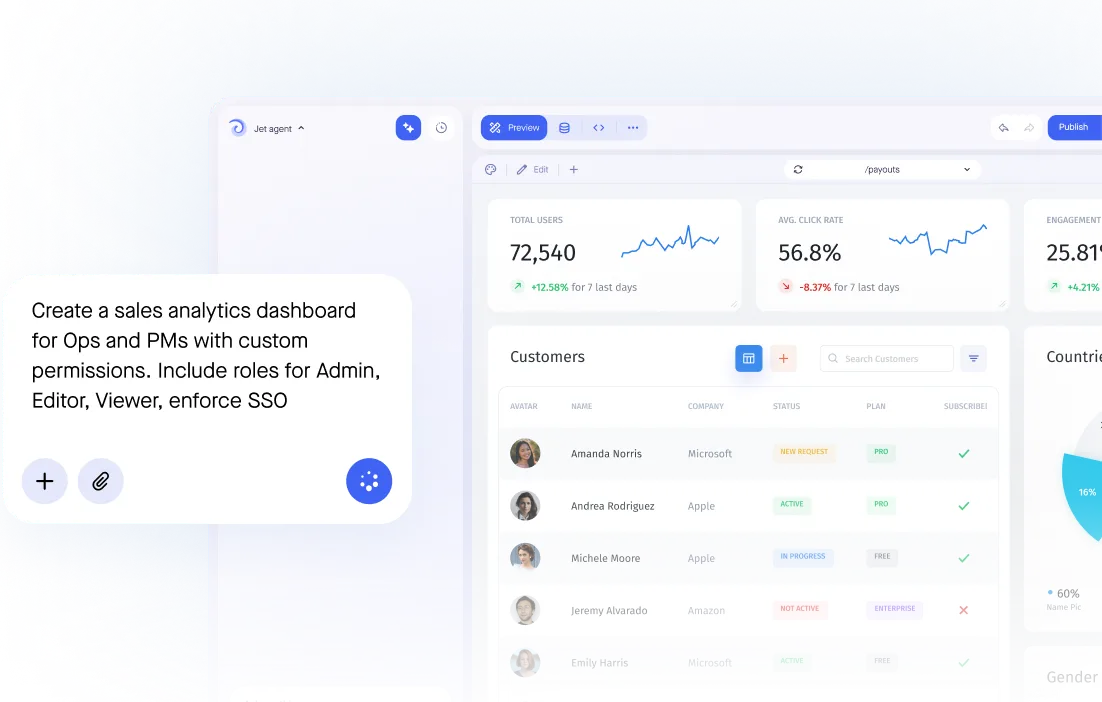
Jet Admin's work order template takes a different approach. As an AI-powered no-code app builder, it generates a production-ready work order management system from a simple prompt, then lets you customize every element visually or with code. Connect your existing PostgreSQL database, Airtable workspace, or REST API from systems like SAP or Maximo-no data migration required. Add role-based permissions so field technicians see only their assigned jobs while managers get full operational dashboards. Set up workflow automations for status notifications, escalation alerts, and preventive maintenance scheduling. Publish to web and mobile devices in minutes.
Whether you need a maintenance work order template, a field service work order app, or a facility maintenance tracker, this template adapts to your business processes. Start by selecting the work order template and build the system your maintenance teams actually need.
Why use this work order template
Every maintenance operation deals with the same friction: a service request comes in, but it sits in someone's inbox. A technician finishes a job but doesn't log parts or labor hours. A preventive maintenance task was supposed to trigger last week, but nobody noticed. These aren't edge cases-they're daily realities that erode operational efficiency and customer satisfaction.
Here's why this work order template directly addresses those problems:
Eliminate lost and scattered work orders. Work order software centralizes maintenance requests in one platform. No more paper slips that disappear, no more verbal requests that never get recorded. Every work request enters the same system, gets assigned a priority and due date, and stays visible until task completion. Work order management centralizes task creation and tracking, giving your entire team a single source of truth.
Give managers real time visibility. Without a centralized work order management system, supervisors spend hours chasing status updates. This template provides dashboards where you can track progress across all open, in-progress, and completed work orders. Real time updates enhance communication and task completion rates, so managers can make informed decisions about resource allocation instead of guessing.
Standardize how work gets done. Templates improve accountability by standardizing work requests. When every work order follows the same structure-requester information, asset details, priority level, parts needed, labor hours-your reporting becomes reliable. Completed work orders provide data about recurring problems and trends to inform maintenance planning. A standard work order template includes sections for job details and requester information, ensuring nothing critical gets missed.
Reduce manual processes and save time. Work order management software can reduce administrative tasks by up to two hours weekly. Instead of manually notifying technicians, updating spreadsheets, or generating reports from scratch, this template automates recurring tasks like status change notifications and preventive maintenance triggers. Automated documentation supports compliance and simplifies audits.
Strengthen collaboration across teams. A well-designed work order template improves communication between teams and clients. Field technicians get clear assignments with full asset history. Dispatchers see technician availability. Clients or tenants receive status updates without calling in. Work order templates enhance communication among teams by creating streamlined communication channels that replace back-and-forth emails and phone calls.
Connect to your existing data-don't start over. Unlike tools that force you into a proprietary database, Jet Admin connects natively to PostgreSQL, MySQL, Airtable, and REST APIs. Your asset register, parts inventory, and technician roster stay where they are. The template reads and writes to your existing sources, avoiding the data migration headaches that stall most implementations.
Template features
Work Order List with Advanced Filtering
The core of any work order management platform is the work order list itself. This template provides a comprehensive dashboard where every work order is visible with status filters-Open, In Progress, Completed, Overdue-so you can instantly identify bottlenecks. Search and sort by technician, priority level, asset type, or completion date. Work orders facilitate tracking of tasks from request to completion, and this filterable interface makes that tracking effortless. Managers get a clear count of open versus completed work orders, while task tracking stays intuitive for every team member.
Technician Assignment and Scheduling
Assign tasks to the right technician using a drag and drop scheduling interface built directly into the template. View technician availability on a calendar, match assignments to skills or proximity to the job site, and plan preventive maintenance windows without conflicts. Drag and drop scheduling simplifies resource allocation-no more spreadsheet gymnastics to figure out who's available. The calendar view also supports recurring scheduling for routine maintenance tasks, so preventive maintenance work orders generate automatically based on your defined intervals.
Mobile-Friendly Field Updates
Field technicians need to update work orders on site, not back at the office. This template publishes as a responsive mobile app, giving field service teams an intuitive interface to change work order status, log notes, and upload before/after photos directly from mobile devices. Technicians can update work orders in real time via mobile apps, ensuring that managers see progress as it happens. Mobile accessibility means technicians spend less time on paperwork and more time on task execution. For remote sites with unreliable connectivity, offline functionality allows technicians to continue working in offline mode and sync updates when they're back online.
Parts and Labor Cost Tracking
Elements of work order templates may include materials needed, labor hours, and associated costs-and this template covers all three. Integrated forms let technicians log every part used, record labor hours with rates, and attach equipment costs per work order. Custom JavaScript calculations automatically compute total costs, eliminating manual math errors. This level of inventory tracking and cost visibility helps managers compare budgeted versus actual spend, control expenses, and prepare accurate invoices. Connect to QuickBooks via API for seamless financial workflows.
Asset Management Integration
Work orders don't exist in isolation-they're tied to specific equipment. This template connects to your asset database, pulling in maintenance history, equipment specifications, warranty status, and location data. When a technician opens a work order, they see the full asset history for that piece of equipment, including every past repair and inspection. Asset tracking at this level supports a proactive approach to maintenance: instead of reacting to breakdowns, you can spot patterns and schedule interventions that reduce downtime. Work orders can be used for preventive maintenance and emergency repairs, and linking them to assets makes both more effective.
Role-Based Access Control
Security and clarity require that different users see different things. This template uses Jet Admin's granular role-based permissions and record-level filtering to ensure technicians see only their assigned work orders, managers have full visibility across all operations and teams, and external clients or tenants access a limited portal view. Using templates improves transparency and accountability in workflows-everyone sees exactly what they need, nothing more. This approach supports regulatory compliance by ensuring sensitive data stays protected.
Automated Workflow Notifications
Manual status chasing is one of the biggest time sinks in maintenance operations. This template integrates with Twilio for SMS notifications and Slack for team alerts, triggering real time notifications when work order status changes. Set up escalation alerts that fire when a work order approaches its SLA threshold-for example, notifying a supervisor when an emergency task hasn't been addressed within two hours. Effective work order management improves operational efficiency and response times by replacing manual follow-ups with automated triggers. You can also configure scheduled maintenance triggers that automatically generate new work orders based on your preventive maintenance scheduling intervals.
Printable Work Order Reports
Detailed reporting is essential for client communication, audit trails, and performance analysis. This template generates printable PDF work orders and completion reports with customizable layouts. Add company branding, select which data fields appear, and export reports for client sign-off or internal review. Inspection work order templates cover necessary compliance checkpoints, and these printable formats ensure every detail is documented. Export data to CSV for deeper analysis of team performance, performance metrics, and cost trends.
Who is this work order template for?
Facilities managers overseeing multiple buildings need centralized work order tracking across every property. This template lets you manage maintenance needs from a single dashboard, coordinate technicians across locations, enforce SLA compliance, and generate detailed insights into cost per building and response times. Facilities management becomes far more efficient when every work request flows through one well organized system instead of fragmented emails and phone calls.
Field service companies managing customer sites-whether HVAC, plumbing, electrical, or general contracting-need mobile work order updates, parts tracking, and client-facing documentation. This template gives field service teams the tools to update job status from the job site, log materials used, capture photos, and generate branded completion reports. As a service provider handling dozens of daily dispatches, you can assign tasks based on technician skill and proximity, then track progress in real time. Connect to your existing CRM or use the agent task management template for broader coordination.
Property management teams handle a constant stream of tenant service requests. This template automates assignment and status communication so tenants know when their maintenance request has been received, assigned, and completed. The property management template can complement this setup for broader portfolio management, while the work order template handles the maintenance workflow specifically.
Manufacturing plant operators rely on preventive maintenance to avoid costly equipment downtime. Maintenance work order templates minimize downtime during repairs by ensuring every scheduled task is generated on time, assigned to qualified technicians, and completed with full documentation. Track equipment-level costs, monitor asset history for recurring failures, and use that data to shift from reactive to predictive maintenance planning.
HVAC and plumbing contractors working across multiple client sites need mobile forms that capture parts, labor hours, and on site conditions. This template provides everything a small business or growing contractor needs: drag and drop scheduling, mobile access for technicians, cost tracking per job, and exportable reports for client invoicing. AI features in work order software can save technicians up to two hours weekly by reducing administrative overhead.
IT helpdesk teams managing hardware repairs, software installations, and infrastructure maintenance across multiple locations benefit from the same structured approach. Track each work order from initial request to task completion, attach assets like servers or workstations, escalate by priority, and generate closing reports. The template adapts to IT-specific workflows just as easily as physical maintenance scenarios.
How to set up your work order template
Step 1: Select the work order management template from Jet Admin's template library. Choose the work order management template. The AI-generated starting point includes pre-built interfaces for work order lists, technician assignment views, asset records, and reporting dashboards.
Step 2: Connect your data sources. Link your existing databases-PostgreSQL, MySQL, or Airtable-using native connectors. If your asset or work order data lives in an ERP or CMMS system like SAP or Maximo, connect via REST API. Unlike platforms limited to Airtable or Google Sheets, Jet Admin supports multiple simultaneous data sources, so your assets can live in Postgres while your parts inventory sits in Airtable.
Step 3: Map your data to template fields. Use the visual data mapping interface to connect your existing work order, asset, and technician tables to the template's pre-built components. Map fields like work order ID, asset serial number, technician name, priority level, due date, parts used, and labor hours. The template's data model supports separate entities for work orders, assets, technicians, clients, parts inventory, and status history.
Step 4: Customize the interface. Modify forms, adjust dashboard layouts, add company branding, and configure different views for different user roles. Add custom fields specific to your industry-whether that's compliance checkpoints for inspections or warranty expiration dates for asset tracking. For advanced customization, use custom JavaScript, React, or Vue components with GitHub sync to build exactly the logic your custom workflows require.
Step 5: Set up workflow automations. Configure status change notifications via Twilio (SMS) or Slack (team alerts). Define escalation rules-for example, alert a manager if a high-priority work order hasn't moved to "In Progress" within four hours. Set up recurring maintenance triggers that automate recurring tasks by generating new work orders on your defined schedule. Connect Google Calendar for scheduling visibility.
Step 6: Configure role-based permissions. Define what technicians, managers, dispatchers, and clients can access and modify. Apply record-level filtering so technicians see only their assigned work orders, while managers see everything. Work order software improves accountability by tracking technician activities, and proper permissions ensure that accountability without exposing sensitive cost or client data to the wrong roles.
Step 7: Test and publish. Create sample work orders to verify that assignments, notifications, cost calculations, and reporting all work as expected. Check the mobile experience to ensure field technicians have a smooth interface. Once validated, publish to web and mobile for immediate team access.
Your work order management app is live. Start creating work orders, assigning them to your maintenance teams, and tracking every task from request to completion. Build your work order template now and replace manual processes with efficient work order management.
Frequently asked questions
What is a work order management template?
A work order management template is a pre-built application framework for creating, assigning, and tracking maintenance or service tasks from initial request to completion. The template serves as a framework to capture, assign, track, and complete tasks efficiently, including structured sections for requester information, job details, asset linkage, priority levels, parts and labor logging, and status tracking. Work order templates streamline task management processes by providing a consistent, repeatable structure that replaces ad-hoc spreadsheets or paper forms.
Can I customize work order fields for my industry?
Yes. Jet Admin's visual builder lets you add, remove, or modify any field in the template without code. Need compliance checkpoints for inspection work orders? Add them. Want custom priority labels or industry-specific asset categories? Configure them in the interface. For deeper logic-like conditional field visibility or custom cost formulas-use the built-in code editor supporting JavaScript, React, Vue, or Angular, with GitHub sync for version control. Templates help ensure compliance with industry standards by letting you tailor fields to your specific regulatory requirements.
How do I connect this to my existing asset database?
Jet Admin connects natively to PostgreSQL and MySQL, so if your asset register lives in a relational database, you can link it directly without middleware or data migration. For ERP or CMMS systems like SAP or Maximo, use REST API connections to pull asset data, maintenance history, and equipment specifications into the template. You can also connect Airtable workspaces if your team manages assets there. Multiple data sources can be connected simultaneously, so your assets, parts inventory, and work orders can each live in different systems.
Can field technicians update work orders from mobile devices?
The template publishes as a responsive mobile app that field technicians can use to view assigned work orders, update status, log parts and labor, upload photos, and capture notes-all from the job site. For remote sites with limited connectivity, offline mode allows technicians to continue updating work orders without an internet connection; changes sync automatically when connectivity returns. Mobile access ensures that real time data flows between the field and the office without delays.
How do I set up automated notifications when work order status changes?
In Jet Admin's workflow automation builder, create triggers tied to status changes on work order records. Connect Twilio to send SMS alerts-for example, notifying a technician when a new work order is assigned, or alerting a manager when a task moves to "Completed." Connect Slack for team-level notifications. Set time-based escalation rules that trigger alerts when work orders approach or exceed SLA thresholds, helping maintain accountability and response times.
Can I track parts inventory and costs within the template?
The template includes integrated forms for logging every part used, labor hours worked, and associated costs per work order. Elements of work order templates may include materials needed, labor hours, and associated costs, and this template captures all three. Use custom JavaScript to calculate total costs automatically. For end-to-end financial workflows, connect to QuickBooks via API to push cost data into your accounting system. Over time, this cost data helps you analyze spending patterns, identify expensive assets, and make informed decisions about repair versus replacement.
How do I control what technicians vs. managers can see?
Jet Admin provides granular role-based permissions with record-level filtering. Define roles-admin, manager, technician, client-and set permissions for each. Technicians can be restricted to viewing and updating only their assigned work orders, while managers see all work orders across every team and location. Clients or tenants can access a limited customer portal view showing only their submitted requests and status updates. This structure keeps data secure, supports regulatory compliance, and ensures every user has an intuitive interface tailored to their responsibilities.

.svg)


Use Cases
Categories
Features
Similar templates




Connect & sync your data with 30+ data sourse’s


Build frontend Apps 10x faster


Frequently asked questions
Jet Admin provides granular role-based permissions with record-level filtering. Define roles-admin, manager, technician, client-and set permissions for each. Technicians can be restricted to viewing and updating only their assigned work orders, while managers see all work orders across every team and location. Clients or tenants can access a limited customer portal view showing only their submitted requests and status updates. This structure keeps data secure, supports regulatory compliance, and ensures every user has an intuitive interface tailored to their responsibilities.
The template includes integrated forms for logging every part used, labor hours worked, and associated costs per work order. Elements of work order templates may include materials needed, labor hours, and associated costs, and this template captures all three. Use custom JavaScript to calculate total costs automatically. For end-to-end financial workflows, connect to QuickBooks via API to push cost data into your accounting system. Over time, this cost data helps you analyze spending patterns, identify expensive assets, and make informed decisions about repair versus replacement.
In Jet Admin's workflow automation builder, create triggers tied to status changes on work order records. Connect Twilio to send SMS alerts-for example, notifying a technician when a new work order is assigned, or alerting a manager when a task moves to "Completed." Connect Slack for team-level notifications. Set time-based escalation rules that trigger alerts when work orders approach or exceed SLA thresholds, helping maintain accountability and response times.
The template publishes as a responsive mobile app that field technicians can use to view assigned work orders, update status, log parts and labor, upload photos, and capture notes-all from the job site. For remote sites with limited connectivity, offline mode allows technicians to continue updating work orders without an internet connection; changes sync automatically when connectivity returns. Mobile access ensures that real time data flows between the field and the office without delays.
Jet Admin connects natively to PostgreSQL and MySQL, so if your asset register lives in a relational database, you can link it directly without middleware or data migration. For ERP or CMMS systems like SAP or Maximo, use REST API connections to pull asset data, maintenance history, and equipment specifications into the template. You can also connect Airtable workspaces if your team manages assets there. Multiple data sources can be connected simultaneously, so your assets, parts inventory, and work orders can each live in different systems.
Yes. Jet Admin's visual builder lets you add, remove, or modify any field in the template without code. Need compliance checkpoints for inspection work orders? Add them. Want custom priority labels or industry-specific asset categories? Configure them in the interface. For deeper logic-like conditional field visibility or custom cost formulas-use the built-in code editor supporting JavaScript, React, Vue, or Angular, with GitHub sync for version control. Templates help ensure compliance with industry standards by letting you tailor fields to your specific regulatory requirements.
A work order management template is a pre-built application framework for creating, assigning, and tracking maintenance or service tasks from initial request to completion. The template serves as a framework to capture, assign, track, and complete tasks efficiently, including structured sections for requester information, job details, asset linkage, priority levels, parts and labor logging, and status tracking. Work order templates streamline task management processes by providing a consistent, repeatable structure that replaces ad-hoc spreadsheets or paper forms.