HR Management
App
HR Management
Overview
An HR management template is a pre-built, customizable framework that centralizes every core human resources function-employee records, onboarding, leave management, document storage, performance tracking, and reporting-into a single operational app. Instead of juggling disconnected spreadsheets, email threads, and paper files, your HR team works from a single source of truth for employee records that keeps data accurate, processes consistent, and access controlled.
The problem is familiar. Employee information lives in a shared drive, onboarding tasks get tracked in someone's inbox, leave requests bounce between managers on Slack, and nobody can pull a reliable headcount report without spending an afternoon reconciling data. Research shows that nearly 48% of HR teams' time is spent reconciling spreadsheets, fixing errors, and moving data across manual systems. An effective HR management template standardizes the entire employee lifecycle-from recruitment to offboarding-so your human resources department can shift from administrative firefighting to strategic workforce planning.
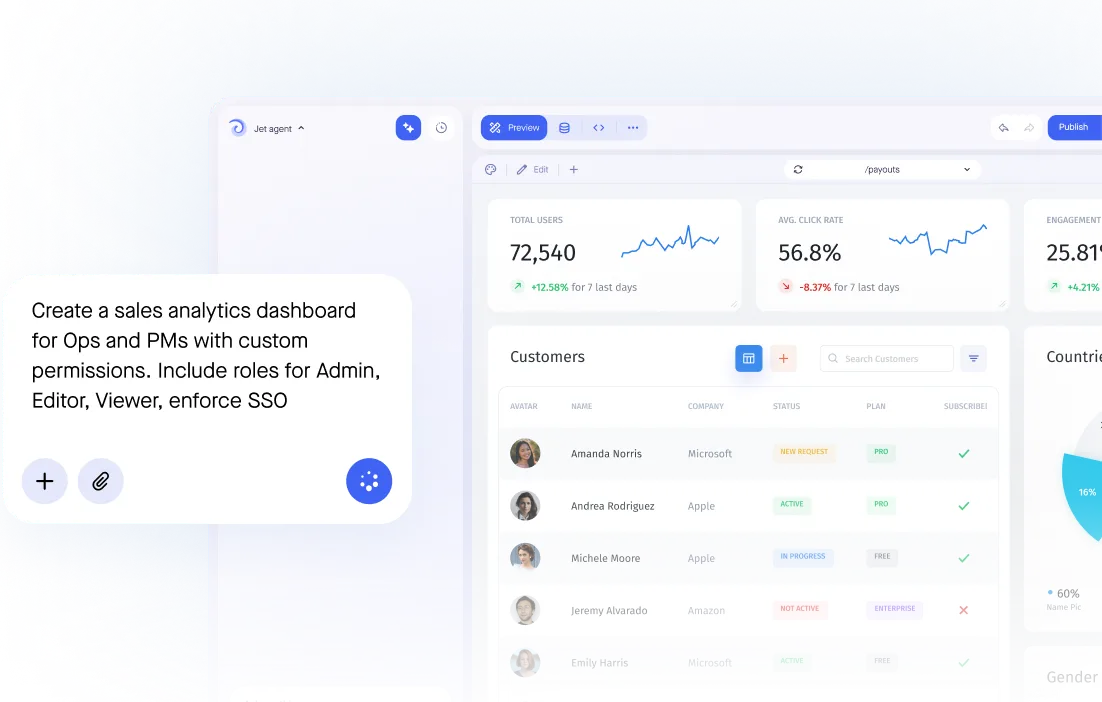
What makes this template practical is its customizable nature. Every company has different organizational structures, workplace policies, and business needs. With Jet Admin's AI-powered no-code app builder, you can generate a complete HR operations app, connect it to your existing data sources-PostgreSQL, MySQL, Supabase, Airtable, Google Sheets, or HRIS platforms through APIs-and tailor the interface, workflows, and permissions to match exactly how your organization operates. Ready to see what your HR app could look like? Describe your hr needs and let Jet Admin generate a starting point in minutes.
Why use this hr management template
Manual human resource management creates compounding problems as your company grows. Here's how this hr management template addresses the most common pain points head-on:
- Scattered employee data becomes centralized – When employee records live across Google Sheets, local files, and legacy systems, no one has a complete picture. This template consolidates personal information, roles, departments, compensation fields, and status into one secure location. Employee information should be stored in a secure, centralized location, and this template makes that the default.
- Time-consuming onboarding gets structured – Without a repeatable process, new employees receive inconsistent experiences. Onboarding and offboarding checklists standardize the employee experience, ensuring every hire completes the same steps-document collection, training programs enrollment, system access setup-without tasks falling through the cracks.
- Spreadsheet chaos gives way to real visibility – An HR dashboard surfaces key metrics like headcount by department, turnover rates (essential for tracking employee retention), upcoming reviews, and leave balances. The use of summary dashboards for key metrics can enhance HR management and give leadership the data they need without waiting for a manual report.
- Inconsistent processes become repeatable – Best practices suggest using standardized forms for onboarding and performance reviews. When every manager follows the same workflows for approvals, reviews, and leave requests, you eliminate the variance that causes compliance gaps and employee frustration.
- Manual administrative work drops sharply – HR processes payroll, manages documents, tracks compliance, and coordinates across the organization. A case study of a multi-branch organization showed that manual workflows were reduced by approximately 70–80% after implementing a centralized system with role-based access and standardized processes.
- Collaboration between HR, managers, and employees improves – HR acts as a liaison between employees and management. When everyone works from the same system-managers reviewing leave requests, employees updating their profiles, HR generating reports-communication friction drops and employee relations strengthen.
Template features
Employee Records Management
A centralized employee database stores personal information, job titles, departments, compensation details, employment status, and contact information. Every record is linked, searchable, and editable by authorized users. HR manages employee records to ensure compliance with laws, and having a single source of truth eliminates the version conflicts that plague spreadsheet-based systems. Proper recordkeeping supports compliance and improves consistency across the organization.
HR Dashboard
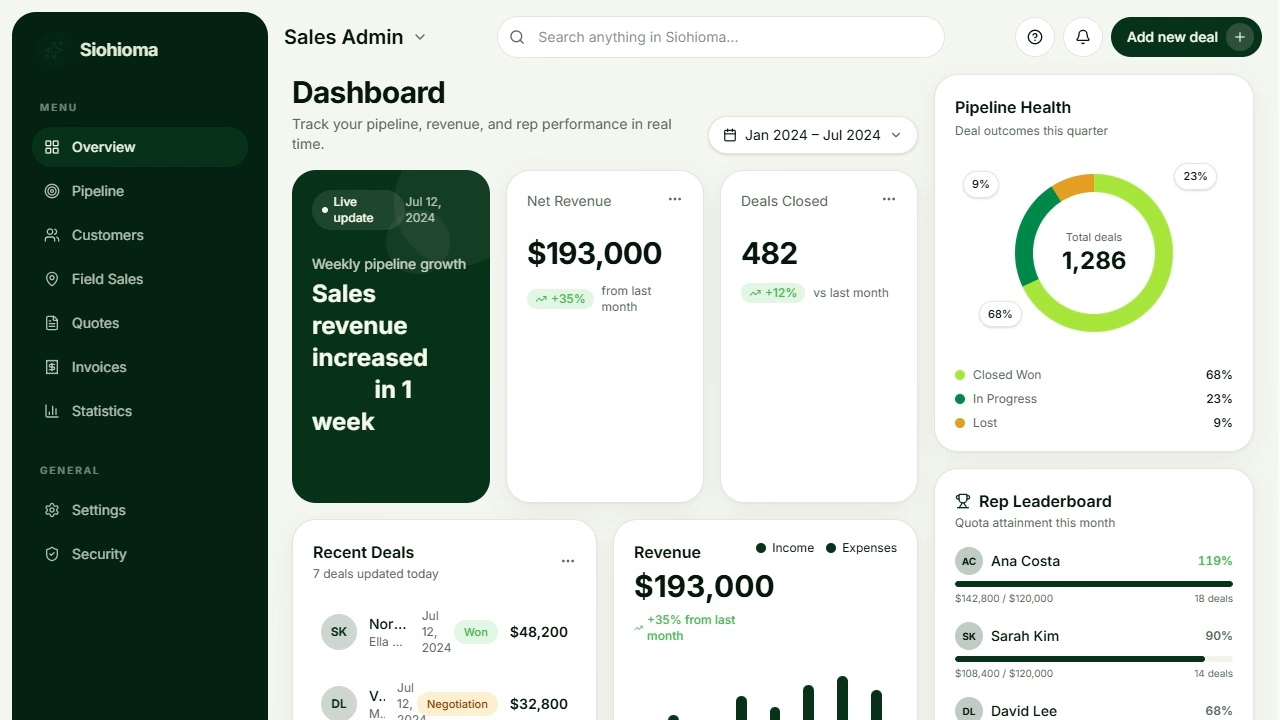
A visual dashboard tracks the metrics that matter to your hr team-active headcount, departmental breakdowns, turnover rates, upcoming performance reviews, and leave balances. A HR data and compliance dashboard tracks key metrics in real time, replacing the manual report-building that consumes significant weekly hours for many HR professionals. Filter by department, location, or status to get the view you need.
Onboarding and Offboarding Workflows
Structured task lists guide new employees and departing workers through every required step-document submission, equipment provisioning, training enrollment, access setup or revocation. HR manages the complete employee lifecycle from recruitment to onboarding, and these workflows ensure nothing is missed. Each task can be assigned, tracked, and marked complete, giving managers and hr professionals clear visibility into progress.
Leave Request Management
Employees submit time-off requests directly in the app. Managers receive notifications, review balances, and approve or deny with a click. The entire history is logged, so there's no ambiguity about who approved what or when. This replaces the email chains and shared calendars that make leave tracking unreliable, and it supports employees in managing their own well being.
Document Library
Securely store employee contracts, offer letters, company policies, and compliance documentation in one organized library. An employee handbook centralizes company policies and expectations, and templates for compliance documentation help meet federal and state regulations. Documents are accessible only to users with appropriate permissions, supporting security verification and regulatory compliance.
Performance Review Tracking
Schedule, conduct, and record performance reviews with structured templates. A performance management system includes templates for appraisals and goal setting, and performance appraisal templates typically use a 5-point rating scale. Modern performance management prioritizes continuous feedback, and this feature supports both formal review cycles and regular check-ins. SMART goals-Specific, Measurable, Attainable, Relevant, and Time-bound-can be tracked against each employee record. Performance improvement plans outline necessary improvements and timelines for employees who need additional support.
Role-Based Access Control
Different permission levels for employees, managers, and HR administrators ensure that sensitive data stays protected. With Jet Admin, you can configure field-level, record-level, and role-level permissions so that an employee sees their own profile and leave balance, a manager sees their direct reports, and an HR admin accesses the full system. This approach to access control aligns with how NIST describes RBAC implementation in information systems-ensuring users only see or act on data consistent with their job function.
HR Reporting
Generate workforce analytics and compliance reports from live data. Track trends in hiring, attrition, department growth, benefits administration, and training completion. HR ensures compliance with local, state, and federal laws, and having reporting built into the same system where data lives means reports are always current-no more exporting, reformatting, and cross-referencing.
Who is this hr management template for?
- HR teams in growing companies – If your human resources department is scaling past the point where spreadsheets work, this template gives you centralized employee records, workflow automation, and reporting without a months-long implementation. HR teams needing to process payroll, manage benefits administration (including health insurance and retirement plans), and ensure compliance with labor regulations will find the structure they need.
- People operations professionals – People ops leaders managing the daily operations of workforce planning, employee engagement, and employee training need tools that keep up with a growing headcount. This template handles the operational infrastructure so you can focus on company's culture, employee satisfaction, and strategic initiatives that encourage employees and support employee development.
- Startup founders handling HR responsibilities – When there's no dedicated HR department, founders and managers end up managing people alongside everything else. This template provides practical guidance and structure for the hiring process, onboarding, leave tracking, and performance management-covering core hr functions without requiring an hr manager on staff.
- Small to medium businesses outgrowing spreadsheets – Most companies hit a breaking point around 50–100 employees where manual tracking becomes unsustainable. A comprehensive HR management template focuses on compliance and data-driven performance management, giving SMBs the infrastructure of a more mature organization without the cost of a full enterprise HRIS.
- Remote-first organizations – Distributed teams need digital-first HR workflows. When you can't walk down the hall to submit a document or ask about a leave balance, having a centralized app where employees and managers interact with HR data is essential. This template supports remote work patterns with self-service access and automated notifications.
- Companies preparing for compliance requirements – HR ensures compliance with employment laws to reduce penalties, and HR develops compliance practices to reduce the risk of penalties. If your organization is approaching the size or industry threshold where ensuring compliance with hiring regulations, benefits oversight, and workplace policies becomes critical, this template provides the documentation structure, audit trails, and reporting you need. Regular updates are necessary to maintain templates in line with current regulations, and Jet Admin makes those updates straightforward.
How to set up your hr management template
- Select the HR management template Start by choosing the HR management template in Jet Admin. The AI-powered builder generates a complete app structure with screens for employee records, dashboards, leave management, onboarding workflows, and more. You get a functional starting point built around proven HR workflows.
- Connect your existing employee data sources Link the template to where your data already lives. Jet Admin offers native connections to PostgreSQL, Supabase, MySQL, Airtable, and Google Sheets. If you use an existing human resources information system or payroll platform, connect it through API integrations. This means you're not starting from scratch-your current employee records flow directly into the app.
- Map employee fields and configure your data structure Align the template's fields with your data-names, roles, departments, start dates, compensation, status, and any custom fields your organization tracks. Adjust the organizational structure to reflect your departments, locations, and reporting hierarchy. This step ensures that the system mirrors your actual business, not a generic org chart.
- Customize the interface layout and add company branding Modify the app's layout, colors, and navigation to match your company identity. Build separate views for different hr roles-an admin portal with full access, a manager view focused on their team, and an employee self-service portal for personal information, leave requests, and documents. Every screen should serve the user looking at it.
- Set up workflows for onboarding, leave requests, and approvals Configure automated workflows that match your workplace policies. When a new employee record is created, trigger an onboarding checklist. When a leave request is submitted, notify the appropriate manager. When a performance review is due, send a reminder. Connect Gmail or Slack actions for notifications so your team stays informed without checking the app constantly. HR updates workplace policies annually to reflect organizational changes, and these workflows can be updated alongside them.
- Configure role-based permissions for different user types Define who sees what. Set field-level and record-level permissions so employees access only their own data, managers see their direct reports, and HR administrators have full visibility. Restrict sensitive fields like compensation or disciplinary actions to appropriate roles. This is where you ensure that your security service model matches your actual access requirements.
- Test with sample data and publish for team access Before going live, run through the app with sample scenarios-submit a leave request, complete an onboarding checklist, generate a report, check that permissions restrict the right data. Once everything works, publish the app and invite your team. HR conducts benefit analysis to attract top talent and conducts regular check-ins to support employee career growth-now they can do it from a system that actually supports them.
Ready to build your HR management app? Describe your requirements in Jet Admin and generate your custom template today.
Frequently asked questions
What is included in an HR management template?
The template includes employee records management, an HR dashboard with key workforce metrics, onboarding and offboarding task workflows, leave request submission and approval, a secure document library for contracts and policies, performance review tracking with structured appraisal templates, role-based access control, and HR reporting capabilities. It covers the core resources and responsibilities of a human resources department in a single app. HR conducts benefit analysis to ensure competitive employee offerings, and the template supports tracking employee benefits data alongside other records.
Can employees have self-service access?
Yes. With role-based permissions in Jet Admin, you can build an employee portal where workers view and update their personal information, submit leave requests, access onboarding checklists, and review company policies. Employees see only their own data, while managers and HR administrators see broader views. This self-service approach reduces the administrative load on your hr department and improves the employee experience.
Can leave and onboarding be managed?
Absolutely. The template supports workflow automation for both. Onboarding checklists assign tasks to new employees, their managers, and HR-covering everything from document collection to employee training enrollment and scheduling interviews. Leave management includes request submission, manager approval notifications, balance tracking, and a complete audit history. These workflows keep daily operations running without manual coordination.
Can sensitive HR data be restricted?
Yes. Jet Admin supports field-level, record-level, and role-level permissions. You can restrict access to compensation data, performance issues documentation, disciplinary actions, and personal identifiers so only authorized hr professionals see them. HR tracks changes in employment-related legal requirements, and proper access control is essential for ensuring compliance. Compliance is a core reason HR exists as a function, and the permission model supports that.
Can I connect payroll or an HRIS?
Jet Admin connects natively to PostgreSQL, MySQL, Supabase, Airtable, and Google Sheets. For payroll platforms, HRIS tools, and other specialized systems, you can connect through API integrations. This lets you pull employee data from your existing systems into the template-or push updates back-without manual data entry. HR manages payroll, including tax deductions and reimbursements, and having that data accessible alongside other employee records adds more value to both systems.
Can workflows be customized?
Yes. Every workflow in the template-onboarding sequences, leave approval chains, review reminders, document requests-can be customized to match your company policies and approval processes. You configure the triggers, assign the right employees or managers, set notification channels (Gmail, Slack), and adjust the logic as your organization evolves. HR supports employee development through training and education programs, and workflows can be built to track training completion, continuing education, and career path progression alongside standard HR processes. Ongoing training enhances employee adaptability and business readiness, and your workflows should reflect that priority.

.svg)



Use Cases
Categories
Features
Similar templates


Connect & sync your data with 30+ data sourse’s


Build frontend Apps 10x faster


Frequently asked questions
Yes. Every workflow in the template-onboarding sequences, leave approval chains, review reminders, document requests-can be customized to match your company policies and approval processes. You configure the triggers, assign the right employees or managers, set notification channels (Gmail, Slack), and adjust the logic as your organization evolves. HR supports employee development through training and education programs, and workflows can be built to track training completion, continuing education, and career path progression alongside standard HR processes. Ongoing training enhances employee adaptability and business readiness, and your workflows should reflect that priority.
Jet Admin connects natively to PostgreSQL, MySQL, Supabase, Airtable, and Google Sheets. For payroll platforms, HRIS tools, and other specialized systems, you can connect through API integrations. This lets you pull employee data from your existing systems into the template-or push updates back-without manual data entry. HR manages payroll, including tax deductions and reimbursements, and having that data accessible alongside other employee records adds more value to both systems.
Yes. Jet Admin supports field-level, record-level, and role-level permissions. You can restrict access to compensation data, performance issues documentation, disciplinary actions, and personal identifiers so only authorized hr professionals see them. HR tracks changes in employment-related legal requirements, and proper access control is essential for ensuring compliance. Compliance is a core reason HR exists as a function, and the permission model supports that.
Absolutely. The template supports workflow automation for both. Onboarding checklists assign tasks to new employees, their managers, and HR-covering everything from document collection to employee training enrollment and scheduling interviews. Leave management includes request submission, manager approval notifications, balance tracking, and a complete audit history. These workflows keep daily operations running without manual coordination.
Yes. With role-based permissions in Jet Admin, you can build an employee portal where workers view and update their personal information, submit leave requests, access onboarding checklists, and review company policies. Employees see only their own data, while managers and HR administrators see broader views. This self-service approach reduces the administrative load on your hr department and improves the employee experience.
The template includes employee records management, an HR dashboard with key workforce metrics, onboarding and offboarding task workflows, leave request submission and approval, a secure document library for contracts and policies, performance review tracking with structured appraisal templates, role-based access control, and HR reporting capabilities. It covers the core resources and responsibilities of a human resources department in a single app. HR conducts benefit analysis to ensure competitive employee offerings, and the template supports tracking employee benefits data alongside other records.