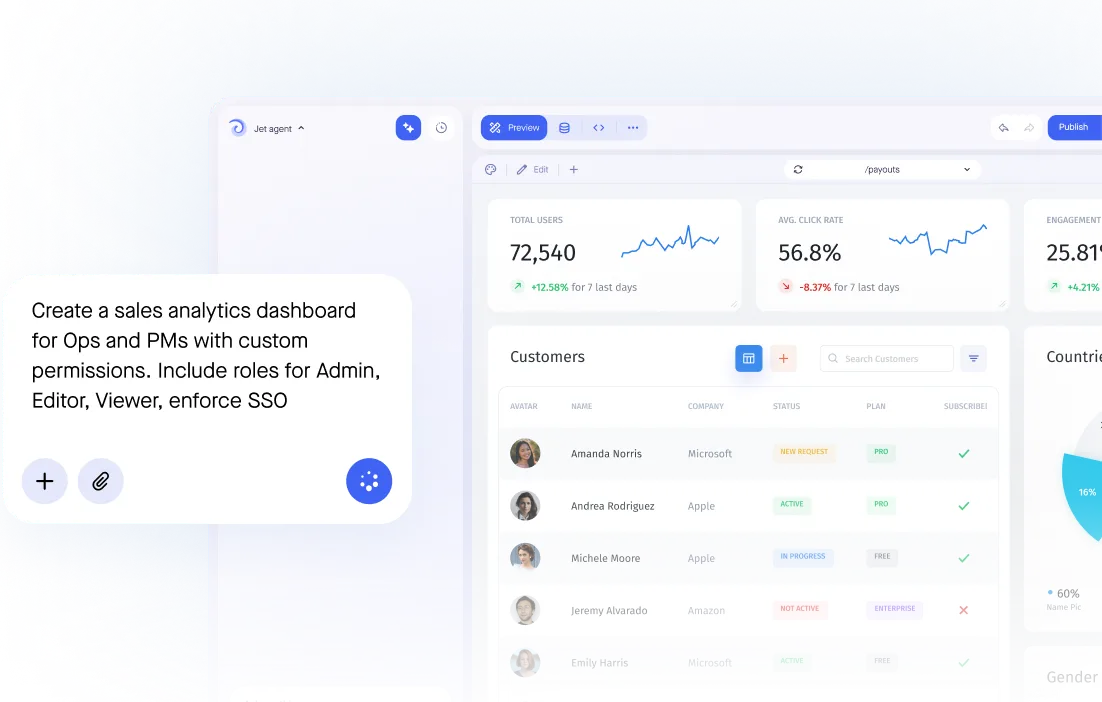
360 customer view
360-Degree View Template
Customer and company data is typically stored in a CRM, while support communication is managed in systems like Zendesk. Often, crucial data is scattered across internal and external systems, making it difficult to get a complete picture of customer interactions. The 360-Degree View Template solves this problem by bringing all relevant data together, allowing you to see a comprehensive view of your customer relationships and their overall perception of your company.
This 360-Degree View Template is useful in several scenarios:
View All of Your Customers: Access a list of customers with their logos and task completion progress in a convenient card gallery view. Drill down into individual items to get more detailed information.
Track Client Health Signals: For each client, monitor key health indicators such as archived projects, created releases, and invited users—all customizable to fit your unique use case. View critical scores like Customer Fit Score and Onboarding Score, calculated using data from your CRM and onboarding analytics tools.
Analytics: Track key metrics and trends in your client relationships, including activity trends, project volume, issue volume, and task completion rates for ongoing projects.
Track Financial Health: View a list of transactions for each client, pulled directly from your payment system (e.g., Stripe), providing an overview of financial data in the broader context of your client relationships.
Manage Users and Stakeholders: For every B2B client, get a complete view of the stakeholders involved, synced with your CRM system. Access their contact details instantly to make calls, schedule appointments, or send messages seamlessly.
Why use a 360-degree View Template in Jet Admin?
Having a 360-degree view app is especially important for support and customer success teams in B2B settings, where building strong relationships with multiple stakeholders from a client company directly impacts the bottom line.
Along with the template, you can use Jet Admin’s platform to pull in all relevant data from various systems and data sources, providing tailored and highly actionable views for your support and success teams. This ensures they can quickly navigate client information without switching between apps or manually copying and pasting IDs.
Easy and flexible deployment: You can self-host the Order Management app in the cloud, with Jet Admin handling infrastructure and updates, or host it locally behind your VPN in your own VPC. Ensure your live app is bug-free with version control, multiple environments, and audit logs.
Combine multiple data sources: Jet Admin allows you to connect and unify data from multiple sources, including databases, external apps, and APIs, to create a 360-degree view of your order management process. No need to switch between apps or manually copy IDs—Jet Admin links all related data, ensuring seamless workflows.
Search and filtering: All UI components in Jet Admin come with built-in search, sorting, filtering, and pagination. These features can be easily enabled, disabled, or customized. You can also unbind search and filter options and place them anywhere in your app.
Variety of UI components: Jet Admin provides 60+ ready-to-use UI components that can be linked to your data without any coding. These components also come with built-in styling functions, allowing you to easily customize the look and feel of your app.
Granular permission management: Set role-based access rules for pages, data (Create, Read, Update, Delete), and UI components (conditional visibility). You can also set up authentication for users using Jet Admin’s built-in Auth system or external providers such as Auth0, Xano Auth, and others.
Data drill-downs: In addition to ready-to-use UI components, Jet Admin provides granular control over data and variables, allowing you to pass dynamic parameters across components, formulas, and pages. This helps create complex user flows with dynamic context, enabling users to zoom in on relevant data instantly.
Consolidate Client Data: Jet Admin offers 60+ native integrations and the ability to connect to any custom system via APIs. Beyond that, you can combine and blend data from multiple sources into a single table without writing a single line of code. Additionally, you can transform and adapt data using a library of formulas and functions, ensuring operational efficiency and reducing errors in your app.
Actions: The Template is not just for visualizing data—it’s a highly interactive tool. Jet Admin includes a library of inputs, forms, and buttons, along with a workflow builder that allows you to configure fully customized, user-specific interactions for editing data, initiating chats, providing discounts, and other operations.
Data sources

.svg)


Use Cases
Categories
Features
Similar templates




Connect & sync your data with 30+ data sourse’s


Build frontend Apps 10x faster


Frequently asked questions
Jet Admin is a development platform that allows developers to quickly build custom business apps like internal tools, portals, dashboards for their businesses. Jet offers a drag-and-drop interface and pre-built components, making it easy to create applications while writing little code.